
Table of Contents
USP 1121 Nomenclature: Using Naming Standards to Strengthen Pharmacy MFRs
Pharmacy compliance is often discussed through the lens of USP <795>, USP <797>, USP <800>, accreditation standards, inspection checklists, and day-to-day documentation. But one chapter that can quietly influence the quality of a pharmacy’s documentation program is USP <1121> Nomenclature.
USP <1121> Nomenclature is not usually the first chapter pharmacy teams think about when building or reviewing their master formulation records, commonly called MFRs. It does not read like a standard operating procedure for compounding. It does not replace the requirements in USP <795> or USP <797>. It also does not turn a pharmacy into a pharmaceutical manufacturer operating under current good manufacturing practice, or cGMP, standards.
What it can do, however, is help pharmacy teams think more clearly about names.
That matters more than it may seem. The name of a compounded preparation can influence how formulas are searched, selected, reviewed, prepared, labeled, inspected, and trended over time. A small difference in wording can create confusion between a solution and a suspension, an oral preparation and a topical preparation, a compounded preparation and a conventionally manufactured product, or one strength and another.
For pharmacies trying to improve standardization, USP <1121> nomenclature can be a useful educational framework for building clearer MFRs, cleaner formula libraries, and more reliable compounding records.
What Is USP <1121> Nomenclature?
USP <1121> Nomenclature provides general information about naming conventions for compendial articles in the United States Pharmacopeia-National Formulary, or USP-NF. The related USP Nomenclature Guidelines describe how USP approaches names for drug substances, drug products, excipients, biologics, dietary supplements, and compounded preparations.
At a high level, nomenclature is about consistent naming. USP’s naming approach helps support a shared language for official names, dosage forms, routes of administration, drug substances, and certain special preparation types.
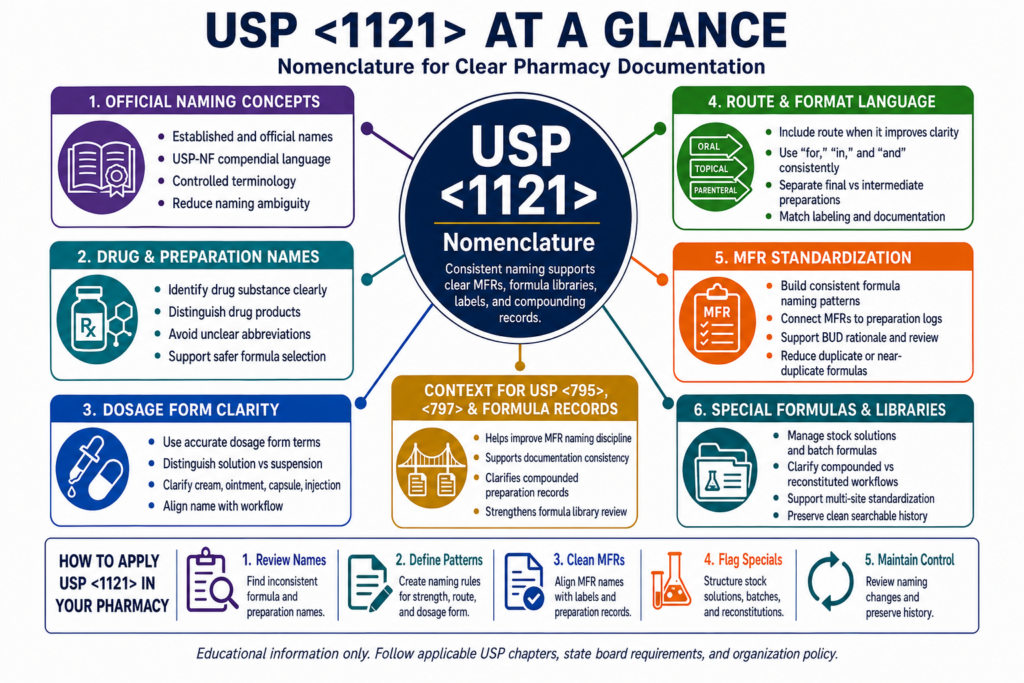
The chapter and supporting guidance discuss concepts such as:
- Established names and official compendial names
- Drug substance and drug product naming
- Use of dosage form terms
- When route of administration is included or omitted
- Naming conventions using terms such as “for,” “in,” and “and”
- Preferred and non-preferred dosage form terminology
- Naming conventions for official compounded preparations
For pharmacy teams, the practical value is not that every compounded preparation will have a USP monograph title. Many pharmacy-specific formulas will not. The value is that USP <1121> can help teams apply a more disciplined naming mindset.
Why USP 1121 Nomenclature Matters for Pharmacy Documentation
Pharmacies rely on names everywhere: formularies, medication lists, formula libraries, labels, worksheets, MFRs, compounding records, inventory records, training materials, and audit reports. When names are inconsistent, the documentation system becomes harder to trust.
For example, a pharmacy might have multiple formula names for what is essentially the same preparation:
- Baclofen 5 mg/mL Suspension
- Baclofen Oral Susp 5mg/mL
- Baclofen 5mg per mL Compound
- Baclofen Compounded Oral Suspension 5 mg/mL
Those differences may seem minor, but over time they can make it harder to search formulas, merge duplicate records, review historical preparations, compare compounding logs, or verify whether the correct formula was selected.
USP <1121> encourages pharmacy teams to ask better naming questions:
- What is the active drug substance?
- What is the dosage form?
- Is the route of administration understood, or should it be stated?
- Is this a solution, suspension, cream, ointment, capsule, tablet, or another dosage form?
- Is the preparation compounded?
- Does the name clearly distinguish one preparation from another?
- Are abbreviations creating avoidable ambiguity?
- Does the name match the documentation, label, and compounding workflow?
In other words, nomenclature is not just a naming exercise. It is part of documentation quality.
USP <1121>, MFRs, and Compounding Records
Master formulation records are one of the most important tools pharmacies use to standardize repeat compounding. An MFR typically establishes the preparation-specific recipe and process before compounding occurs. A compounding record then documents what happened for a specific preparation event.
USP <795> and USP <797> provide the direct compounding expectations for MFRs and compounding records. USP <1121> does not replace those chapters. Instead, it can support the naming discipline behind them.
A strong MFR name should help a pharmacy identify the preparation without relying on tribal knowledge. The name should be specific enough to reduce mix-ups, but not so overloaded that it becomes hard to maintain.
A practical pharmacy naming structure might consider:
- Drug substance name
- Strength or concentration
- Route of administration, when needed for clarity
- Dosage form
- “Compounded” status, where useful
- Special handling or formulation distinction, when relevant
- Versioning or internal identifier, when the pharmacy needs operational control
For example, a clearer MFR naming convention may look like:
Baclofen 5 mg/mL Compounded Oral Suspension
That name tells the team the drug, strength, compounded nature, route, and dosage form. It is more useful than a shorthand name such as “Baclofen Susp” because it is easier to search, easier to review, and easier to distinguish from other dosage forms or strengths.
Compounded Nature, Preparation Type, and Documentation Consistency
An important but often overlooked aspect of MFR design is how the compounded nature of a preparation is captured and differentiated within pharmacy systems.
In many practice settings, whether a preparation is “compounded” may be inherently understood by workflow context. In other environments, electronic documentation systems can explicitly differentiate between compounded preparations and reconstituted or non-compounded repackaging preparation logs using structured fields rather than relying solely on the MFR name.
For example, Pestle Formulas includes a dedicated preparation type field that allows pharmacies to clearly distinguish between:
- Compounded preparations
- Reconstituted products
- Other defined preparation workflows
This distinction is important because it ensures that the MFR name does not have to carry all classification burden on its own, while still maintaining clarity across the system.
Just as importantly, the compounded nature of a preparation can directly impact the Beyond-Use Date (BUD) rationale within the MFR. Compounded preparations often require different stability considerations, risk assessments, and environmental assumptions compared to reconstituted manufacturer-prepared products. As a result, the preparation type should be consistently tied to:
- The MFR itself
- The compounding or preparation log
- The BUD justification and supporting documentation
When these elements are aligned, pharmacies reduce ambiguity between what was compounded, what was simply reconstituted, and how stability decisions were made.
Standard Pharmacy MFRs vs. Pharmaceutical Manufacturing and cGMP
It is important to separate pharmacy compounding documentation from pharmaceutical mass manufacturing documentation.
Traditional pharmacy compounding under section 503A of the Federal Food, Drug, and Cosmetic Act is generally patient-specific and is not the same as commercial drug manufacturing. Pharmacies operating under 503A are typically focused on USP compounding standards, state board of pharmacy requirements, accreditation expectations, internal policies, and appropriate documentation for patient care.
Pharmaceutical manufacturers and outsourcing facilities have different regulatory expectations. For example, 503B outsourcing facilities are subject to cGMP requirements, and commercial manufacturers operate under manufacturing-focused regulatory frameworks such as 21 CFR Parts 210 and 211.
That does not mean pharmacies should ignore manufacturing concepts. It means pharmacies should avoid copying cGMP language without understanding whether it applies to their practice setting. A hospital pharmacy, independent compounding pharmacy, home infusion pharmacy, or long-term care pharmacy may benefit from manufacturing-style discipline, but the compliance basis and documentation requirements may be different.
USP <1121> can help bridge the educational gap. It gives pharmacy teams a way to think about naming with more precision without turning the MFR into a manufacturing batch record.
For example:
- A manufacturer may rely on formal product codes, regulatory submissions, approved labeling, and cGMP batch production records.
- A pharmacy may rely on an MFR, compounding record, beyond-use dating (BUD) rationale, component documentation, labeling, and pharmacist review.
- Both environments benefit from clear names, consistent dosage form language, and controlled terminology.
The lesson for pharmacies is not “become a manufacturer.” The lesson is “use clear nomenclature as part of a mature quality system.”
Naming Considerations Pharmacies Can Apply to MFRs
USP nomenclature principles can help pharmacies review their MFR library and identify where naming inconsistencies may create risk or inefficiency.
Use Complete Drug Names Where Practical
Avoid unnecessary abbreviations in formula names. Abbreviations can make records harder to search and may increase the chance of confusion.
For example, “Morph Sulf Inj” is less clear than “Morphine Sulfate Injection.” Internal shorthand may feel efficient, but it can become a problem when new staff, inspectors, auditors, or cross-site teams need to interpret records.
Distinguish Dosage Form Clearly
USP nomenclature guidance places significant attention on dosage form terminology. For pharmacies, that matters because the dosage form influences preparation steps, packaging, labeling, storage, administration route, and patient-use instructions.
A solution and a suspension are not the same. A cream and an ointment are not the same. An oral suspension and a topical suspension are not interchangeable.
When reviewing formula names, pharmacy teams should ask whether the dosage form is accurate and consistent with the MFR.
Include Route of Administration When Needed
USP naming conventions sometimes omit route when it is understood. For pharmacy MFRs, route may still be useful when it reduces ambiguity.
For example, “Clotrimazole 1% Solution” may be less useful internally than “Clotrimazole 1% Topical Solution” if the pharmacy manages multiple routes, dosage forms, or similar preparations.
The goal is not to make names longer for no reason. The goal is to make them clear enough for safe selection and reliable documentation.
Be Consistent With “For” Language
USP nomenclature uses “for” in certain names when a product must be dissolved or suspended before administration, such as products named “for Oral Suspension” or “for Oral Solution.”
Pharmacies can use this concept when reviewing preparations that are intermediate, reconstituted, or prepared into a final dosage form. The MFR should make it clear whether the record describes the preparation as compounded, the final dosage form, or an intermediate step used to create another preparation.
Identify Compounded Preparations Clearly
The USP Nomenclature Guidelines include a convention for official compounded preparation monograph titles using the format:
[Drug Substance] Compounded [Route of Administration] [Dosage Form]
A pharmacy does not need every internal formula name to exactly copy this format. But the concept is useful. Adding “Compounded” in the right place can help distinguish a pharmacy-prepared item from a conventionally manufactured product, especially in Electronic Health Records (EHR) or dispensing systems that contain both. For example, in a shortage a pharmacy may dispense a compounded IV piggy back with the “Compounded” wording in the name vs a commercially available premix solution.
How Special Formulas Can Help Pharmacies Manage MFRs
Many pharmacies have formulas that do not fit neatly into a simple one-product model. These may include stock solutions, repackaging workflows, non-patient-specific preparations, flavoring or vehicle variations, special concentrations, hazardous-drug preparations, pediatric preparations, or site-specific versions.
This is where special formulas can become valuable.
In a formula management system, a “special formula” approach can help pharmacies create controlled records for preparations that require additional structure, such as:
- Stock solutions used as ingredients in other preparations
- Repackaged or relabeled conventionally manufactured products
- Batch preparations used for multiple patients
- Sterile preparations with specific container-closure requirements
- Preparations that vary by package size but share the same core MFR
- Formulas that require special handling, storage, labeling, or review
The key is to avoid allowing special formulas to become a dumping ground for inconsistent naming. Instead, pharmacies can use special formulas to create a more intentional layer of standardization.
For example, a pharmacy may decide that stock solutions always follow a pattern such as:
Drug Name Strength Stock Solution
Or that compounded oral liquids follow:
Drug Name Strength Compounded Oral Solution or Suspension
Or that sterile batch preparations include a route, final container, and concentration when those details are important for selection and review.
When special formulas are managed well, they can support safer formula selection, clearer MFR ownership, better version history, and cleaner compounding logs.
Practical MFR Review Questions for Pharmacy Teams
A pharmacy reviewing its formula library can use USP <1121> nomenclature as a prompt for quality improvement. Helpful questions include:
- Do similar preparations follow the same naming structure?
- Are strengths and concentrations displayed consistently?
- Is the dosage form accurate?
- Is the route included when it prevents confusion?
- Are abbreviations minimized?
- Are compounded preparations clearly distinguished from manufactured products?
- Are special formulas named in a way that supports search, selection, and audit review?
- Can a new staff member understand the formula name without asking the original creator?
- Do labels, worksheets, MFRs, and compounding records use the same naming logic?
- Are duplicate or near-duplicate formulas creating unnecessary risk?
These questions are simple, but they can reveal documentation drift that accumulates over time.
How Pestle Can Help
Pestle Formulas is designed to help pharmacy teams organize formula records, preparation workflows, approvals, labels, preparation inventory activity, and compounding logs in one structured system. For pharmacies working to improve MFR consistency, Pestle can support a more standardized approach to formula naming and documentation.
For example, Pestle can help teams:
- Maintain a searchable formula library
- Standardize formula names across pharmacy locations
- Separate formula creation, preparation, and approval workflows
- Preserve preparation history in compounding logs
- Support special formulas such as stock solutions or batch-related workflows
- Reduce reliance on informal naming conventions
- Improve visibility into formula access, updates, and use over time
Pestle Compliance can also help teams manage the related SOPs, tasks, training, and inspection-readiness activities that surround compounding documentation. Together, these tools can support a stronger quality management approach without implying that software replaces pharmacist judgment, regulatory interpretation, or the pharmacy’s responsibility to maintain compliant policies and procedures.
Conclusion
USP <1121> Nomenclature may not be the most obvious chapter for pharmacy teams focused on compounding compliance, but it offers an important reminder: names matter.
Clear nomenclature can make MFRs easier to manage, formulas easier to search, labels easier to interpret, and compounding records easier to review. It can also help pharmacy teams distinguish between pharmacy compounding documentation and pharmaceutical manufacturing terminology, while still borrowing the useful discipline of standardization.
For pharmacies building or cleaning up their MFR library, USP <1121> is worth more than a quick glance. It can become a practical guide for improving consistency, reducing ambiguity, and strengthening the documentation foundation that supports safe, compliant compounding practice.
To learn more about how Pestle helps pharmacy teams standardize compliance documentation and compounding workflows, explore Pestle Compliance and Pestle Formulas.