
Table of Contents
DSCSA for Pharmacies: A Dispenser Guide to FDA Requirements
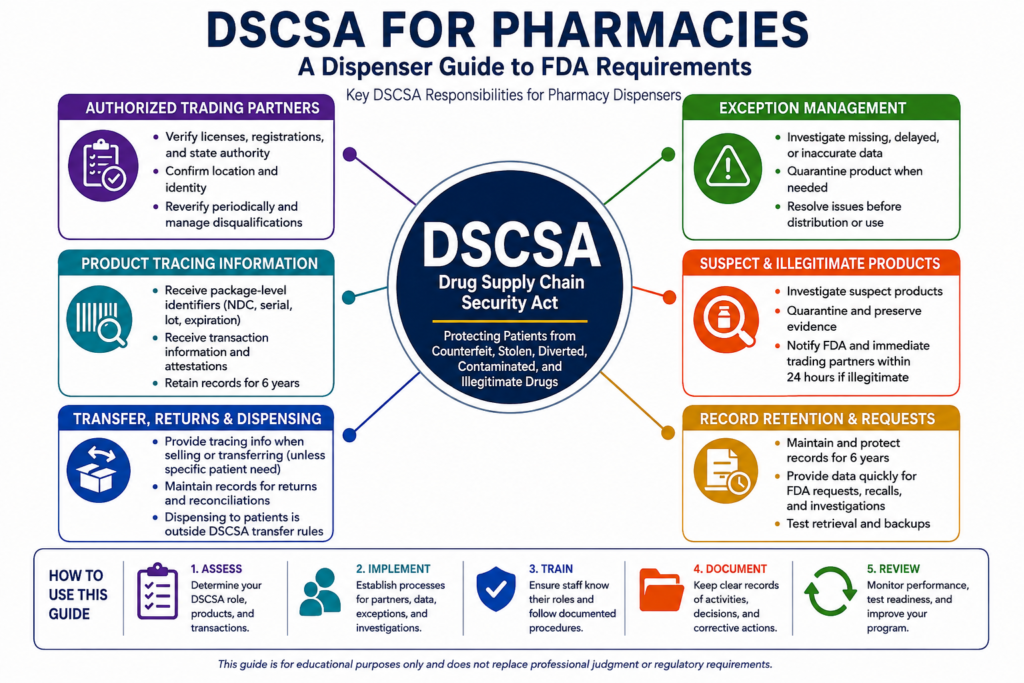
The Drug Supply Chain Security Act, better known as DSCSA, is a federal law designed to help protect patients from counterfeit, stolen, diverted, contaminated, and otherwise illegitimate prescription drugs.
For pharmacies, DSCSA is not simply a wholesaler or information technology project. Pharmacies are generally considered dispensers under the law, which makes product tracing, supplier verification, record retention, and suspect product response part of the pharmacy’s compliance responsibilities.
These responsibilities reach into purchasing, receiving, inventory control, pharmacy-to-pharmacy transfers, product returns, recalls, vendor management, and incident response. A pharmacy may use a vendor or wholesaler platform to exchange tracing data, but the pharmacy still needs to understand how its own processes satisfy the applicable requirements.
This article explains DSCSA from the dispenser perspective, including the FDA’s current requirements and exemptions as of August 20, 2026.
What Does DSCSA Mean?
DSCSA stands for the Drug Supply Chain Security Act. Congress enacted it in 2013 as Title II of the Drug Quality and Security Act.
The law established a framework for tracing certain prescription drugs as they move through the United States pharmaceutical distribution supply chain. Manufacturers, repackagers, wholesale distributors, and dispensers are among the trading partners subject to its requirements.
At a high level, DSCSA is intended to help the pharmaceutical supply chain:
- Prevent harmful or illegitimate drugs from entering legitimate distribution channels
- Detect suspect products when warning signs appear
- Respond quickly when an illegitimate product is identified
- Trace covered products through their distribution history
- Verify certain product identifiers at the package level
- Exchange product tracing information electronically and securely
For a broader explanation of where FDA authority fits within pharmacy compliance, see our article on FDA pharmacy regulations.
What Is a Dispenser Under DSCSA?
FDA describes dispensers as primarily pharmacies. Depending on the organization and its activities, the definition can include retail pharmacies, hospital pharmacies, certain groups of chain pharmacies under common ownership and control, and authorized healthcare practitioners who dispense products.
An organization can perform more than one DSCSA role. For example, an entity that meets the definition of both a dispenser and a wholesale distributor may need to comply with the requirements applicable to both roles.
Pharmacy leaders should therefore avoid relying only on the organization’s name or license type. The analysis should consider what the organization actually does, including:
- Whether it purchases covered prescription drugs
- Whether it transfers ownership of products to other entities
- Whether it distributes products outside ordinary dispensing
- Whether it provides central-fill services
- Whether it replenishes inventory at another location
- Whether it operates multiple legal entities or licensed locations
The organization’s legal structure and operational relationships can affect which DSCSA requirements apply.
Which Products Are Covered by DSCSA?
DSCSA product tracing requirements generally apply to human prescription drugs in finished dosage form that are intended for administration to a patient without substantial further manufacturing.
FDA identifies several categories that are outside the DSCSA product definition, including:
- Over-the-counter drugs
- Animal drugs
- Blood or blood components intended for transfusion
- Radioactive drugs and radioactive biologic products
- Imaging drugs
- Certain intravenous products
- Medical gases
- Certain homeopathic drugs
- Lawfully compounded drugs
The exclusions have specific statutory definitions and conditions. A pharmacy should not assume that every product in a broad category is automatically excluded without reviewing the applicable definition.
A mixed pharmacy inventory may therefore contain products with different tracing obligations. Receiving and purchasing teams need a reliable way to distinguish covered products from excluded products and transactions.
The Main DSCSA Requirements for Pharmacy Dispensers
A dispenser-focused DSCSA program should address several connected responsibilities.
| DSCSA responsibility | Dispenser workflow | Example evidence |
|---|---|---|
| Authorized trading partners | Supplier onboarding and periodic verification | Licenses, registrations, verification logs, approval records |
| Product tracing information | Receiving, exception handling, and data storage | Electronic transaction information and transaction statements |
| Record retention | Long-term data availability | Six-year searchable archive and retrieval test results |
| Suspect product response | Quarantine, investigation, and escalation | Investigation record, photographs, scans, communications |
| Illegitimate product response | Notification and disposition | FDA notification, trading partner notices, disposition records |
| Outbound transfers | Pharmacy-to-pharmacy sales and transfers | Transfer classification and required tracing documentation |
| Returns | Product return and reconciliation | Return authorization and related tracing information |
| Regulatory requests | Recall and investigation response | Product trace report and response log |
1. Conduct Business With Authorized Trading Partners
Pharmacies must limit covered transactions to appropriately authorized trading partners.
The appropriate verification depends on the type of trading partner. For example, a pharmacy may need to confirm:
- FDA registration for a manufacturer or repackager
- Applicable licensing for a wholesale distributor
- Applicable state authority for another pharmacy
- The identity and authorization of entities involved in a transaction
This should be more than a one-time checkbox during contracting. Licenses can expire, ownership can change, suppliers can add distribution locations, and approved vendors can be replaced.
A practical authorized trading partner process should define:
- Who performs the initial verification
- Which sources are used
- How frequently authorization is rechecked
- What happens when a license cannot be verified
- How purchasing access is removed after disqualification
- How emergency purchases are reviewed and documented
The evidence should connect the legal entity, licensed location, purchasing account, and actual product source. A license stored in a folder is less useful if the pharmacy cannot show which supplier account or distribution location it supports.
2. Receive and Retain Product Tracing Information
A pharmacy should receive the required product tracing information for covered prescription drug transactions.
Under the enhanced drug distribution security framework, transaction information includes package-level product identifiers. These identifiers are designed to connect the physical package to its electronic tracing data and commonly involve:
- National Drug Code
- Serial number
- Lot number
- Expiration date
Dispensers also receive a transaction statement containing required attestations about the transaction and the trading partner’s compliance.
FDA tells pharmacies to retain product tracing documentation for six years. That means the information must remain available even if the pharmacy:
- Changes wholesalers
- Replaces its DSCSA technology vendor
- Closes or consolidates a location
- Changes ownership
- Moves records into an archive
- Experiences a system outage or cybersecurity incident
A six-year retention promise is not enough by itself. The pharmacy should test whether authorized staff can retrieve the correct records by product, lot, serial number, transaction date, supplier, and location.
3. Exchange Information Electronically and at the Package Level
Enhanced DSCSA requirements call for secure, interoperable, electronic exchange of tracing information at the package level.
FDA recommends the GS1 Electronic Product Code Information Services, or EPCIS, standard to support this exchange. However, FDA’s FAQs clarify that DSCSA does not itself require a pharmacy to obtain a particular location identifier such as a Global Location Number. A wholesaler or technology vendor may still require a GLN as a business or technical condition for exchanging EPCIS data.
This distinction matters:
- A statutory requirement comes from the law.
- FDA guidance communicates the agency’s current recommendations and interpretations.
- A wholesaler or vendor requirement may come from a contract or technical implementation.
All three may influence the pharmacy’s workflow, but they should not be presented as if they have the same legal source.
4. Manage Missing or Inaccurate Data
A physical shipment and its electronic tracing information do not always arrive together without errors.
Common exceptions may include:
- Missing transaction data
- Incorrect quantities
- Unrecognized location identifiers
- Duplicate serial numbers
- Lot or expiration discrepancies
- Products included in the data but not in the shipment
- Products received physically but absent from the data
- Data sent to the wrong pharmacy location
- Delayed files or system outages
A data exception does not automatically mean the product is counterfeit or illegitimate. It does mean the pharmacy needs a defined process for deciding whether the product can be received, held, investigated, returned, or otherwise resolved.
The process should identify:
- Who reviews the exception
- Whether the product must be physically segregated
- What information must be requested from the supplier
- How long the issue can remain unresolved
- When the issue becomes a suspect product investigation
- Who can authorize release of the product
- How patient access concerns are escalated
Exception logs can also reveal recurring supplier, location, integration, or staff-training problems that should be addressed through corrective action.
How Should a Pharmacy Handle Suspect and Illegitimate Products?
DSCSA distinguishes between a suspect product and an illegitimate product.
A suspect product is one for which there is reason to believe it may be counterfeit, diverted, stolen, intentionally adulterated, involved in a fraudulent transaction, or otherwise unfit for distribution in a way that may create serious health consequences.
An illegitimate product is a product for which credible evidence establishes one of the conditions identified by the law.
The distinction matters because a suspicious condition begins an investigation. It does not always begin with a final determination.
A Practical Dispenser Response Workflow
When a product may be suspect, the pharmacy should be prepared to:
- Stop product movement. Prevent dispensing, administration, transfer, or return while the concern is evaluated.
- Quarantine the product. Physically separate it and apply a clear status that prevents accidental use.
- Preserve the evidence. Retain the package, label, barcode, serial number, lot number, expiration date, invoice, transaction data, shipping materials, photographs, and relevant communications.
- Review the tracing information. Compare the physical product with the electronic transaction information and investigate discrepancies.
- Coordinate with trading partners. Contact the manufacturer, wholesaler, or other appropriate trading partner using verified contact information.
- Document the determination. Record whether the product was cleared, returned, recalled, destroyed, or determined to be illegitimate.
- Complete required notifications. If the product is determined to be illegitimate, notify FDA and all appropriate immediate trading partners within the required timeframe.
FDA states that trading partners, including dispensers, must notify FDA and appropriate immediate trading partners within 24 hours after determining that a product is illegitimate. FDA’s preferred submission method is the 3911 Platform in CDER NextGen, although Form FDA 3911 can also be used.
A pharmacy’s SOP should identify who has authority to make the determination, who submits the notification, who communicates with trading partners, and who documents final disposition.
Does DSCSA Apply When a Pharmacy Transfers Product to Another Pharmacy?
It depends on the purpose of the transfer.
When a pharmacy sells a covered product to another trading partner, it generally must generate and provide the applicable product tracing information. However, dispensing a prescription drug to a patient does not require the pharmacy to provide DSCSA tracing documentation to that patient.
There is also an exception for a dispenser-to-dispenser transfer made to fulfill a specific patient need. FDA explains that this means transferring a product to fill a prescription for an identified patient.
The exception does not include moving product to another pharmacy merely to increase or replenish that pharmacy’s general stock in anticipation of possible future demand.
This distinction is important for:
- Health-system locations
- Affiliated retail pharmacies
- Long-term care pharmacy operations
- Specialty pharmacy networks
- Central-fill arrangements
- Emergency inventory sharing
- Pharmacy acquisitions and consolidations
A transfer between related locations is not automatically outside DSCSA. The pharmacy should document the legal entities involved, whether ownership changes, the purpose of the transfer, and whether an applicable transaction exclusion is satisfied.
What Is the Current DSCSA Deadline for Dispensers?
The enhanced drug distribution security requirements became effective on November 27, 2023. FDA subsequently used compliance policies and exemptions to provide additional implementation time for portions of the supply chain.
As of August 20, 2026, the enhanced requirements apply to dispensers that do not qualify for a current exemption or have another FDA-authorized waiver, exception, or exemption.
FDA’s Small Business Dispenser Exemption
On August 6, 2026, FDA announced an additional one-year exemption for qualifying small business dispensers. The exemption continues from November 27, 2026, until November 27, 2027, for certain requirements under sections 582(g)(1) and 582(d)(4) of the Federal Food, Drug, and Cosmetic Act.
For this exemption, FDA defines a small business dispenser based on the corporate entity that owns the dispenser having a total of 25 or fewer full-time employees licensed as pharmacists or pharmacy technicians as of November 27, 2026.
FDA’s notification explains that a full-time employee is generally an employee working an average of at least 30 hours per week or 130 hours per month for purposes of this exemption.
This ownership-level definition deserves careful attention. A pharmacy that was previously independent may be acquired by a larger organization, join a chain, or undergo another ownership change. The employee count of the owning corporate entity may affect whether the exemption is available.
The exemption covers certain enhanced requirements, including specified elements of:
- Electronic, interoperable exchange
- Package-level product identifiers in transaction information
- Package-level verification systems and processes
- Responses to tracing information requests
- Gathering transaction information back to the manufacturer
- Saleable return association
- Designated product-identifier verification activities
It does not eliminate every DSCSA responsibility. FDA specifically states that the exemption does not apply to other requirements in section 582.
Qualifying dispensers and their trading partners do not need to submit information to FDA merely to use the exemption. FDA recommends communicating reliance on the exemption to trading partners when needed to prevent distribution delays. FDA also urges small dispensers to continue implementing the enhanced requirements rather than treating the additional year as a reason to stop preparing.
Because FDA timelines and policies can change, pharmacies should verify the current FDA position before relying on any exemption.
A DSCSA Readiness Checklist for Dispensers
Whether a pharmacy is already operating under the enhanced requirements or qualifies for the small business exemption, pharmacy leaders can use the following questions to evaluate readiness.
Governance and Applicability
- Have we documented why each legal entity and location is considered a dispenser?
- Have we identified activities that could create another trading-partner role?
- Have we classified the products and transactions that are within DSCSA?
- If relying on the small business exemption, have we documented the owning corporate entity and the applicable employee count?
- Have acquisitions, reorganizations, or ownership changes affected our analysis?
Trading Partners
- Do we maintain an approved trading partner list?
- Can we connect each supplier account and ship-from location to a verified license or registration?
- Do we periodically recheck authorization?
- Can purchasing be stopped promptly when a trading partner is no longer authorized?
Data Exchange and Retention
- Are covered shipments accompanied by the required electronic tracing information?
- Can we match package-level data to the physical product?
- Can we retrieve tracing information for at least six years?
- Can we export our records if we change vendors?
- Have we tested retrieval by NDC, serial number, lot, date, supplier, and location?
- Do we have a downtime and recovery process?
Exception Management
- What happens when product arrives before the data?
- Who reviews quantity, lot, serial number, and expiration discrepancies?
- When is a product placed on hold?
- Who can release product after an exception is resolved?
- Are recurring exceptions trended and assigned corrective actions?
Suspect and Illegitimate Products
- Can staff recognize common warning signs?
- Is quarantine space available and clearly controlled?
- Does the SOP distinguish a suspect product from an illegitimate product?
- Can the pharmacy notify FDA and immediate trading partners within 24 hours after an illegitimate-product determination?
- Has the pharmacy conducted a response drill?
Transfers and Returns
- Can staff distinguish a specific-patient-need transfer from inventory replenishment?
- Are tracing records provided when required?
- Can return records be associated with the original transaction information?
- Are transfers between affiliated locations classified based on the actual transaction rather than assumed to be exempt?
DSCSA Is More Than a Technology Project
A dispenser may need specialized technology to receive, store, reconcile, and retrieve electronic package-level tracing data. However, software alone does not establish an effective DSCSA program.
The pharmacy also needs:
- Clear policies and procedures
- Defined ownership and escalation
- Authorized trading partner controls
- Staff training
- Exception-management rules
- Investigation documentation
- Notification workflows
- Vendor oversight
- Record-retention controls
- Periodic testing
The technology may identify a missing serial number, but the organization still needs to decide what happens to the physical product, who investigates the problem, when the supplier is contacted, and how the resolution is documented.
How Pestle Can Help Organize DSCSA Compliance
Pestle Compliance can help pharmacy teams organize the operational compliance work surrounding DSCSA, including policies, procedures, training, vendor reviews, assigned tasks, incident documentation, and evidence of corrective action.
For example, a pharmacy could use a compliance management workflow to:
- Assign periodic trading partner verification
- Schedule DSCSA policy reviews
- Document staff training
- Maintain a suspect product response procedure
- Track unresolved receiving exceptions
- Record investigations and corrective action
- Prepare evidence for internal reviews or inspections
Pestle should complement, rather than replace, the specialized system used to exchange and retain serialized DSCSA transaction data. It also does not replace professional judgment, legal advice, or an organization’s responsibility to interpret the law for its operations.
Conclusion
DSCSA gives pharmacies an active role in protecting the integrity of the prescription drug supply chain. From the dispenser perspective, compliance depends on more than receiving electronic files from a wholesaler. It requires connected controls for supplier authorization, package-level tracing, six-year record retention, exception management, product quarantine, investigation, notification, transfers, and returns.
The FDA’s small business dispenser exemption provides qualifying organizations additional time for certain enhanced requirements through November 27, 2027. It does not remove every DSCSA obligation, and FDA continues to encourage implementation during the exemption period.
Pharmacy leaders should use the available time to test their systems, close documentation gaps, train staff, and confirm that the organization can respond effectively when a product or its data does not look right.
Pestle can help pharmacy teams organize the policies, responsibilities, evidence, and corrective actions that support a sustainable DSCSA compliance program.