
Table of Contents
CMS Pharmacy Requirements: A Guide for Pharmacy Leaders
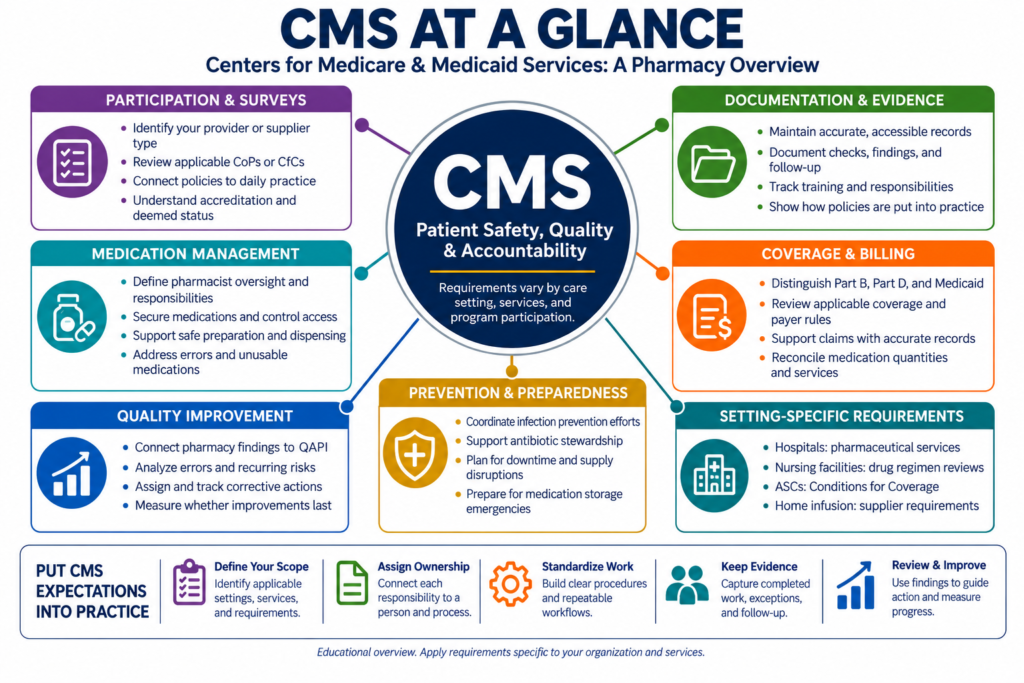
CMS pharmacy requirements influence how healthcare organizations manage medications, document care, improve quality, and participate in Medicare and Medicaid. For pharmacy leaders, understanding CMS means understanding both the conditions that support safe patient care and the program rules that affect coverage and payment.
This article continues Pestle’s Pharmacy Compliance Alphabet Soup series with an overview of the Centers for Medicare & Medicaid Services, commonly called CMS.
The starting point is your organization’s setting. A hospital pharmacy, a pharmacy serving nursing facilities, and a community pharmacy processing Medicare prescription claims encounter CMS through different requirements. Identifying that relationship makes it easier to determine which policies, workflows, and records deserve attention.
What Is CMS?
CMS is a federal agency within the U.S. Department of Health and Human Services. Its responsibilities include Medicare, federal oversight of Medicaid and the Children’s Health Insurance Program, and responsibilities related to the Health Insurance Marketplace. Its reach extends across healthcare coverage, payment, quality, and patient safety.
For pharmacy teams, two major areas are especially relevant:
- Health and safety requirements: Expectations that apply to particular participating healthcare providers and suppliers.
- Coverage and payment requirements: Rules governing whether services or medications are covered and how claims must be supported and submitted.
CMS publishes resources addressing both areas through its Pharmacist Information Center. A pharmacy’s compliance program should identify which parts apply to its services and business relationships.
How CMS Pharmacy Requirements Differ by Setting
CMS develops Conditions of Participation, or CoPs, and Conditions for Coverage, or CfCs, for specified healthcare provider and supplier types. These establish health and safety requirements for participation in the applicable programs. They are specific to the provider or supplier category; there is no single hospital style CMS checklist that applies to every pharmacy.
| Setting or relationship | How CMS enters the picture |
|---|---|
| Hospitals | Hospital CoPs include pharmaceutical services, nursing services, medical records, quality improvement, and infection prevention. |
| Skilled nursing facilities and nursing facilities | Federal participation requirements include pharmacy services, pharmacist drug regimen reviews, medication safety, labeling, and storage. |
| Ambulatory surgical centers | ASC Conditions for Coverage provide a separate framework for these facilities. |
| Qualified Medicare home infusion therapy suppliers | Specific requirements address plans of care, required services, and supplier qualifications. |
| Community and specialty pharmacies serving Part D patients | Medicare Part D plan requirements and pharmacy network relationships affect pharmacy operations. |
The relevant starting points include CMS’s hospital and ASC resources, the nursing facility pharmacy services regulation, home infusion supplier requirements, and Part D contracting resources.
“Specialty pharmacy” or “infusion clinic” alone does not identify the applicable CMS framework. Leaders should establish the organization’s provider or supplier classification, services, enrollment, and payer relationships before selecting requirements.
Medication Management and Pharmaceutical Services
For hospitals, 42 CFR § 482.25 is a central reference. It addresses pharmacist oversight, staffing, controlled substance records, medication security, compounding and dispensing supervision, removal of unusable medications, and reporting of medication related problems. It also requires a formulary system established by the medical staff.
These requirements connect pharmacy operations to the broader medication-use process. A pharmacy leader should be able to explain how the organization:
- Controls access to medications.
- Prevents expired, mislabeled, or otherwise unusable products from reaching patients.
- Provides medication access when a pharmacist is unavailable.
- Supervises compounding and dispensing.
- Maintains controlled substance accountability.
- Escalates medication errors and adverse reactions.
Practical example: A medication storage inspection identifies expired products in a treatment area. A useful response includes removing the products, determining how they remained available, assigning corrective action, and checking whether the revised process works.
The completed inspection provides evidence of a check. The follow-up provides evidence that the organization addressed the problem.
Quality Assessment and Performance Improvement
Quality Assessment and Performance Improvement, often shortened to QAPI, connects identified problems to measurable improvement.
The hospital QAPI regulation, 42 CFR § 482.21, requires an ongoing, organization-wide, data-driven program. Hospitals must track relevant quality indicators, analyze errors and adverse events, implement improvements, and evaluate whether those improvements are sustained. Pharmacy services belong within that broader effort.
Potential pharmacy improvement topics include:
- Repeated medication storage failures.
- Preparation errors or recurring verification problems.
- Delays in resolving controlled substance discrepancies.
- Medication related incidents with similar contributing factors.
- Gaps in completing corrective actions.
These are examples for local consideration, rather than a universal CMS required metric list.
Practical example: A pharmacy identifies repeated ingredient selection errors. The team investigates contributing factors, changes the selection or verification process, educates staff, and measures whether the errors decrease. A dashboard becomes useful when its findings lead to action and follow-up.
Documentation That Demonstrates the Work
Documentation connects a policy to what actually happened.
Depending on the requirement, relevant evidence may include medication records, inspection results, pharmacist reviews, incident reports, training records, or corrective-action documentation. Hospital pharmaceutical services requirements include specific recordkeeping obligations, while the QAPI condition requires evidence of the quality program.
For recurring operational work, a practical documentation approach answers:
- What was evaluated?
- Who completed the work, and when?
- What problem or exception was identified?
- What action followed?
- Who reviewed the result?
- Was additional follow-up needed?
This is a useful organizational framework, not a claim that CMS requires the same six fields on every form.
For example, a completed refrigerator check is more useful when an out-of-range result can be connected to the investigation, product assessment, and resolution. Teams should select the evidence needed for the specific requirement and retain it according to applicable rules and organizational policy.
Infection Prevention, Compounding, and Antibiotic Stewardship
CMS’s hospital infection prevention and antibiotic stewardship condition, 42 CFR § 482.42, requires hospital-wide programs addressing infection prevention and appropriate antibiotic use. Pharmacy participates alongside medical staff, nursing, infection prevention, laboratory services, and quality leadership.
For pharmacy leaders, this creates opportunities to connect medication-use practices with broader patient safety efforts. Examples include reviewing antibiotic-use concerns, supporting approved treatment policies, and coordinating education and improvement activities.
Compounding is another area where CMS expectations overlap with professional standards. CMS’s hospital survey guidance addresses pharmaceutical services and preparation of compounded sterile products, including preparation outside the pharmacy.
Teams should evaluate compounding practices against the applicable laws, standards, CMS guidance, and facility policies. The CMS overview provides the organizational context; detailed compounding requirements deserve their own focused review.
Nursing Facility Pharmacy Services
For pharmacies serving skilled nursing facilities and nursing facilities, 42 CFR § 483.45 is a key reference.
Its provisions include pharmacist consultation, controlled drug accountability, and review of each resident’s drug regimen by a licensed pharmacist at least monthly. It also addresses unnecessary medications, psychotropic medications, medication errors, labeling, and storage. Identified drug regimen irregularities must be reported and acted upon, with specific documentation responsibilities.
For a pharmacy serving these facilities, clear coordination is essential. The pharmacy and facility should understand who communicates findings, who follows up, and where the response is documented.
Practical example: Completing a monthly pharmacist review is one step. Tracking an identified concern through communication and the documented clinical response makes the process easier to evaluate.
These are requirements for participating facilities. The pharmacy’s services help the facility meet its responsibilities, while the pharmacy also maintains its own applicable professional and legal obligations.
Home Infusion and Ambulatory Services
Home infusion illustrates why identifying the exact Medicare benefit and supplier category matters.
For qualified Medicare home infusion therapy suppliers, 42 CFR Part 486, Subpart I addresses supplier qualifications, a physician-established plan of care, and required services. Those services include professional services, patient training and education, and monitoring. These provisions apply to that defined supplier category.
Ambulatory surgical centers operate under their own Conditions for Coverage. A physician office, hospital outpatient department, and freestanding ASC should therefore begin with their respective classifications when evaluating CMS obligations. CMS’s ASC resources provide a starting point for that setting.
For organizations operating multiple service lines, a practical approach is to map requirements by site and service rather than assume one set applies everywhere.
Emergency Preparedness and Medication Continuity
CMS emergency preparedness requirements for covered provider and supplier types address four core areas: risk assessment and planning, policies and procedures, communication, and training and testing. Specific requirements vary by provider type.
Pharmacy can translate the organization’s emergency plan into medication-related questions:
- How will temperature-sensitive inventory be protected during an outage?
- How will urgent medication needs be met during a supply interruption?
- What happens if prescribing, dispensing, or compounding systems become unavailable?
- Who communicates medication concerns during evacuation or transfer?
- How will staff practice the planned response?
Practical example: A downtime procedure becomes more useful when staff can locate it, understand their responsibilities, and demonstrate how medication documentation will continue.
The appropriate scope and exercise schedule should follow the requirements applicable to the organization.
Coverage, Billing, and Program Integrity
CMS also affects pharmacy through coverage and payment. These obligations should be evaluated alongside clinical and operational requirements.
Medicare Part B medications
Certain drugs and biologicals are covered under Medicare Part B. For applicable separately payable drugs from single-dose containers, CMS’s JW and JZ policies address reporting discarded amounts or the absence of discarded amounts. The policy contains specific applicability rules and exceptions.
A practical starting point is to reconcile the medication order, preparation or dispensing record, administration record, and claim-supporting documentation. Teams should investigate inconsistencies before assuming that a recorded quantity supports a billable quantity.
Medicare Part D
CMS oversees Part D plan sponsors through program requirements and compliance oversight. Pharmacies interact with that structure through plan networks, contracts, and dispensing workflows. Leaders should distinguish the sponsor’s regulatory responsibilities from the pharmacy’s own applicable obligations and contract terms.
Examples of related topics include formulary processes, dispensing safety alerts, and medication therapy management. CMS requires Part D sponsors to establish medication therapy management programs; that does not mean every network pharmacy independently carries the sponsor’s entire obligation.
Medicaid
Medicaid prescription drug coverage operates within federal requirements and state program policies. Pharmacy teams should review the applicable state Medicaid program and managed care arrangements when evaluating coverage, authorization, and reimbursement workflows.
CMS Surveys, Accreditation, and Deemed Status
CMS requirements may be evaluated through state survey agencies or, for eligible provider types, a CMS-approved accreditation program.
Deemed status refers to a pathway through which qualifying accreditation demonstrates compliance with applicable Medicare conditions. CMS approval applies to specific accreditation programs. An organization’s accreditation does not automatically establish deemed status for every service it offers.
CMS also publishes interpretive guidance, including the State Operations Manual, to support survey evaluation. Pharmacy leaders should distinguish the regulatory requirement from the guidance explaining how surveyors assess it. The hospital guidance is available in State Operations Manual Appendix A.
A practical preparation question is: Can we show how our policy becomes routine work, and how we respond when that work identifies a problem?
Turning CMS Expectations Into a Pharmacy Work Plan
Start with a manageable map of the requirements relevant to your organization.
For each area, identify the applicable source, responsible owner, operational process, supporting evidence, and follow-up method.
| Operational area | Example evidence to organize |
|---|---|
| Medication storage | Inspection results, identified exceptions, and documented resolution |
| Compounding | Preparation records, verification documentation, and relevant staff assessments |
| Quality improvement | Problem analysis, action plans, measures, and follow-up results |
| Nursing facility services | Pharmacist reviews, communicated findings, and documented responses |
| Emergency preparedness | Pharmacy procedures, staff education, and exercise findings |
| Billing support | Records supporting the medication, service, and quantity claimed |
These examples can guide internal planning. Each organization should adapt them to its actual obligations, services, and approved policies.
How Pestle Can Help
Pestle Compliance helps pharmacy teams schedule, track, and manage compliance activities, organize SOPs and supporting documentation, and maintain records of training and competency activities established by the organization. Issue and investigation tracking can help teams connect identified problems with follow-up work.
Pestle Formulas supports structured compounding workflows through master formulation records, ingredient barcode verification, photo documentation, configurable quality checks, and preparation records. These tools can help teams organize evidence for operational review and quality improvement.
The organization remains responsible for determining which requirements apply, establishing policies, and exercising professional judgment. Software can support that work by making responsibilities and documentation easier to manage.
Bringing CMS Into Your Compliance Program
CMS connects pharmacy practice to a broader system of patient safety, organizational accountability, coverage, and payment.
Understanding that connection begins with the right questions: What kind of organization are we? Which programs and services do we participate in? What requirements apply? How do we show that the work is completed and problems are addressed?
Those questions turn a broad acronym into a practical compliance plan.
Explore the rest of Pestle’s Alphabet Soup series to see how CMS fits alongside other pharmacy oversight frameworks, or learn how Pestle Compliance can help your team organize the daily work behind inspection readiness.