
Table of Contents
NDC Labeling Requirements and FDA Product Information: A Pharmacy Guide
Drug labels contain more than a product name and strength. They connect the physical medication to information about its labeler, package configuration, lot, expiration date, storage conditions, approved uses, preparation instructions, safety warnings, and supply-chain history.
For pharmacies, understanding NDC labeling requirements is therefore not only a purchasing or billing concern. Product identification and labeling affect receiving, formulary management, barcode verification, medication storage, compounding, dispensing, recalls, Drug Supply Chain Security Act compliance, and inspection readiness.
The FDA’s new rule establishing a uniform 12-digit National Drug Code makes this a timely subject. Although the new format does not take effect until 2033, pharmacies have years of systems, interfaces, barcode scanners, master data, and vendor workflows to evaluate before the transition.
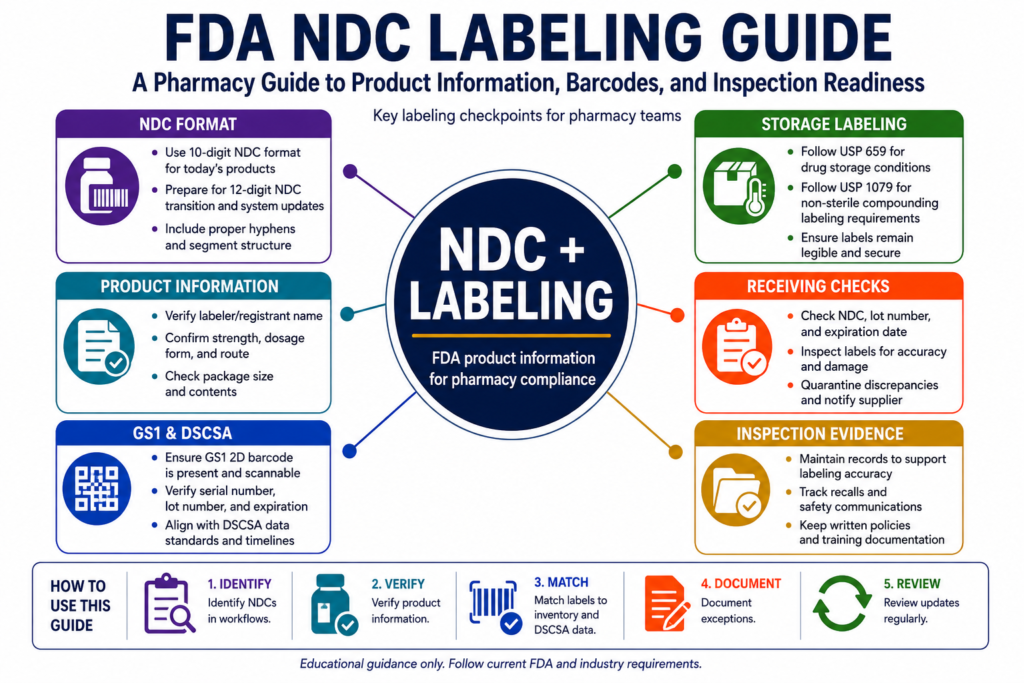
This guide explains what an NDC identifies, what it does not prove, how the new format will work, how NDCs connect to GS1 and DSCSA, and how inspectors and accreditation surveyors may use labeling and product information to evaluate pharmacy operations.
This article is part of Pestle’s Pharmacy Compliance Alphabet Soup series and supports our broader guide to FDA pharmacy regulations. It is educational and is not legal or regulatory advice. Requirements may vary by product, activity, practice setting, state law, accreditation program, and contract.
What Is a National Drug Code?
A National Drug Code, or NDC, is an FDA-assigned identifier used for drugs listed with the agency. Each finished or unfinished drug subject to FDA drug-listing requirements receives a unique NDC that identifies three elements:
| NDC segment | What it identifies |
|---|---|
| Labeler code | The labeler associated with the product |
| Product code | The drug’s specific formulation, strength, dosage form, and other distinguishing characteristics |
| Package code | The package size and package type |
A labeler may be a manufacturer, repackager, relabeler, private-label distributor, or another entity named on the product label. For that reason, the labeler code should not automatically be interpreted as the identity of the facility that physically manufactured the medication.
The package code is also important. Two packages containing the same drug, strength, and dosage form may have different NDCs because their package sizes or package types differ. A pharmacy should therefore verify the complete NDC rather than matching only the product name or a portion of the code.
Current NDC formats
As of September 3, 2026, FDA-assigned NDCs contain 10 digits divided into three segments. The segments may appear in one of three configurations:
- 4-4-2
- 5-3-2
- 5-4-1
Hyphens help show which configuration is being used. Pharmacy systems sometimes remove hyphens or add leading zeros when converting the FDA-assigned 10-digit NDC to the 11-digit format used for certain HIPAA transactions and reimbursement workflows.
These conversions create an important data-governance issue: an NDC should not be treated as an ordinary number. Leading zeros, segment boundaries, and format context matter. Storing an NDC in a numeric field can remove a leading zero and change how the identifier is interpreted.
Does an NDC Mean a Drug Is FDA Approved?
No. An NDC does not, by itself, prove that a drug is FDA approved.
The FDA National Drug Code Directory contains product-listing data submitted by labelers. It includes approved and unapproved drugs, prescription and nonprescription drugs, repackaged and relabeled products, and certain compounded-drug reports submitted by outsourcing facilities.
FDA explicitly states that assignment of an NDC or inclusion in the directory does not mean that FDA has approved the product or verified all submitted information.
What Is Changing Under the New 12-Digit NDC Rule?
FDA published its final rule, “Revising the National Drug Code Format and Drug Label Barcode Requirements,” in the Federal Register on March 5, 2026.
The rule creates a uniform 12-digit NDC using a 6-4-2 configuration:
| Segment | Future length |
| Labeler code | 6 digits |
| Product code | 4 digits |
| Package code | 2 digits |
| Total | 12 digits |
Existing 10-digit NDCs will be converted to the 12-digit format by adding leading zeros to the applicable segments. The underlying labeler, product, and package relationships will remain important even though the length becomes uniform.
FDA’s NDC transition timeline
| Date | NDC transition milestone |
| March 5, 2026-March 6, 2033 | Preparation period for systems, processes, interfaces, and labeling |
| March 7, 2033 | Final rule becomes effective; FDA begins using the uniform 12-digit format and converts existing FDA-assigned NDCs |
| March 7, 2033-March 6, 2036 | Three-year labeling transition period; systems should support both 10- and 12-digit NDCs |
| After March 6, 2036 | Drugs labeled with the old 10-digit NDC may be subject to regulatory action |
During the three-year transition, FDA does not intend to object to the continued use of previously assigned 10-digit NDCs on drug labeling while companies update labeling and use remaining label inventory.
The final rule affects FDA-assigned NDCs. It does not itself change the separate 11-digit format currently used for HIPAA transactions and reimbursement. Pharmacy billing teams should not assume that a change to the FDA format automatically changes payer submission requirements. Updates from HHS, standards organizations, payers, and claims-processing vendors will need to be monitored separately.
How Are NDCs Different From GTINs and Barcodes?
The NDC, Global Trade Item Number, barcode, and DSCSA product identifier are related, but they are not interchangeable.
| Term | Primary purpose |
| NDC | Identifies the labeler, drug product, and package configuration in FDA drug-listing systems |
| GTIN | GS1 identifier for a specific trade item and packaging level |
| Serial number | Uniquely distinguishes an individual package or homogeneous case |
| Lot number | Connects product to a specific production lot |
| Expiration date | Identifies the labeled period through which the product is expected to meet applicable specifications when properly stored |
| GS1 DataMatrix | A two-dimensional data carrier that can encode multiple identifiers and attributes |
| EPCIS | A standard used to exchange information about product movements and supply-chain events |
A barcode is the carrier, not the complete meaning of the information. What matters is which data elements are encoded, how they are formatted, and whether the receiving system can interpret them correctly.
The GS1 and DSCSA connection
FDA states that, beginning March 7, 2033, a 2D DataMatrix may encode the 12-digit NDC using GS1 Application Identifier 715 along with the serial number, lot number, and expiration date. For products subject to both FDA drug-barcode requirements and DSCSA product-identifier requirements, one conforming 2D DataMatrix may be able to satisfy both.
Pharmacies should still validate how their wholesalers, DSCSA vendors, barcode scanners, drug databases, and internal systems plan to implement the change. A standards-based barcode does not guarantee that every connected system will parse, store, or display every data element correctly.
For a fuller explanation of electronic tracing, package-level data, authorized trading partners, and suspect-product investigations, see DSCSA for Pharmacies: A Dispenser Guide to FDA Requirements.
Which FDA Product Information Source Should a Pharmacy Use?
FDA maintains several product databases, and each answers a different question. A pharmacy should not treat the NDC Directory, Drugs@FDA, DailyMed, FDALabel, Orange Book, and REMS@FDA as interchangeable.
| Pharmacy question | Recommended starting source | Important limitation |
| Is this human drug FDA approved? | Drugs@FDA | Does not contain every CBER-regulated biological product |
| What is the most recent FDA-approved prescribing information? | Drugs@FDA | Current in-use labeling may sometimes contain later changes submitted through an annual report or supplement |
| What current labeling has the company submitted in structured product labeling format? | DailyMed or FDALabel | Current in-use labeling may differ from the last FDA-approved labeling |
| Is this NDC currently listed, and what package does it identify? | NDC Directory | Listing or NDC assignment does not prove approval |
| Does FDA identify therapeutic-equivalence information? | Orange Book | Applies to products within the scope of the Orange Book |
| Does the product have an FDA-required REMS? | REMS@FDA | Program requirements must be reviewed for the specific drug or shared system |
| Is a particular lot affected by a recall? | FDA recall information plus manufacturer or supplier notice | NDC alone may be insufficient; lot, expiration, and distribution information may be needed |
| What storage or preparation instructions apply? | Current approved labeling, manufacturer information, and applicable pharmacy policy | Product-specific instructions should not be replaced with a generic storage assumption |
FDA explains that human prescription drug labeling can include Prescribing Information, Medication Guides, Patient Package Inserts, Instructions for Use, and carton and container labeling.
These materials serve different audiences and purposes. A medication carton, for example, may provide the NDC, strength, route, storage conditions, lot, expiration date, and barcode. The Prescribing Information provides more complete clinical and preparation information. A Medication Guide or Instructions for Use may contain patient-facing information that the pharmacy must distribute or use in counseling when applicable.
How Labeling and Product Information Affect Pharmacy Workflows
Purchasing and receiving
The receiving process is often the first opportunity to identify a labeling or product-data problem.
Personnel should be able to verify that:
- The product and package match the purchase order
- The complete NDC or applicable product identifier matches the expected item
- The strength, dosage form, concentration, and package size are correct
- The physical label is intact and legible
- The product has not expired
- Required storage conditions were maintained during shipment
- The DSCSA tracing information corresponds to the physical product when applicable
- The lot, expiration date, serial number, or GTIN can be captured when the workflow requires them
A package-data mismatch should not be treated as a routine receiving inconvenience. It may indicate a catalog error, substitution, relabeling issue, barcode problem, DSCSA exception, damaged product, or potentially suspect product.
The pharmacy’s procedure should identify when personnel may correct a low-risk master-data issue and when the product must be quarantined and escalated.
Inventory and storage
Product labeling provides product-specific storage instructions. USP terminology, facility policies, and accreditation standards help pharmacies translate those instructions into operational controls.
Our guides to USP <659> packaging and storage requirements and USP <1079> storage and transportation explain how labeling, storage terminology, monitoring, transportation, and excursion investigations fit into a broader pharmacy quality system.
A generic policy cannot account for every product. When labeling establishes a specific storage range or handling precaution, that information should be reflected in the applicable pharmacy workflow.
Dispensing, repackaging, and compounding
It is important to distinguish manufacturer labeling from the label generated by a dispensing pharmacy.
The manufacturer’s carton, immediate container, and FDA-approved labeling describe the commercially distributed product. A pharmacy-generated prescription label is governed by a different combination of state law, federal requirements, compendial standards, accreditation requirements, payer or program rules, and pharmacy policy.
An NDC is not universally required on every pharmacy-generated patient label. Pharmacies should verify the requirements applicable to their state, setting, product, and accreditation program rather than adding or removing an NDC based on assumption.
Repackaging creates additional questions:
- Has the package configuration changed?
- Which entity performed the repackaging?
- Does a different listed NDC apply?
- What expiration date or beyond-use date is supported?
- What storage and light-protection information must remain with the product?
- Can the original manufacturer, NDC, lot, and expiration date still be traced?
- Does the activity create DSCSA, state-law, USP, or accreditation obligations?
A pharmacy should not invent an NDC for a repackaged or compounded preparation. Certain 503B outsourcing facilities may elect to assign NDCs to reported compounded products, but the presence of that NDC still does not mean the compounded product is FDA approved.
For compounded preparations, the master formulation record, compounding record, ingredient-verification process, and final label should preserve the product information required by applicable USP chapters, state law, facility policy, and accreditation standards. Source ingredient records may also need to retain manufacturer or labeler information, NDC, lot number, and expiration date so the pharmacy can investigate recalls and quality events.
Recalls and suspect-product investigations
An NDC identifies a product and package, but it usually does not identify the exact inventory affected by a lot-specific recall.
A closed-loop recall process may need to search:
- NDC or GTIN
- Lot number
- Expiration date
- Serial number, when applicable
- Supplier and receipt date
- Pharmacy or storage location
- Automated dispensing cabinet or kit location
- Repackaged or compounded products containing the affected item
- Dispensing or administration history
- Patients or facilities that received the product
This is where labeling data, DSCSA tracing records, inventory records, and patient-level documentation come together. If the pharmacy records only the NDC, it may know which product was involved but not whether its inventory came from the affected lot.
How Do Inspectors Use Labeling and Product Information?
Inspectors and surveyors may begin with different authorities, but they often use product labeling as objective evidence of whether the pharmacy’s processes are working.
FDA and DSCSA
FDA-related review may examine whether a pharmacy can connect a covered product to its trading partner, tracing information, product identifier, quarantine status, and suspect-product investigation.
An NDC mismatch, unreadable product identifier, missing lot or expiration date, or failure to connect a physical package to its electronic record may trigger additional questions.
State boards of pharmacy
State boards may evaluate prescription labeling, repackaging, compounding labels, expiration and beyond-use dating, storage, outdated inventory, recalls, and pharmacy records.
Requirements vary significantly by state and practice setting. Policies should cite the actual state authority rather than referring generically to “FDA labeling requirements” when the controlling requirement comes from the state board.
CMS hospital requirements
Under 42 CFR § 482.25, hospitals must provide pharmaceutical services that meet patient needs and manage the pharmacy according to accepted professional principles. The regulation also requires hospitals to keep outdated, mislabeled, and otherwise unusable drugs and biologicals from being available for patient use.
A CMS surveyor or accreditor evaluating this requirement may trace how the hospital:
- Identifies mislabeled or expired products
- Performs medication-area inspections
- Controls product master data or formularies
- Responds to recalls
- Removes unusable products
- Maintains storage conditions
- Verifies products used in preparation and administration
The inspection question is not simply whether a label exists. It is whether the pharmacy consistently uses label and product information to prevent an inappropriate product from reaching a patient.
Accreditation organizations
Accreditation standards may address labeling accuracy, barcode or NDC verification, storage instructions, lot and expiration tracking, recall readiness, medication delivery, and documentation.
For example, LTC pharmacy accreditation may examine how the organization verifies the correct drug and package, labels medications for a facility or resident, communicates storage conditions, and identifies patients or facilities affected by recalled lots.
The exact standard depends on the accreditation program and edition. Pharmacies should review their current licensed standards rather than relying on a generic accreditation checklist.
USP standards
USP requirements may connect labeling to official drug articles, expiration-date presentation, compounded-preparation labels, beyond-use dating, packaging, storage, and hazardous-drug precautions.
USP General Chapter <7> provides labeling standards for official articles, including standardized expiration-date presentation. USP <659> addresses packaging and storage terminology, while USP <795>, <797>, <800>, and <825> contain labeling provisions relevant to their respective compounding settings.
Applicability should be evaluated carefully. Not every USP provision applies to every pharmacy activity, and manufacturer expiration dates should not be confused with pharmacy-assigned beyond-use dates.
Payers and manufacturer programs
NDCs can also appear in pharmacy claims, medical claims, rebate and chargeback workflows, specialty-pharmacy reporting, limited-distribution arrangements, and manufacturer programs.
A payer’s 11-digit claims format is not necessarily the same as the FDA-assigned NDC printed on a package. Policies and system documentation should identify when conversion occurs and which format is required by each transaction.
An Inspection Tracer for Labeling and Product Information
Consider a surveyor who selects one refrigerated prescription drug from an outpatient infusion refrigerator.
The pharmacy may need to show:
- The product name, strength, dosage form, and package configuration.
- The NDC or GTIN and how it maps to the pharmacy’s drug master.
- The lot number and expiration date.
- The supplier and receiving record.
- Applicable DSCSA tracing information.
- The labeled storage conditions.
- Refrigerator monitoring and alarm records.
- Any excursion investigation affecting the product.
- The preparation, dispensing, or administration record.
- Evidence that the product was checked against applicable recalls.
- The policy governing expired, damaged, mislabeled, or quarantined inventory.
- Staff training or competency relevant to the workflow.
No single record answers every question. Inspection readiness comes from connecting product identity, labeling, supply-chain data, storage evidence, and patient-use records into one traceable story.
How Pestle Can Help
NDC and labeling compliance involve recurring work across purchasing, pharmacy operations, informatics, medication safety, compounding, and quality. The challenge is often not locating one regulation. It is making sure responsibilities, reviews, exceptions, and evidence remain connected.
Pestle Compliance can help pharmacy teams organize activities such as:
- Medication-area inspections
- Supplier and authorized-trading-partner reviews
- Policy review and staff attestation
- Storage and temperature-log reviews
- Corrective-action follow-up
- Multi-site compliance oversight
Pestle Formulas can help standardize compounding and IV workflows involving ingredient verification, NDCs, lot numbers, expiration dates, preparation records, storage instructions, labels, and approval documentation.
Pestle is designed to help organize and document pharmacy compliance work. It does not replace product labeling, pharmacist judgment, legal advice, manufacturer consultation, or qualified interpretation of FDA, USP, state, accreditation, and payer requirements.
Conclusion
An NDC is a powerful identifier, but it is only one part of the product-information picture. It identifies a labeler, drug product, and package configuration. It does not prove FDA approval, identify a specific lot, replace a DSCSA serial number, or answer every storage, clinical, or regulatory question.
For pharmacy leaders, labeling should be treated as both an operating instruction and a source of inspection evidence. The label connects the product to receiving controls, storage requirements, preparation instructions, recalls, DSCSA records, billing data, and patient use.
The FDA’s move to a uniform 12-digit NDC gives pharmacies time to improve that infrastructure. The most prepared organizations will use the transition period to inventory systems, strengthen product-data governance, test barcode and recall workflows, clarify source hierarchies, and assign responsibility for future changes.
Want a more organized way to manage medication inspections, product-data reviews, recall exercises, storage requirements, and related evidence? Explore Pestle Compliance or contact the Pestle team to learn how standardized workflows can support your pharmacy’s compliance and inspection-readiness program.