
Table of Contents
FDA REMS Program: What Pharmacies Need to Know
Pharmacy teams routinely manage medications with boxed warnings, Medication Guides, payer restrictions, specialty distribution requirements, and detailed monitoring recommendations. An FDA REMS program is different. A Risk Evaluation and Mitigation Strategy, or REMS, is an FDA-required drug safety program for certain medications with serious safety concerns.
FDA may require a REMS when additional measures beyond the approved prescribing information are necessary to help ensure that a medication’s benefits outweigh its risks. A REMS does not attempt to address every adverse effect associated with a drug. It focuses on one or more specific serious risks and the actions needed to prevent, monitor, or manage them.
For a pharmacy, those actions can reach far beyond ordinary prescription processing. Depending on the medication and program, the pharmacy may need to become certified, train staff, confirm prescriber or patient enrollment, verify laboratory or monitoring requirements, obtain authorization before dispensing, provide required information, and retain evidence that each step occurred.
This article explains the FDA REMS program from the pharmacy perspective and is part of Pestle’s Pharmacy Compliance Alphabet Soup series. For a broader view of the agency’s role, begin with FDA Pharmacy Regulations: Programs Every Leader Should Know.
What Does REMS Mean?
REMS stands for Risk Evaluation and Mitigation Strategy.
The FDA describes a REMS as a drug safety program it can require for certain medications with serious safety concerns. REMS apply to certain prescription drugs and biologics; they do not apply to over-the-counter medications.
FDA may determine that a REMS is necessary during the approval process or after a medication is already on the market if new safety information becomes available. FDA specifies and approves the program requirements, while the drug manufacturer is responsible for developing and implementing the approved program. Manufacturers may operate a REMS directly or use a vendor or program administrator.
That structure helps explain why pharmacies often interact with a manufacturer-sponsored website, call center, portal, or electronic verification system even though the underlying safety program is required by FDA.
Why the FDA REMS Program Matters to Pharmacies
Pharmacists are frequently the final checkpoint before a medication reaches the patient. In a REMS with dispenser requirements, the pharmacy’s role may be to confirm that the conditions for safe use have been met before the medication is dispensed.
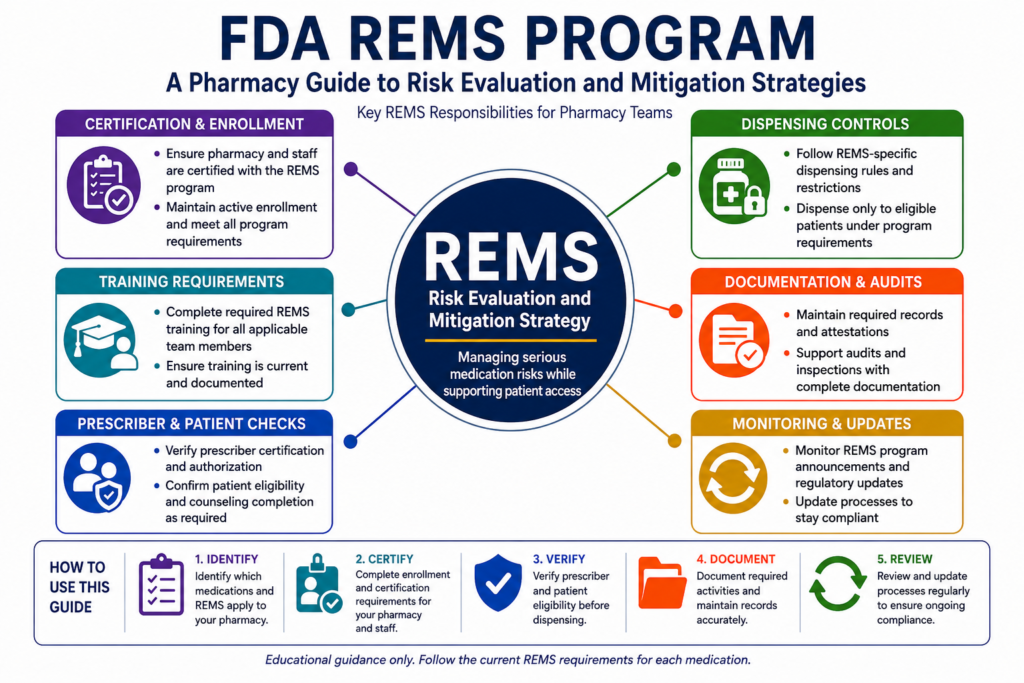
The exact requirements vary by program and practice setting. According to FDA’s guidance for pharmacies and health care settings, a REMS may require a pharmacy or setting to:
- Become certified to receive or dispense the medication.
- Designate an authorized representative responsible for enrollment and oversight.
- Complete program-specific training and train affected staff.
- Verify that the prescriber is certified or enrolled.
- Verify that the patient is enrolled when required.
- Confirm that laboratory tests, monitoring, counseling, agreements, or other safe-use conditions have been completed.
- Obtain an authorization or confirmation before dispensing.
- Follow quantity, refill, timing, setting, or distribution limitations.
- Provide required patient materials, counseling, or a Medication Guide.
- Maintain documentation and cooperate with a program audit.
Many medications with REMS do not require the pharmacist to perform activities outside normal dispensing. The critical point is that pharmacy teams should not assume all REMS work the same way. The approved documents for the individual program are the source of truth.
What May Be Included in a REMS?
Every REMS is designed around a particular serious risk. FDA explains that a program may use communications, required activities, or a combination of measures to accomplish its safety goal.
Communications and Educational Materials
A REMS may include communications to prescribers, pharmacists, nurses, or patients. These materials can explain the serious risk and the actions needed to reduce it.
A program may also include patient-facing materials. However, a Medication Guide should not automatically be treated as proof that a drug has an active REMS. FDA notes that all Medication Guides are part of drug labeling, while only a small number are also included as an element of a REMS. Pharmacy teams should verify the medication in REMS@FDA rather than relying on the presence of a Medication Guide alone.
Elements to Assure Safe Use
Some REMS include elements to assure safe use, commonly shortened to ETASU. These are requirements intended to help ensure that specific safety conditions are met before or during treatment.
ETASU may require one or more of the following:
- Prescribers have specific training or experience or become specially certified.
- Pharmacies, practitioners, or health care settings become specially certified.
- The medication is dispensed only in certain health care settings.
- The medication is dispensed only with evidence of safe-use conditions, such as required laboratory results.
- Patients undergo specified monitoring.
- Patients enroll in a registry.
For pharmacies, ETASU can turn a general safety concept into a hard stop in the medication-use process. If the required condition cannot be verified, the pharmacy may not be authorized to dispense the medication.
An Implementation System and Assessments
Some programs include systems through which manufacturers monitor and evaluate whether participants are complying with ETASU. Manufacturers also assess whether the REMS is meeting its risk-mitigation goals and submit assessment information to FDA.
FDA may modify a REMS, remove individual components, or release the REMS when the additional measures are no longer necessary. A pharmacy’s procedure therefore needs a change-management process, not just a one-time setup.
A Practical FDA REMS Program Workflow for Pharmacies
The safest operational approach is to translate each active REMS into a pharmacy-specific workflow. The following framework can help pharmacy leaders identify the required control points.
1. Determine Whether the Medication Has an Active REMS
Start with REMS@FDA, FDA’s listing of currently approved REMS and associated materials. Review the current REMS document, participant requirements, and program materials. Product labeling and the manufacturer’s REMS website can provide additional operational instructions.
Do not rely exclusively on an old policy, saved bookmark, wholesaler message, or staff memory. REMS can be revised, and FDA may remove a program when it is no longer necessary.
2. Identify the Pharmacy’s Role
Determine whether the program applies to the pharmacy, an individual pharmacist, the prescriber, the patient, a health care setting, or several participants together.
The program may also distinguish among retail, specialty, inpatient, outpatient, infusion, practitioner-dispensing, and other settings. A health system should avoid assuming that certification for one site, department, or legal entity automatically extends to every affiliated location.
3. Complete Certification and Training
When pharmacy certification is required, the pharmacy may need to name an authorized representative. That person may be responsible for enrolling the site, completing initial training, ensuring that policies and procedures are implemented, and confirming that affected personnel are trained.
Operationally, the pharmacy should document:
- Which entity and location were certified.
- Who serves as the authorized representative and backup.
- Which roles require initial or recurring training.
- When certification, enrollment, or training must be renewed.
- How access will be changed when staff leave or responsibilities shift.
4. Build Pre-Dispense Verification Into the Workflow
The pharmacy should map each required verification to a specific point before product release. Depending on the REMS, that may include confirming:
- Prescriber certification or enrollment.
- Patient enrollment.
- Completion of a patient-prescriber agreement.
- Required counseling or informed acknowledgment.
- Laboratory testing or clinical monitoring.
- An allowable dispensing window, days’ supply, quantity, or refill status.
- A program-generated authorization number or successful electronic response.
Verification may occur through a REMS portal, call center, fax process, or an electronic connection sometimes described as a switch. The pharmacy procedure should define what constitutes acceptable verification and where the result is documented.
5. Dispense and Provide Required Information
Once authorization is confirmed, staff should follow program-specific dispensing and education requirements. These may include counseling, distribution of a Medication Guide or other REMS material, or communicating time-sensitive instructions.
The dispensing record should allow the pharmacy to reconstruct what occurred without collecting unnecessary duplicate information. A useful record may identify the medication, patient, date, responsible staff member, verification result, authorization reference, materials provided, and any exception or escalation.
6. Manage Exceptions, Downtime, and Care Transitions
REMS workflows can fail at the boundaries: a portal is unavailable, a patient changes pharmacies, a prescriber’s status cannot be confirmed, a hospitalized patient arrives with a home REMS medication, or a refill is needed while the patient is away from home.
Policies should tell staff when to pause the transaction, whom to contact, how to document the issue, and how to avoid an unnecessary interruption in therapy without bypassing a required safety control. Downtime procedures should come from the applicable program rather than from a locally invented workaround.
7. Retain Evidence and Monitor for Changes
Create a recurring review process for active REMS medications handled by the pharmacy. The review should confirm that program documents, training, certification, system access, contacts, and workflows remain current.
Record-retention expectations may come from the REMS materials as well as applicable federal or state law, accreditation standards, contracts, and organizational policy. When requirements differ, pharmacy leadership should work with appropriate compliance or legal resources to determine the governing retention rule.
REMS Is Not the Same as Prior Authorization or Limited Distribution
Several controls can affect access to the same medication, but they do not have the same purpose or authority.
| Requirement | Primary purpose | What the pharmacy should verify |
|---|---|---|
| FDA REMS program | Mitigate a specific serious medication risk | Current FDA-approved program requirements and required safe-use conditions |
| Payer prior authorization | Determine coverage or payment under a benefit plan | Payer approval, coverage criteria, and claim status |
| Limited-distribution network | Limit which pharmacies or distributors may obtain or dispense a product | Manufacturer or network participation and distribution terms |
| Medication Guide | Provide FDA-approved patient information | Applicable distribution requirement; do not assume it is part of a REMS |
| Boxed warning or prescribing information | Communicate serious risks and approved-use information | Clinical and dispensing implications in labeling and policy |
| Controlled-substance requirements | Govern controlled-substance handling under federal and state law | DEA, state, prescribing, inventory, security, and dispensing requirements |
A limited-distribution arrangement may support a REMS, but restricted distribution can also exist for commercial or operational reasons unrelated to REMS. Similarly, a payer may approve coverage while a REMS authorization is still incomplete or the REMS conditions may be satisfied while the payer denies the claim. Pharmacy procedures should keep these checkpoints distinct.
How REMS Responsibilities Differ by Pharmacy Setting
Retail and Specialty Pharmacy
Retail and specialty pharmacies may encounter certification, enrollment verification, laboratory confirmation, dispensing windows, quantity limits, patient counseling, and required authorizations. Specialty operations may also manage hub communication and limited-distribution requirements alongside the REMS.
The main risk is allowing multiple external processes to blur together. Teams should clearly identify which step is FDA REMS-related, which is a payer requirement, and which comes from a manufacturer network agreement.
Hospital and Health-System Pharmacy
A hospital can be affected even when it is not certified to dispense a particular REMS medication. A patient may be admitted while already receiving the drug, present to the emergency department with a related adverse event, or need continuity of therapy during the stay.
Health systems should define how medication reconciliation identifies REMS medications, how home medications are handled, whether the facility can procure or administer the product, and who contacts the REMS program or outpatient prescriber. Site-specific certification and outpatient-versus-inpatient distinctions should be checked against the individual program.
Infusion Centers and Clinics
Some REMS restrict administration to certified health care settings capable of providing specified monitoring or emergency response. The organization may need to connect pharmacy procurement and dispensing controls with nursing competency, emergency preparedness, observation, documentation, and follow-up.
Long-Term Care and Other Residential Settings
Long-term care workflows can involve the dispensing pharmacy, facility staff, prescriber, patient, and caregiver. Teams should determine who performs each required activity and how evidence moves across organizational boundaries. Delivery to the facility does not eliminate the need to satisfy a required authorization-to-dispense check.
Common REMS Compliance Gaps
REMS failures are often workflow and governance failures rather than a lack of clinical knowledge. Common gaps can include:
- No complete inventory of REMS medications handled by the organization.
- Certification tied to a former employee with no succession process.
- Staff training that is undocumented or limited to one shift or location.
- A local procedure based on an outdated version of program materials.
- Unclear responsibility among the prescriber, pharmacy, clinic, and patient.
- Confusing payer approval with REMS authorization.
- Treating a Medication Guide as proof that a REMS exists or assuming every REMS requires the same patient handout.
- Missing evidence that required enrollment, monitoring, or authorization was verified before dispensing.
- No approved downtime or exception workflow.
- Certification or portal access that does not cover every site using the medication.
- No review process for REMS modifications, removals, or changes in product availability.
These gaps can delay treatment, create inconsistent patient experiences, and make it difficult to demonstrate that required safety conditions were met.
Preparing for a REMS Audit
FDA states that it conducts risk-based inspections to evaluate compliance with REMS requirements. If a REMS includes pharmacy requirements, the pharmacy may also be audited by FDA, the manufacturer, or a third party acting for the manufacturer.
Audit-ready evidence may include, as applicable:
- Current pharmacy or health care setting certification.
- Authorized representative designation and contact information.
- Current policies, procedures, and program materials.
- Staff training and competency records.
- Evidence of prescriber and patient verification.
- Safe-use condition or authorization-to-dispense records.
- Documentation of required counseling and patient materials.
- Exception, escalation, and downtime records.
- Internal audits, identified gaps, and corrective actions.
- Evidence that program changes were reviewed and implemented.
The required evidence depends on the individual REMS. A generic “REMS policy” is not a substitute for translating each applicable program into the pharmacy’s actual workflow.
How Pestle Can Help Organize REMS Compliance
Pestle Compliance can help pharmacy teams organize the operational work around applicable REMS programs. For example, a pharmacy may use Pestle to:
- Assign recurring reviews of active REMS requirements.
- Maintain pharmacy-specific policies, procedures, and reference materials.
- Schedule and document staff training or competency activities.
- Track certification renewals and authorized representative responsibilities.
- Standardize audit checklists across multiple pharmacy locations.
- Record internal reviews, exceptions, and corrective actions.
- Preserve evidence in a more consistent, inspection-ready structure.
Pestle does not determine whether a drug requires a REMS or replace the approved program materials, professional judgment, legal guidance, or regulatory interpretation. It is designed to help teams organize responsibilities and evidence around the requirements they have identified.
Conclusion: Treat REMS as a Medication-Use Workflow
The FDA REMS program is not simply a list of restricted medications or a form completed during pharmacy enrollment. For medications with dispenser requirements, REMS becomes part of the medication-use workflow from sourcing and staff training to verification, dispensing, patient communication, documentation, and change management.
The most reliable approach is to identify each applicable program, translate its current requirements into clear roles and hard stops, and retain evidence that the required steps occurred. That structure can support patient safety, reduce avoidable treatment delays, and help the pharmacy prepare for program audits.
To learn how REMS fits within the FDA’s broader impact on pharmacy operations, read FDA Pharmacy Regulations: Programs Every Leader Should Know