
Table of Contents
FDA Pharmacy Regulations: Programs Every Leader Should Know
Pharmacy compliance is full of overlapping agencies, laws, standards, and programs. FDA is one of the most recognizable names in that alphabet soup, but its role in pharmacy operations is often misunderstood. FDA does not function like a state board of pharmacy, and it does not write every rule a pharmacy follows. Instead, FDA pharmacy regulations and programs shape the products pharmacies purchase, receive, store, compound, dispense, monitor, quarantine, and recall.
For pharmacy leaders, compliance managers, directors of pharmacy, sterile compounding teams, and health-system operations leaders, the practical question is not simply, “Does FDA regulate pharmacies?” A better question is, “Where does FDA authority or an FDA-managed program intersect with our workflow, and what evidence should our team be prepared to produce?”
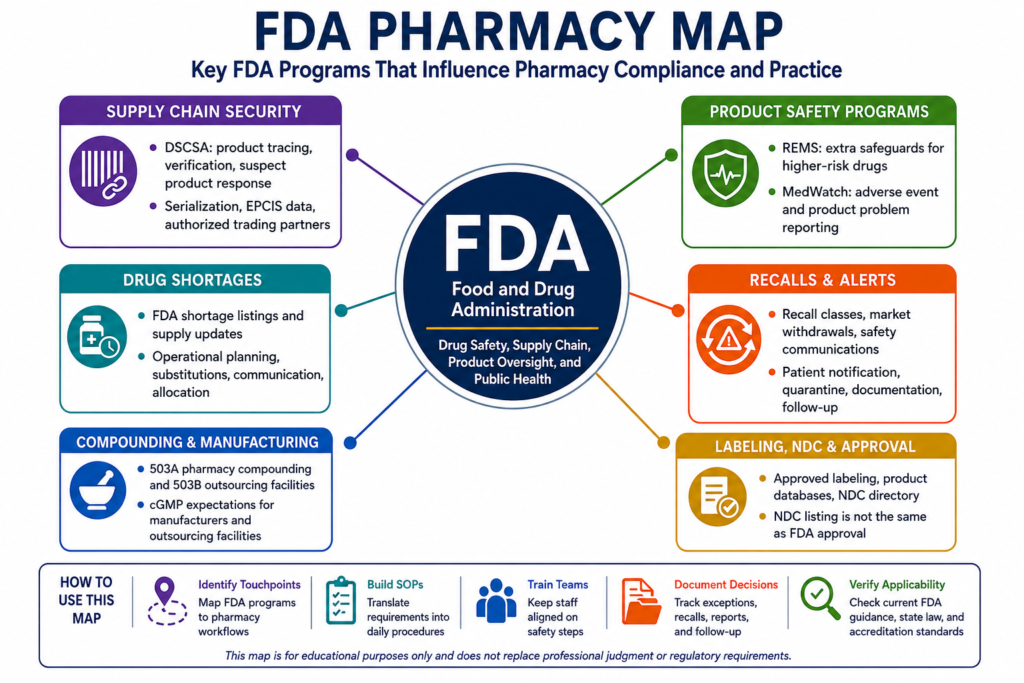
This article introduces FDA as part of Pestle’s Pharmacy Compliance Alphabet Soup Series. It provides a high-level map of the FDA laws, regulations, guidance documents, databases, safety programs, and supply-chain requirements that can affect pharmacy operations. It is not legal or regulatory advice, and individual requirements may depend on the product, activity, practice setting, state law, accreditation program, and contractual obligations involved.
What Is FDA?
FDA stands for the U.S. Food and Drug Administration, an agency within the Department of Health and Human Services. FDA’s public-health mission includes helping ensure the safety, effectiveness, and security of human and veterinary drugs, biological products, and medical devices. The agency also has responsibilities involving food, cosmetics, tobacco products, and products that emit radiation.
Within the pharmacy world, FDA’s work is most visible through oversight of human drugs, biologics, certain medical devices, drug manufacturing and quality, product labeling, postmarket safety, the pharmaceutical supply chain, drug shortages, recalls, and human drug compounding under federal law. The Center for Drug Evaluation and Research, commonly called CDER, is central to many drug-related activities. Other FDA centers may also matter, including the Center for Biologics Evaluation and Research and the Center for Devices and Radiological Health.
FDA generally does not license pharmacists, issue pharmacy permits, or establish the routine scope of pharmacy practice. Those functions usually arise under state law and state boards of pharmacy. However, a pharmacy may still have direct responsibilities under federal law or participate in FDA-regulated programs. That is why FDA belongs in a pharmacy compliance map even when the state board remains the pharmacy’s most visible licensing authority.
FDA Laws, Regulations, Guidance, and Programs Are Not the Same Thing
One reason FDA pharmacy compliance can feel confusing is that teams may use “FDA requirement” as a blanket term. In reality, pharmacy leaders should distinguish among several kinds of authority and information.
Federal statutes
Congress enacts statutes. The Federal Food, Drug, and Cosmetic Act is the foundational federal law for many FDA responsibilities. Later laws and amendments have added important pharmacy-facing programs. The Drug Quality and Security Act, for example, contains provisions related to human drug compounding and the Drug Supply Chain Security Act.
Federal regulations
FDA issues regulations under authority granted by statute. Many FDA regulations appear in Title 21 of the Code of Federal Regulations. Regulations carry a different legal status from an agency webpage, educational handout, or nonbinding guidance document.
FDA guidance documents
FDA guidance documents describe the agency’s current thinking on a topic. FDA explains that guidance documents generally do not establish legally enforceable responsibilities and that an alternative approach may be used when it satisfies applicable statutory and regulatory requirements. That distinction should appear in pharmacy policies and educational materials. A team should not label every FDA recommendation as a regulation, but it should not ignore guidance that explains how FDA interprets or intends to administer a federal requirement.
Programs, databases, alerts, and enforcement communications
FDA also administers programs and publishes operational resources such as REMS@FDA, Drugs@FDA, the National Drug Code Directory, the Drug Shortage Database, recall notices, MedWatch safety alerts, inspection information, and warning letters. These resources may not all have the same legal effect, but they can still trigger pharmacy action, vendor review, patient communication, or policy updates.
How FDA Pharmacy Regulations and Programs Affect Daily Operations
The FDA topics most likely to reach a pharmacy are not confined to one department. They cross purchasing, receiving, inventory management, medication safety, compounding, clinical services, informatics, quality, and compliance.
Drug approval, labeling, and product information
FDA reviews drug applications and maintains resources that help users identify approved products and current labeling. Pharmacy teams may use Drugs@FDA and the Orange Book when researching approval status, labeling, therapeutic equivalence, or product history. These tools support better questions, but each database has a specific purpose and should not be treated as interchangeable.
The National Drug Code Directory is a useful example. An NDC identifies a listed drug product, but FDA explicitly states that assignment of an NDC or inclusion in the directory does not mean the product is FDA approved. The directory includes approved and unapproved products, as well as repackaged, relabeled, and certain compounded products. Pharmacy purchasing and formulary teams should therefore avoid using “has an NDC” as a substitute for approval verification or supplier qualification.
See our article on NDC and Labeling to learn more.
DSCSA and prescription-drug supply-chain security
The Drug Supply Chain Security Act, or DSCSA, establishes requirements intended to help prevent, detect, and respond to harmful prescription drugs in the U.S. supply chain. FDA refers to pharmacies as “dispensers” under DSCSA. Depending on the transaction and product, pharmacy responsibilities can include working only with authorized trading partners, receiving and maintaining product-tracing documentation, investigating suspect products, quarantining affected inventory, and notifying FDA and trading partners when an illegitimate product is identified.
For operations teams, DSCSA is not only an IT project. It affects wholesaler onboarding, receiving, barcode and master-data quality, exception management, record retrieval, product quarantine, returns, and downtime planning. Electronic serialized tracing also creates important connections to GS1 identifiers, two-dimensional DataMatrix barcodes, Global Trade Item Numbers, Global Location Numbers, and Electronic Product Code Information Services, or EPCIS.
DSCSA requirements and current exemptions are time sensitive. As of this publication, FDA states that qualifying small dispensers have exemptions from certain enhanced drug-distribution-security requirements through November 27, 2027. Before making implementation decisions, pharmacies should verify current FDA information and determine whether an exemption actually applies to their organization.
See our article on DSCSA to learn more.
REMS and medication-specific safe-use requirements
REMS stands for Risk Evaluation and Mitigation Strategy. FDA may require a REMS for certain medications with serious safety concerns when additional measures are needed to help ensure the medication’s benefits outweigh its risks. Each REMS is tailored to a specific medication or group of medications, so pharmacy teams should not assume all programs work the same way.
Depending on the program, a pharmacy or healthcare setting may need to become certified, train staff, verify that a prescriber or patient is enrolled, confirm laboratory testing or another safe-use condition, provide required materials, obtain authorization before dispensing, or maintain specific documentation. These operational steps can involve pharmacists, technicians, prescribers, nurses, laboratory teams, specialty hubs, and information systems.
REMS should also be distinguished from payer prior authorization, limited-distribution arrangements, manufacturer contracts, and internal clinical policies. Those requirements can occur in the same workflow, but they do not have the same source or purpose.
See our article on REMS to learn more.
Drug recalls, market withdrawals, and safety alerts
FDA recall information can trigger one of the most urgent workflows in pharmacy operations. FDA classifies recalls as Class I, II, or III based on the health-risk framework described by the agency. A market withdrawal is different from a recall, and a medical-device safety alert may create another response pathway.
For pharmacies, receiving a recall notice is only the beginning. A closed-loop recall process may need to identify affected NDCs or GTINs, lot numbers, expiration dates, serial numbers, locations, automated dispensing cabinets, kits, repackaged products, compounded preparations, and patients who received the product. The pharmacy may then need to quarantine inventory, block further use, retrieve distributed stock, communicate with clinicians and patients, arrange returns or disposition, reconcile quantities, document effectiveness checks, and approve closure.
Practice setting matters. A retail pharmacy may focus on dispensing history and patient outreach. A hospital may need to search central inventory, satellites, procedural areas, automated dispensing cabinets, crash carts, and patient administrations. An LTC pharmacy may also need facility coordination, resident identification, prescriber notification, and documentation of safe disposition.
MedWatch and postmarket safety reporting
FDA continues monitoring medical products after they reach the market. MedWatch is the agency’s safety information and adverse-event reporting program for many FDA-regulated medical products. Healthcare professionals can voluntarily report serious adverse events, product quality problems, and product-use errors using FDA Form 3500 or the online reporting pathway.
Not every event uses the same reporting route. For example, vaccine events generally use the Vaccine Adverse Event Reporting System, while certain medical-device reports may involve mandatory user-facility reporting. Pharmacy policy should therefore define how staff identify a possible safety signal, who evaluates it, which external pathway applies, what internal patient-safety or risk-management reporting is required, and how the organization documents follow-up.
Drug shortages and availability information
FDA maintains a Drug Shortage Database and works with manufacturers to prevent or reduce the impact of supply disruptions. Manufacturing quality problems, production delays, discontinuations, demand changes, and recalls can all contribute to shortages.
For pharmacy leaders, FDA shortage information is an input to a larger governance process. Teams may need to validate the scope of the shortage, assess inventory and utilization, allocate supply, identify alternatives, coordinate therapeutic interchange, evaluate conservation strategies, communicate with prescribers and frontline staff, monitor extended-use-date information, and document decisions. In some settings, shortages may also affect sterile compounding, outsourcing-facility purchasing, and medication-safety risk.
Human drug compounding: Sections 503A and 503B
FDA’s role in pharmacy compounding is one of the most important, and most easily oversimplified, parts of the alphabet soup. Section 503A of the Federal Food, Drug, and Cosmetic Act describes conditions under which qualifying compounded drugs may receive exemptions from certain federal requirements. Section 503B establishes the outsourcing-facility category. State-licensed pharmacies and federally registered outsourcing facilities do not operate under identical frameworks.
For pharmacy leaders, the 503A-versus-503B distinction can affect patient-specific compounding, office stock, bulk drug substances, products that are essentially copies, interstate distribution, adverse-event reporting, current good manufacturing practice expectations, supplier qualification, inspection history, quality agreements, and recall readiness. State board requirements and USP standards may also apply, but they should not be presented as if they are interchangeable with FDA law or policy.
A hospital purchasing from a 503B outsourcing facility should look beyond registration status alone. A mature supplier review may consider FDA inspection and enforcement history, product reporting, quality systems, certificates of analysis, shipping and storage controls, complaint handling, recall performance, and the specific responsibilities allocated in the quality agreement.
Current good manufacturing practice and product quality
Current good manufacturing practice, commonly shortened to CGMP or cGMP, refers to FDA requirements governing how certain drug products are manufactured, processed, packed, or held. CGMP is especially important when pharmacies evaluate manufacturers and 503B outsourcing facilities. It is not simply another name for USP compliance, and ordinary pharmacy compounding under section 503A should not be described as operating under the same federal manufacturing framework as a registered outsourcing facility.
Even when a pharmacy is not the manufacturer, CGMP-related quality failures can reach the pharmacy through recalls, shortages, import alerts, supplier changes, product complaints, or availability disruptions. This makes FDA quality information relevant to procurement, medication safety, and business continuity.
Biologics, medical devices, medical gases, and combination products
Pharmacies may also handle FDA-regulated products outside the familiar prescription-tablet supply chain. Vaccines and other biologics, infusion pumps and administration sets, blood glucose monitors, certain diagnostic tests, medical gases, combination products, and durable medical equipment may create different labeling, storage, tracing, complaint, recall, and reporting considerations.
The correct workflow depends on the product category. Drug, biologic, and device requirements should not be collapsed into a single generic “FDA policy.” Pharmacy leaders should know which products their organization handles, which FDA center or database is relevant, and which internal owner manages complaints, maintenance, recalls, and external reporting.
FDA, USP, State Boards, and Accreditors: One Workflow, Multiple Authorities
FDA pharmacy regulations rarely operate in isolation. A single event can activate several parts of the compliance system.
Consider a sterility-related recall involving a compounded sterile preparation purchased from an outsourcing facility. FDA information may drive the recall and provide insight into the facility’s federal status. USP standards may influence the pharmacy’s storage, handling, compounding, and quality procedures. State board rules may govern pharmacy practice, reporting, and patient notification. An accreditor may expect evidence of recall control, adverse-event management, and corrective action. A health system may also route the event through medication safety, risk management, infection prevention, purchasing, and quality committees.
The goal is not to decide that one authority “wins.” The goal is to map each applicable source to the operational action it controls. Pharmacy policies should identify the requirement, owner, workflow, evidence, escalation path, and review date.
A Practical FDA Compliance Framework for Pharmacy Leaders
A pharmacy does not need to reproduce FDA’s entire organizational chart. It needs an operational map that shows where FDA intersects with the organization.
- Products: Which drugs, biologics, devices, medical gases, compounded preparations, and combination products do we purchase, prepare, dispense, administer, or distribute?
- Programs: Which DSCSA, REMS, recall, shortage, reporting, or compounding requirements apply?
- Owners: Who is accountable for purchasing, receiving, inventory, medication safety, compounding, informatics, quality, and regulatory monitoring?
- Evidence: Which licenses, tracing records, certifications, transaction data, recall logs, reports, training records, supplier files, and CAPAs must be retrievable?
- Exceptions: What happens when product and electronic data do not match, a REMS authorization fails, a recall affects a patient, or a supplier has a quality event?
- Escalation: Which issues require notification to FDA, a state board, an accreditor, a manufacturer, a trading partner, a prescriber, or a patient?
- Change control: How does the pharmacy monitor new rules, guidance updates, safety communications, REMS changes, recalls, and shortage information?
This framework turns “FDA compliance” from a vague regulatory label into a manageable set of owners, workflows, and evidence.
How Pestle Can Help
Pestle Compliance can help pharmacy teams organize FDA-related obligations into repeatable operational workflows. Teams can assign owners, schedule reviews, centralize policies and evidence, document completion, track issues, and maintain visibility across locations or departments. That can support work such as authorized-trading-partner reviews, REMS program oversight, mock recalls, supplier qualification, policy attestations, and corrective-action follow-up.
Pestle Formulas can help standardize compounding workflows, master formulation records, preparation records, ingredient verification, and related documentation. Those capabilities can support consistent pharmacy operations while teams separately evaluate the FDA, USP, state, accreditation, and internal requirements applicable to their practice.
Pestle Intelligence can help authorized users search approved internal policies, procedures, and knowledge resources more efficiently. It does not replace pharmacist judgment, legal advice, FDA source review, or qualified regulatory interpretation.
Conclusion
FDA’s impact on pharmacies extends far beyond drug approval. FDA pharmacy regulations and programs can shape supply-chain security, product identification, REMS workflows, recalls, safety reporting, shortage response, compounding boundaries, outsourcing-facility oversight, product quality, biologics, and medical devices.
The key is to identify the type of authority involved. A federal statute, FDA regulation, nonbinding guidance document, safety alert, database entry, accreditation standard, state rule, and internal policy are not the same thing. They may still converge on the same pharmacy workflow, but teams should understand what each source requires and how it affects operations.
For pharmacy leaders, the goal is not to memorize every FDA acronym. It is to build a reliable FDA compliance map: which programs apply, who owns them, what evidence is required, how exceptions escalate, and when the source must be refreshed.
As Pestle’s Pharmacy Compliance Alphabet Soup Series continues, this article will serve as the FDA hub connecting future guides on DSCSA, GS1 barcodes and EPCIS, REMS, recalls, MedWatch, drug shortages, and 503A-versus-503B compounding oversight.
Want a clearer way to organize pharmacy compliance responsibilities, recurring reviews, and supporting evidence? Explore Pestle Compliance or contact the Pestle team to learn how standardized workflows can support your pharmacy’s quality and inspection-readiness program.
Helpful Links:
FDA Related Laws, Regulations, and Guidances
FDA DSCSA information for pharmacists
FDA Recalls Background and Definitions