
Table of Contents
USP <1116> Environmental Monitoring: A Practical Guide for Sterile Compounding
Environmental monitoring is easy to reduce to a calendar: viable air sampling every six months, surface sampling every month, certification twice a year. But a calendar alone does not show whether a sterile compounding environment remains in a state of microbial control. USP <1116> environmental monitoring provides the scientific context that helps teams interpret their sampling program as an integrated system rather than a collection of isolated plates and reports.
For pharmacies, USP <797> remains the controlling compounding chapter for required microbiological air and surface monitoring when it is applicable through law, regulation, accreditation, organizational policy, or another authority. USP <1116>, Microbiological Control and Monitoring of Aseptic Processing Environments, is an informational general chapter. It does not replace <797>, lower <797>’s minimum frequencies, or convert its informational recovery-rate values into alternate pharmacy action levels.
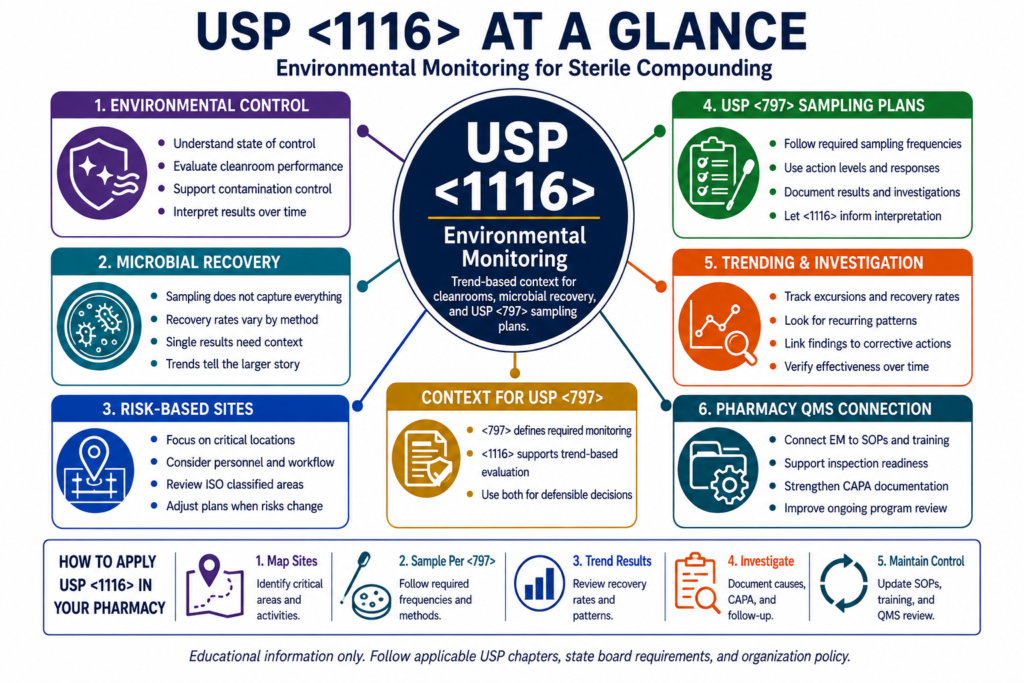
Its value is different. USP <1116> helps pharmacy leaders understand why sampling locations should be risk based, why results must be trended over time, why a zero result does not prove sterility, why organism identity and location matter, and why sampling technique can itself introduce contamination or variability. Used together, the two chapters support a more defensible USP <797> sampling plan and a stronger quality management system.
What Is USP <1116>?
USP <1116> is a general information chapter focused on microbiological control and monitoring of aseptic processing environments. Its scope includes cleanrooms, restricted-access barrier systems, and isolators used for aseptic processing. The chapter explains the relationship among facility design, personnel practices, cleaning and disinfection, sampling methods, culture conditions, risk assessment, data interpretation, investigations, and continuous improvement.
Because <1116> is numbered above <1000>, it is generally informational rather than a standalone compendial requirement. That does not make it irrelevant to pharmacy. USP <797> expressly points readers to <1116> in its surface-sampling provisions, and USP’s <797> FAQs explain that the incubation conditions for environmental air and surface samples are consistent with <1116>. A pharmacy should therefore use <1116> as supporting scientific guidance while preserving the explicit requirements in the current official version of <797> and any stricter state, federal, accreditation, or organizational expectations.
Five Ideas From USP <1116> That Strengthen Environmental Monitoring
1. Monitoring supports a state-of-control assessment; it does not prove sterility
A microbiological sample examines a limited location, area, volume, and moment in time. A plate with no growth means that the method did not recover growth under those sampling and incubation conditions. It does not establish that the room, PEC, surface, or CSP was sterile. This distinction helps prevent a false sense of security when a program reports many zeros.
2. Sampling locations should reflect contamination risk
The most useful locations are not simply evenly spaced dots on a cleanroom drawing. They are locations selected because personnel, materials, airflow, interventions, equipment, pass-through activity, or proximity to exposed sterile materials may create risk. USP <1116> emphasizes prospective risk analysis, while <797> requires the pharmacy’s SOPs to include a sampling-location diagram and directs sampling toward locations that pose the highest possible risk and represent actual compounding conditions.
3. Results must be interpreted over time
USP <1116> emphasizes contamination recovery rate, sometimes described as detection frequency: the percentage of samples with any recovered contamination, regardless of colony count. This does not replace the cfu action levels in <797>. It adds another lens. A location may remain below an action level but show a rising rate of positive samples, a recurring organism, or a shift-specific pattern that deserves review.
4. Microbiological methods have meaningful variability
Air and surface sampling methods are not perfectly efficient or interchangeable. Equipment design, sampling volume, airflow disruption, media, contact pressure, surface type, organism stress, analyst technique, transport, and incubation can affect recovery. A pharmacy should avoid interpreting a single low-count result with false precision. The location, organism, surrounding results, process conditions, and historical pattern all matter.
5. Sampling personnel and technique are part of the control system
Environmental monitoring requires intervention in a controlled environment. Poor technique can contaminate the environment, the sample, or both. USP <1116> calls for formal training of monitoring personnel. Under <797>, personnel must also be trained and competent in air- and surface-sampling procedures, and impaction air samplers must be serviced and calibrated according to manufacturer recommendations.
How USP <1116> Connects to the USP <797> Sampling Plan
USP <797> requires a written microbiological air and surface monitoring program. The program includes viable impact volumetric airborne sampling and surface sampling. It must be designed to detect unacceptable contamination, evaluate environmental quality, identify trends and routes of contamination, assess cleaning and disinfection, and support corrective action.
The pharmacy’s SOPs must clearly describe the program. At minimum, the sampling plan should include:
- A diagram showing each sampling location and a stable location identifier.
- Procedures for collecting, labeling, transporting, incubating, reading, and documenting samples.
- The frequency for each sample type and location.
- Sample size, including surface area or air volume as applicable.
- The time of sampling in relation to compounding activities, cleaning, and the work shift.
- Applicable action levels and the response that each threshold triggers.
- Methods for trending, investigation, corrective action, resampling when appropriate, and effectiveness review.
USP <797> minimum monitoring framework
The table below summarizes the sampling framework described in USP <797>. This is an editorial aid, at the time of righting this article and not a substitute for the current official chapter or local requirements.
| Monitoring activity | Category 1 and 2 CSPs | Category 3 CSPs | Important conditions |
| Viable air sampling | At least every 6 months | Within 30 days before beginning Category 3 compounding and at least monthly thereafter | All classified areas; dynamic operating conditions; impaction sampler; at least 1 m3 or 1000 L at each sampled location |
| Surface sampling | All classified areas and pass-through chambers at least monthly | Before assigning the longer Category 3 BUDs and at least weekly thereafter | Risk-based sites; generally at the end of compounding activity or shift and before cleaning and disinfection |
| Category 3 PEC surfaces | Not applicable as a Category 3 requirement | At the end of each batch before cleaning and disinfection; a qualifying self-enclosed robotic device may follow the chapter’s daily provision | Follow the exact chapter language and device-specific applicability |
| Additional monitoring | When specified triggers occur | When specified triggers occur | After relevant facility or equipment service; in response to identified problems or trends; and after changes that could affect the sterile compounding environment |
Sampling frequency is only the floor. USP <1116> adds a practical question: does the plan collect enough representative information to detect a meaningful change without creating unnecessary interventions? A sound program begins with <797>’s required minimums, then uses documented risk assessment and accumulated facility data to decide whether additional locations or sampling events are warranted. It should never use <1116> to reduce a frequency that <797> explicitly requires.
Dynamic Conditions and Timing Matter
A cleanroom can look different microbiologically when empty than when personnel are compounding, materials are moving, doors are opening, and interventions are occurring. USP <797> therefore requires microbiological air and surface monitoring in classified areas during dynamic operating conditions. Viable air sampling must reflect actual operations. Surface sampling is generally performed at the end of a compounding activity or shift, before cleaning and disinfection, so the sample can reflect the residue of real work.
Timing also supports one of <1116>’s central points: environmental data are most meaningful when they are process related. A sample record should capture enough context to interpret the result, including date and time, room and location ID, ISO classification, sample type, sampling personnel, active work, number of people present, unusual interventions, cleaning status, media lot, sampler ID, and relevant maintenance or facility conditions.
Incubation, Media, and Recovery
USP <797> specifies the incubation sequence for environmental air and surface samples: 30 degrees to 35 degrees Celsius for no less than 48 hours, followed by 20 degrees to 25 degrees Celsius for no less than five additional days. Its FAQs explain that using the higher temperature first supports recovery of bacteria, including human-associated Gram-positive cocci, and that the conditions are consistent with <1116>. The chapter also permits a concurrent two-device approach when its stated conditions are met.
Media selection and handling are not administrative details. General growth media must support bacteria and fungi, supplier documentation must support expected media performance, and surface media must include suitable neutralizers for residual disinfectants. Incubator temperature must be monitored and documented. When samples are sent to an outside laboratory, transport time and protection from damaging temperature or humidity extremes should be addressed in the SOP and vendor agreement.
Action Levels and Trends: Use Both Without Confusing Them
USP <797> establishes action levels for viable air and surface sampling. If a result exceeds the applicable level, the pharmacy must investigate the cause, take corrective action, document the plan, and review follow-up data to confirm effectiveness. The corrective action should be proportionate to the colony count and the microorganism recovered, and an attempt must be made to identify recovered microorganisms to the genus level when an action level is exceeded.
USP <1116> discusses suggested contamination recovery rates and the limits of treating small cfu differences as analytically precise. Those concepts are useful for trend analysis, but they do not cancel a pharmacy’s obligation to respond to a <797> action-level excursion. The cleanest operating rule is:
- Apply <797>’s action levels and required response whenever they are reached or exceeded as defined by the chapter.
- Trend all results, including values below action levels and samples with zero recovery.
- Use <1116>’s recovery-rate and variability concepts to interpret longer-term patterns, not to waive a required investigation.
- Escalate based on the full context: location, organism, recurrence, concurrent results, personnel and process conditions, and potential impact on CSPs.
A Practical Trending Model for Pharmacy Teams
A monthly dashboard can convert raw plate counts into a view of environmental control. The goal is not to manufacture statistical certainty from sparse data. It is to make changes visible early enough for thoughtful review.
| Trend view | What to calculate or group | What it may reveal |
| Contamination recovery rate | Positive samples divided by total samples, by room, ISO class, sample type, and location | A rising rate of recovery even when individual counts remain below action levels |
| Location recurrence | Repeated positives at the same PEC, pass-through, staging area, high-touch surface, or room site | A local cleaning, airflow, material-flow, or intervention issue |
| Organism pattern | Organism or genus by location, shift, month, and event | Recurring human flora, environmental organisms, mold, or a potential persistent source |
| Operational context | Results by shift, activity, sampler, sampling personnel, occupancy, maintenance, and cleaning status | Technique variation or a process condition associated with recovery |
| CAPA effectiveness | Pre-event baseline, excursion, corrective action, resample, and subsequent trend | Whether corrective action produced and sustained the intended improvement |
For low-frequency events, avoid overreacting to one percentage. Show both the numerator and denominator, retain the underlying records, and review rolling periods long enough to make the data interpretable. A 50% recovery rate based on one positive result in two samples means something very different from the same rate across 100 samples.
What Should Happen After an Adverse Result?
A predefined response pathway helps the pharmacy move from detection to a documented quality decision. The exact steps must follow the facility’s SOPs and applicable requirements, but a mature workflow generally includes:
- Record and verify the result, including sample identity, count, location, media, incubation record, reader, and any data-quality concerns.
- Assess immediate risk and determine whether compounding, cleaning, access, or use of an affected space or PEC should be limited while the event is evaluated.
- Attempt organism identification when required by <797>, and use qualified microbiology support to interpret objectionable or unusual organisms.
- Investigate people, process, equipment, environment, materials, cleaning, sampling technique, recent maintenance, and concurrent monitoring data.
- Evaluate potentially affected CSPs according to the facility’s quality system, policies, and professional judgment. Environmental monitoring alone should not be treated as a direct sterility test for a CSP.
- Implement corrective action proportionate to the finding, such as cleaning and disinfection, retraining, process revision, facility repair, HEPA service, or sampling-method correction.
- Collect and review follow-up data to confirm that the corrective action was effective, then continue trending for recurrence.
A USP <1116>-Informed Sampling Plan Checklist
- Confirm and review the current official versions of <797> and other applicable chapters, plus state and accreditation requirements.
- Assign a designated owner for the monitoring program, result review, escalation, and trend reporting.
- Maintain a controlled sampling map with unique site IDs and a documented risk rationale.
- Define minimum and event-triggered frequencies for viable air and surface sampling.
- Specify dynamic conditions, timing relative to compounding and cleaning, sample volumes or areas, media, incubation, and transport.
- Train and periodically evaluate sampling personnel; maintain sampler calibration and service records.
- Apply <797> action levels exactly and define the investigation, identification, corrective-action, and effectiveness-review workflow.
- Trend positives, zeros, cfu counts, organisms, locations, shifts, samplers, personnel, operational events, and CAPA outcomes.
- Review the program after facility changes, equipment service, adverse sterility information, recurring personnel failures, or other signals of risk.
- Document why locations and frequencies remain appropriate as the facility, workflow, and evidence change.
How Pestle Can Help
Environmental monitoring programs often become fragmented across a certifier’s report, laboratory portal, cleanroom map, spreadsheet, competency binder, maintenance ticket, and corrective-action email. Pestle Compliance can help pharmacy teams organize recurring tasks, maintain searchable documentation, assign ownership, standardize review workflows, and make supporting records easier to retrieve during internal reviews or inspections.
A pharmacy may use Pestle to support scheduled sampling and certification tasks, attach laboratory or certifier documentation, record review and follow-up, connect deviations to corrective actions, monitor completion across locations, and preserve training and competency evidence. The pharmacy still determines its sampling design, acceptance criteria, clinical and quality decisions, required approvals, and regulatory interpretation. Pestle does not replace a qualified microbiologist, certifier, laboratory, designated person, professional judgment, or the current official USP text.
Conclusion
USP <1116> environmental monitoring is most useful when it changes the question from ‘Did we collect the required sample?’ to ‘What does our full body of evidence say about microbial control?’ For sterile compounding pharmacies, <797> provides the mandatory or adopted operating framework. <1116> adds the scientific perspective needed to design risk-based locations, understand sampling limitations, interpret recovery patterns, investigate intelligently, and improve the program over time.
Pharmacy leaders should start with the current <797> requirements, build a controlled and facility-specific sampling plan, and then use <1116> to strengthen trend review and decision-making. If your monitoring records, sampling map, competencies, investigations, and corrective actions are spread across disconnected systems, Pestle can help bring the documentation and follow-up workflow into one organized compliance program.
Helpful Links:
USP Chapters Explained: Beyond USP <795>, <797>, and <800>
USP <1163>: A Practical Guide to Compounding Quality Assurance
Pharmacy Compliance Documentation in One Place
External Links
USP <1116> Microbiological Control and Monitoring of Aseptic Processing Environments
USP General Chapter <797> resource page
USP <1113> Microbial Characterization, Identification, and Strain Typing