
USP <1163>: Building a Practical Quality Assurance Program for Pharmaceutical Compounding
Table of Contents
A pharmacy can have carefully written compounding procedures and still struggle to prove that its quality system works. Training records may live in one folder, cleaning logs in another, testing results with an outside laboratory, and corrective actions in email. When those pieces are disconnected, leaders may know that work is being done but have difficulty demonstrating control, identifying trends, or confirming that a problem was fully resolved.
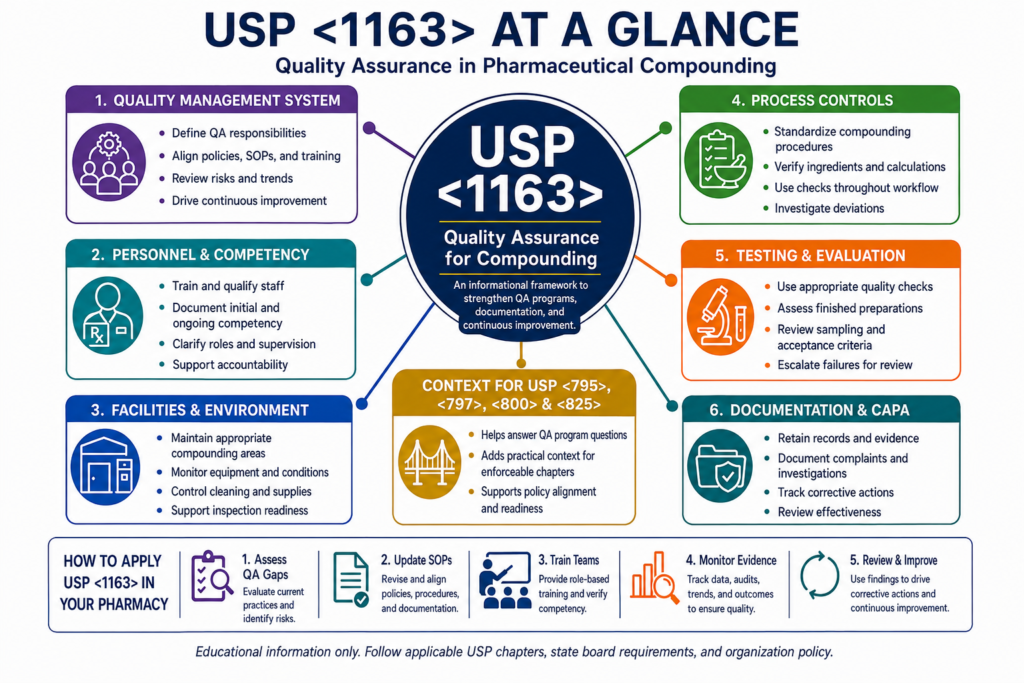
USP <1163>, Quality Assurance in Pharmaceutical Compounding, helps connect those pieces. Although USP <1163> is an informational general chapter rather than a standalone enforceable chapter, it provides a practical framework for designing a compounding pharmacy quality assurance program. It adds operational context to requirements found in USP <795> for nonsterile compounding and USP <797> for sterile compounding, and its principles can also strengthen programs involving hazardous drugs under USP <800> and radiopharmaceuticals under USP <825>.
For pharmacy directors, designated persons, quality managers, and compounding leaders, the chapter is useful because it asks a larger question than “Did we complete the required task?” It asks whether the organization has an integrated system that defines responsibility, standardizes work, creates reliable evidence, verifies performance, investigates deviations, and improves over time.
| Quick answer: What is USP <1163>? USP <1163> is an informational USP general chapter that describes a quality assurance framework for pharmaceutical compounding. Its nine integrated components are training, SOPs, documentation, verification, testing, cleaning/disinfecting/safety, containers and storage, outsourcing, and responsible personnel. |
Why USP <1163> matters even though it is informational
USP general chapters numbered 1000 through 1999 are informational. By contrast, chapters numbered below 1000 can become compendially applicable when referenced in a monograph, another applicable chapter below 1000, or the General Notices. State boards of pharmacy, accreditation organizations, federal requirements, and organizational policy can also affect what a particular pharmacy must follow.
That distinction should not be read as “optional means unimportant.” USP <1163> can function as the connective tissue of a compounding quality management system. Chapters such as <795> and <797> establish requirements for defined compounding activities. USP <1163> helps leaders think through how those activities should be governed, evidenced, reviewed, and improved as one system.
For example, <795> or <797> may tell a pharmacy that personnel must be trained and demonstrate competency. USP <1163> prompts the next operational questions: Who owns the training program? Where is completion documented? How is competency distinguished from attendance? What happens when performance is unacceptable? How does the pharmacy show retraining and follow-up?
The chapter does not override or replace <795>, <797>, <800>, or <825>. It should instead be used as an interpretive and program-design resource alongside the current official text, applicable state law, accreditation standards, and the pharmacy’s own risk assessment.
The nine integrated components of USP <1163>
USP identifies nine separate but integrated components of a compounding quality assurance program. The word integrated is important: a training record without an approved SOP, a test result without predefined acceptance criteria, or a deviation without documented corrective action does not demonstrate a complete quality loop.
1. Training and competency
Compounding requires role-specific education, hands-on training, competency evaluation, and periodic retraining beyond routine dispensing responsibilities. A defensible program identifies which activities each role is authorized to perform and retains evidence that the individual can perform them correctly.
In practice, this may include onboarding curricula, observed technique assessments, written knowledge checks, media-fill and gloved fingertip requirements where applicable, cleaning competencies, equipment training, due dates, remediation plans, and approval by qualified personnel. The governing requirements and frequencies must come from the applicable chapter and setting; <1163> helps organize them into a coherent program.
2. Standard operating procedures
SOPs translate requirements and professional standards into repeatable work. USP <1163> describes broad subject areas that a compounding SOP library may need to address, including formulation development, calculations, measuring and weighing, component evaluation, compounding methods, equipment, environmental quality, cleaning, garbing, labeling, packaging, storage, shipping, testing, training, patient education, complaints, and adverse events.
A useful SOP explains who performs the task, when and how it is performed, why it matters, what limitations apply, what evidence must be created, and what action is required when a result is unacceptable. SOPs should be reviewed on a defined cadence and updated when regulations, equipment, formulations, facilities, or workflows change.
3. Documentation
Documentation is the evidence layer of the QA program. Records should be accurate, complete, attributable, and created as close as practical to the activity being performed. Depending on the operation, evidence may include master formulation records, compounding records, calculations, ingredient and lot information, equipment logs, environmental data, testing results, cleaning records, deviations, investigations, and approvals.
USP <1163> also reinforces the need to document the basis for beyond-use dating and, where relevant, sterility or stability support. Pharmacy leaders should be able to connect the assigned BUD to the applicable USP pathway, authoritative source, study, or appropriately documented professional judgment. The documentation should show not only the conclusion but also the source and approval.
4. Verification
Verification is more than a signature. It is documented assurance that a procedure, calculation, ingredient, process, or piece of equipment is functioning as intended and producing the expected result. Examples include checking calculations and measurements, confirming the order of mixing, reviewing component quality information, verifying calibration or qualification status, and documenting an independent check where required.
If a contractor calibrates or services equipment, the pharmacy still owns the responsibility for reviewing the work and deciding whether the equipment is acceptable for use. A certificate filed without review, acceptance, or linkage to the equipment record is weaker evidence than a closed verification workflow.
5. Testing
USP <1163> gives substantial attention to testing because testing decisions must be purposeful. A pharmacy should define what attribute is being evaluated, when testing is indicated, which method is appropriate, what acceptance criteria apply, how results will be interpreted, and what happens when a preparation does not meet specifications.
Not every compounded preparation is tested using every possible method. The testing strategy should reflect the dosage form, preparation risk, applicable USP requirements, formulation history, process capability, batch size, BUD strategy, and intended use. Visual inspection remains foundational, while physical, chemical, or microbiological testing may be required or appropriate depending on the circumstances.
6. Cleaning, disinfecting, and safety
The QA program must address the condition of facilities and equipment, the procedures used to clean or disinfect them, personnel safety, and the records that demonstrate the work occurred. Applicable expectations differ among nonsterile, sterile, hazardous-drug, and radiopharmaceutical operations.
A mature program connects cleaning procedures to trained roles, approved agents, concentrations and contact times, defined frequencies, field-level completion records, exception handling, and periodic review. Under a broader hazardous-drug program, this same systems approach can help coordinate deactivation, decontamination, cleaning, disinfection when applicable, spill response, exposure control, and PPE practices.
7. Containers, packaging, repackaging, labeling, and storage
Quality does not end when compounding is complete. The preparation must remain suitable through packaging, labeling, storage, transport, dispensing, and use. USP <1163> points users to related chapters covering packaging materials, labeling, dosage forms, repackaging, and storage, including USP <659> and USP <1079>.
Operationally, the pharmacy should define container-closure selection, label review, storage conditions, excursion response, transport controls, and any special light, temperature, humidity, or handling requirements. These controls should be traceable to the preparation record and communicated to staff, couriers, receiving departments, patients, or caregivers as appropriate.
8. Outsourcing
When a pharmacy purchases compounded preparations or repackaged products from another pharmacy or facility, it does not outsource accountability. The receiving pharmacy should maintain appropriate documentation for the preparation, including the basis for assigned BUDs and evidence needed to support its supplier-qualification and receiving decisions.
The chapter’s outsourcing discussion is distinct from outsourcing analytical testing, but the same governance principle applies: define requirements, assess qualifications, establish responsibilities, retain records, review results, and address performance problems. Contracts and certificates do not replace ongoing oversight.
9. Responsible personnel
The QA program needs clearly assigned authority. Responsible personnel should have the education, training, experience, and organizational support necessary to oversee documentation, verification, testing, investigations, and corrective action.
This is especially relevant in multi-site organizations. A corporate quality leader may define standards, while a designated person or pharmacy leader owns local execution. The program should specify who can approve policies, release work, investigate deviations, approve CAPA, accept testing results, grant exceptions, and verify effectiveness. Shared responsibility must not become undefined responsibility.
How USP <1163> helps answer operational questions from <795> and <797>
USP <795> and <797> establish the requirements that govern nonsterile and sterile compounding. USP <1163> can help a team convert those requirements into program-level questions and evidence.
| Operational question | QA evidence to consider |
| Training is required. What proves the person is competent? | A role-based curriculum, completed training records, observed assessments, documented results, authorization status, retraining triggers, and remediation follow-up. |
| Written procedures are required. How should the SOP program operate? | Defined owners, approval authority, version control, effective dates, review cadence, staff communication, retired versions, and audits of actual practice. |
| Records must be complete. How does QA review them? | Required fields, contemporaneous entry, second checks where applicable, exception routing, release criteria, record approval, and retention. |
| A deviation occurred. What closes the loop? | Immediate containment, impact assessment, investigation, root cause, corrective and preventive action, assigned ownership, due dates, and effectiveness review. |
| Testing is required or selected. How do we manage it? | Predefined acceptance criteria, sample identity and handling, method and laboratory qualification, result review, out-of-specification response, disposition, and trend analysis. |
| Equipment must perform correctly. What evidence is enough? | An equipment inventory, qualification or calibration status, maintenance history, service review, out-of-tolerance response, and linkage to affected preparations. |
Using <1163> across <795>, <797>, <800>, and <825>
A strong quality system should preserve the distinctions among compounding programs while using a consistent governance model. The procedures for a nonsterile preparation, a sterile compounded preparation, hazardous-drug handling, and a radiopharmaceutical are not interchangeable. However, each program benefits from the same management disciplines: accountable owners, controlled procedures, qualified personnel, reliable documentation, verification, deviation management, CAPA, and periodic review.
This creates an opportunity for health systems and multi-site organizations. Instead of maintaining four isolated compliance binders, leaders can establish an enterprise QA architecture and then configure chapter-specific workflows beneath it. A common deviation taxonomy, policy lifecycle, training framework, audit method, and leadership dashboard can improve consistency without erasing the technical requirements unique to each practice area.
A practical implementation roadmap for pharmacies
- Create a chapter and requirement crosswalk. Map applicable provisions from <795>, <797>, <800>, <825>, state rules, and accreditation standards to the nine <1163> QA components.
- Assign accountable owners. Identify who owns each policy, training program, record review, testing relationship, audit, investigation, and approval decision.
- Inventory the evidence. Locate SOPs, competencies, logs, testing reports, equipment records, vendor files, deviations, CAPAs, and leadership review records.
- Find disconnected workflows. Look for spreadsheets, paper forms, email approvals, or duplicate logs that prevent a complete audit trail.
- Define exceptions before they occur. Establish escalation criteria, product hold or disposition authority, investigation steps, notification pathways, and CAPA expectations.
- Audit execution, not just documents. Compare written procedures with observed practice and actual records.
- Trend the system. Review recurring deviations, late tasks, failed competencies, testing anomalies, equipment issues, environmental data, complaints, and overdue CAPAs.
- Perform effectiveness checks. Confirm that corrective action changed the process and reduced the likelihood of recurrence.
How Pestle Compliance can support USP <1163> implementation
Pestle Compliance is designed to help pharmacies turn recurring quality responsibilities into assigned, documented, and reviewable workflows. It does not determine a pharmacy’s legal obligations or replace USP interpretation, but it can help teams organize the evidence and accountability needed to operate a consistent QA program.
Centralize recurring QA work
Pharmacies can schedule recurring activities such as SOP reviews, competency renewals, equipment checks, cleaning tasks, audits, environmental reviews, and quality meetings. Assignments based on users, locations, equipment, or general pharmacy tasks can be directed to users or groups, helping leaders connect the requirement to the entity responsible for completing it.
Standardize documentation at the point of work
Configurable task fields can prompt users to capture required information consistently rather than relying on free-form email or memory. Signatures, dates, checkboxes, selections, and supporting documentation can help create a clearer record of who performed the work, what was observed, and when it occurred.
Support multi-site oversight without losing local accountability
Organization-level visibility can help health systems identify overdue work, compare implementation across pharmacies, and standardize common programs. Local pharmacy leaders can remain responsible for site-specific execution, exceptions, and evidence.
Connect policies, training, and execution
A QA program is stronger when staff can access the governing procedure, complete the assigned activity, and retain evidence within a coordinated system. Pestle can help organize standards and recurring compliance tasks so policy expectations are more directly connected to operational work.
Prepare for audits and continuous improvement
Searchable records and completion reporting can help teams prepare for inspections, internal audits, and leadership reviews. More importantly, consistent records make it easier to identify gaps, recurring late work, or process variation that should be investigated.
Learn more about Pestle Compliance or request a tour to discuss how your pharmacy can organize quality assurance workflows across compounding programs.
USP’s April 24, 2026 notice: revision of <1163> and development of <1163.1>
On April 24, 2026, USP published a Notice of Intent to Revise for General Chapter <1163>, Quality Assurance in Pharmaceutical Compounding. The notice signals USP’s intent to revise <1163> and develop an additional sub-chapter, <1163.1>.
This is a promising direction for pharmacy quality programs. Compounding practice has evolved, and pharmacies are managing increasingly detailed expectations across nonsterile compounding, sterile compounding, hazardous-drug handling, and radiopharmaceutical operations. A revised <1163> and an additional <1163.1> can provide more room to clarify how a complete QA program should be designed, how its components work together, and how quality systems can support the requirements in <795>, <797>, <800>, and <825>.
The greatest potential benefit is not another checklist. It is clearer connective guidance: how training links to authorization, how procedures link to records, how testing links to release or disposition, how deviations link to CAPA, how outsourced services remain under oversight, and how leadership reviews whether the program is effective.
The notice itself should not be treated as final chapter text or a new compliance deadline. USP’s standards-development process includes proposal, public review and comment, expert committee consideration, approval, and an official date. Pharmacies should monitor subsequent USP publications, review proposed text when available, assess operational impacts, and avoid changing policy based only on assumptions about what <1163.1> will contain.
Read the USP Notice of Intent to Revise <1163> and monitor USP–NF and Pharmacopeial Forum for the proposed revision and new chapter.
Conclusion: use USP <1163> as a quality-system blueprint
USP <1163> does not replace the enforceable or adopted requirements that apply to a pharmacy. Its value is that it helps leaders see the whole quality system around those requirements. Training, SOPs, documentation, verification, testing, safety, packaging and storage, outsourcing, and responsible personnel should operate as connected controls, not isolated compliance activities.
Pharmacies do not need to wait for the revision process to strengthen that foundation. Teams can map current requirements, assign ownership, standardize evidence, close deviation loops, and review performance now. At the same time, the planned revision of <1163> and development of <1163.1> should be welcomed as an opportunity for greater clarity and stronger alignment across USP <795>, <797>, <800>, and <825> quality assurance programs.
A well-designed QA program is more than a collection of completed forms. It is a repeatable system that helps qualified pharmacy professionals recognize risk, make informed decisions, document what occurred, and improve the process for the next preparation.