Pharmacy Compliance: More Than Just One Rulebook
Ask ten pharmacy leaders what “pharmacy compliance” means, and you’ll likely hear ten different answers.
Some immediately think of United States Pharmacopeia (USP) Chapters like <795> or <797>. Others think about Drug Enforcement Administration (DEA) inspections, controlled substances, Health Insurance Portability and Accountability Act (HIPAA), or Food and Drug Administration (FDA) regulations. Hospital leaders may think first about Centers for Medicare & Medicaid Services (CMS) Conditions of Participation or The Joint Commission (TJC) surveys. Specialty pharmacies often focus on accreditation standards, manufacturer requirements, and payer audits.
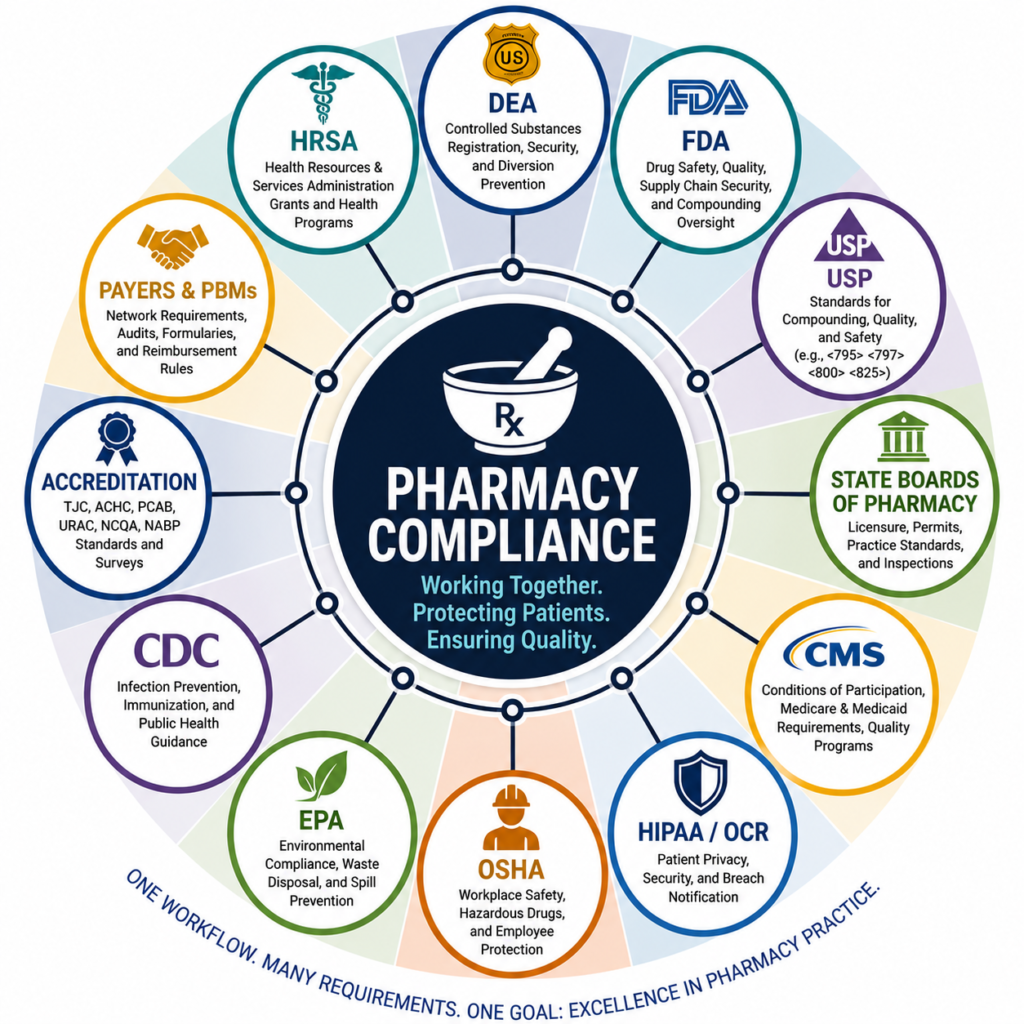
The truth is that pharmacy compliance isn’t one regulation, it is an interconnected system of laws, standards, accreditation requirements, contracts, and operational expectations.
It’s easy to get lost in all the letters of Pharmacy regulation, that’s why we call it the Alphabet Soup of Pharmacy Compliance.
Over the coming months, this series will explore every major organization, regulation, and standard that impacts pharmacy operations. Whether you’re a community pharmacy, health system, compounding pharmacy, specialty pharmacy, or home infusion provider, understanding how these organizations fit together can make inspections less stressful and compliance programs much easier to manage.
Why Pharmacy Compliance Feels So Complicated
Unlike many industries that answer primarily to one regulator, pharmacies operate under overlapping oversight. A single workflow, such as preparing a sterile compounded medication may involve:
- State Board of Pharmacy requirements
- United States Pharmacopeia (USP) standards
- Food and Drug Administration (FDA) guidance
- Occupational Safety and Health Administration (OSHA) worker safety requirements
- Environmental Protection Agency (EPA) waste regulations
- Accreditation standards
- Internal quality policies
- Manufacturer storage requirements
Each organization focuses on a different part of the same process. Rather than replacing one another, they create overlapping layers of accountability.
The Major Players in Pharmacy Compliance
DEA (Drug Enforcement Administration)
The DEA regulates controlled substances. Its responsibilities include:
- Registration
- Controlled substance ordering
- Inventory
- Diversion prevention
- Security
- Theft and loss reporting
- Recordkeeping
For many pharmacies, DEA compliance represents one of the highest enforcement risks.
FDA (Food and Drug Administration)
The FDA oversees drug safety and supply chain integrity. Examples include:
- Drug Supply Chain Security Act (DSCSA)
- Drug recalls
- MedWatch reporting
- Risk Evaluation and Mitigation Strategies (REMS) programs
- Compounding oversight under 503A and 503B
- Drug shortages
USP (United States Pharmacopeia)
The United States Pharmacopeia (USP) publishes standards used throughout pharmacy practice. Many pharmacy teams immediately recognize:
- USP <795>
- USP <797>
- USP <800>
- USP <825>
These chapters influence compounding practices, environmental monitoring, hazardous drug handling, quality systems, and much more.
State Boards of Pharmacy
Every pharmacy ultimately practices under state authority. State Boards of Pharmacy determine:
- Licensure
- Scope of practice
- Technician requirements
- Pharmacy inspections
- Pharmacy permits
- State-specific controlled substance rules
No two states are identical.
CMS (Centers for Medicare & Medicaid Services)
For hospitals, long-term care, ambulatory care, and many specialty settings, CMS requirements significantly influence pharmacy operations. CMS expectations often include:
- Medication management
- Quality programs
- Documentation
- Billing compliance
- Conditions of Participation
Accreditation Organizations
Many pharmacies voluntarily pursue accreditation or require it for business reasons. Examples include:
- The Joint Commission (TJC)
- Accreditation Commission for Health Care (ACHC)
- Pharmacy Compounding Accreditation Board (PCAB)
- Utilization Review Accreditation Commission (URAC)
- National Committee for Quality Assurance (NCQA)
- National Association of Boards of Pharmacy (NABP) accreditation programs
While accreditation is not always required by law, it often becomes essential for payer participation or manufacturer networks.
HIPAA (Health Insurance Portability and Accountability Act) and OCR (Office for Civil Rights)
Protecting patient information remains a core component of pharmacy compliance. Privacy extends well beyond computer security and includes:
- Patient counseling
- Text messaging
- Prescription delivery
- Business Associate Agreements
- Breach response
The Office for Civil Rights (OCR) enforces HIPAA requirements.
OSHA (Occupational Safety and Health Administration) and EPA (Environmental Protection Agency)
Compliance isn’t only about medications. It also includes protecting employees and the environment. These agencies influence:
- Hazardous drugs
- Spill response
- Pharmaceutical waste
- Hazard communication
- Bloodborne pathogens
- Worker safety
Pharmacy Compliance Is Really About Systems
One of the biggest misconceptions is that compliance means memorizing regulations. In reality, successful compliance programs focus on building repeatable systems. Leading pharmacies standardize:
- Documentation
- Standard Operating Procedures (SOPs)
- Staff training
- Competency management
- Audits
- Corrective actions
- Quality improvement
- Inspection readiness
When those systems are in place, meeting individual regulatory requirements becomes significantly easier.
The Alphabet Soup Series
This article is the first in Pestle’s ongoing Pharmacy Compliance Alphabet Soup series. Future articles will explore each major organization in depth, including:
- Drug Enforcement Administration (DEA)
- Food and Drug Administration (FDA)
- United States Pharmacopeia (USP)
- State Boards of Pharmacy
- Centers for Medicare & Medicaid Services (CMS)
- Occupational Safety and Health Administration (OSHA)
- Environmental Protection Agency (EPA)
- Health Insurance Portability and Accountability Act (HIPAA)
- Health Resources and Services Administration (HRSA)
- Centers for Disease Control and Prevention (CDC)
- Drug Supply Chain Security Act (DSCSA)
- Pharmacy Benefit Managers (PBMs)
- Accreditation organizations
- 340B Drug Pricing Program (340B)
- Clinical Laboratory Improvement Amendments (CLIA)
- Nuclear pharmacy regulations
- And many others
We’ll explain not only what each organization does but how they overlap with one another in real pharmacy workflows.
How Pestle Can Help
Understanding pharmacy compliance is one thing. Managing it day after day is another.
Pestle is designed to help pharmacy teams organize documentation, standardize workflows, support compounding operations, and maintain evidence that can make inspections and internal audits easier to prepare for. While software does not replace regulatory interpretation or professional judgment, organized compliance processes can help teams respond more consistently to changing requirements.
Conclusion
Pharmacy compliance isn’t getting simpler. Every year brings new regulations, revised standards, updated guidance, changing payer requirements, and evolving technology.
The good news is that compliance doesn’t have to feel overwhelming once you understand the ecosystem. Think of the various agencies, standards, and accrediting organizations as pieces of one larger puzzle, not separate worlds competing for your attention.
In this series, we’ll break down that puzzle one organization at a time so your team can better understand not just what each regulator expects, but how they all fit together.