Table of Contents
ISMP Medication Safety: Building a Stronger Compliance Program
A strong pharmacy compliance program connects policies, training, and documentation to the everyday work of protecting patients. ISMP medication safety resources can help pharmacy teams make that connection by turning lessons from medication errors into practical improvements.
The Institute for Safe Medication Practices, or ISMP, is a nonprofit organization focused on preventing medication errors. Its work includes education, error reporting, safety recommendations, and tools that help healthcare teams identify and address medication-use risks. Learn about ISMP.
ISMP is not a regulatory agency. It does not license pharmacies or enforce pharmacy laws. However, it can be a key partner in building a strong compliance program, particularly where medication safety, risk assessment, and continuous improvement intersect.
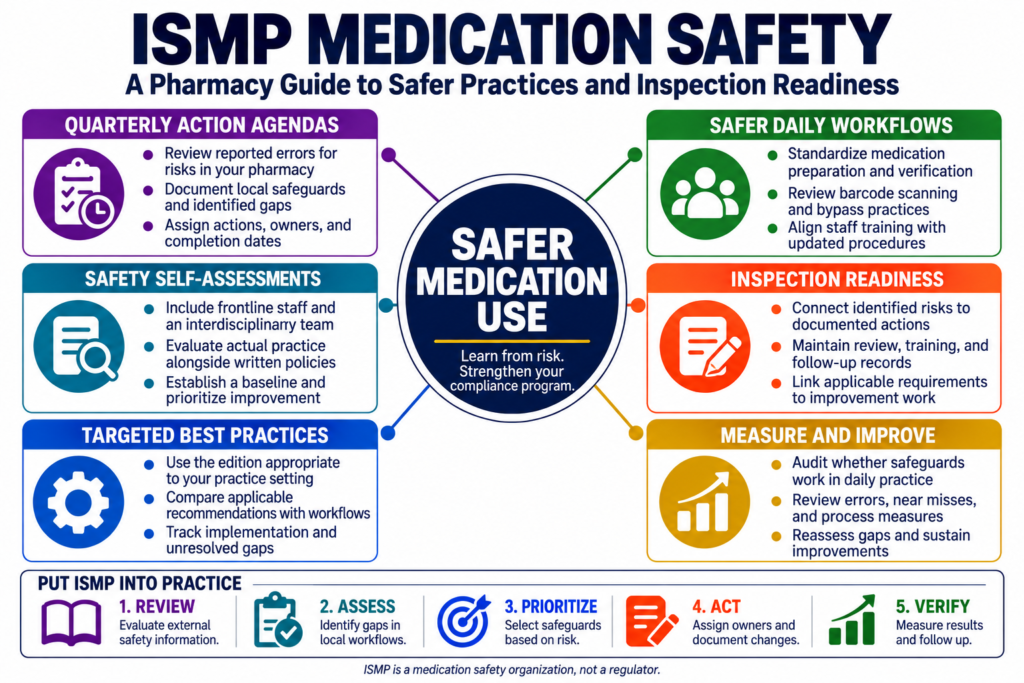
For pharmacy leaders, three resources offer a useful starting point: quarterly Action Agendas, Medication Safety Self Assessments, and Targeted Medication Safety Best Practices. Used together, they can help teams identify vulnerabilities, prioritize changes, and demonstrate how their safety program works in practice.
Where Does ISMP Fit in Pharmacy Compliance?
Pharmacy teams work with requirements and recommendations from many sources. Understanding each source’s role helps teams apply it appropriately.
As discussed in our guide to FDA pharmacy regulations, regulatory agencies have specific legal authorities. ISMP contributes a different kind of expertise: learning from medication errors and translating those lessons into prevention strategies.
An ISMP recommendation does not automatically become a legal requirement because ISMP publishes it. Teams should separately determine whether an applicable law, accreditation standard, or organizational policy incorporates the practice or addresses the same risk. That distinction should not make ISMP guidance an afterthought. A pharmacy can maintain organized records while still having vulnerabilities in product selection, preparation, labeling, dispensing, or administration. External safety guidance helps teams question whether their existing processes adequately protect patients.
For hospitals, this work connects with established quality responsibilities. CMS requires an ongoing, hospital-wide, data-driven quality assessment and performance improvement program. The requirements include tracking errors and adverse events, analyzing causes, taking preventive action, and measuring whether improvements are sustained. ISMP resources can inform that work, although using a particular ISMP tool does not by itself establish compliance. 42 CFR § 482.21.
Three ISMP Medication Safety Resources to Build Into Your Program
Each resource answers a different operational question.
| Resource | Question it helps answer | Practical use |
|---|---|---|
| Quarterly Action Agendas | Could an error reported elsewhere happen here? | Review emerging risks and assign follow-up actions. |
| Medication Safety Self Assessments | Where are our current systems vulnerable? | Establish a baseline and identify improvement priorities. |
| Targeted Medication Safety Best Practices | Which specific safeguards should we prioritize? | Compare current workflows with focused recommendations and close gaps. |
The value comes from connecting these resources to decisions, assigned responsibilities, and follow-up checks.
Use Quarterly Action Agendas to Turn External Learning Into Action
ISMP’s newsletters share medication error reports and prevention strategies. Its Quarterly Action Agendas organize selected newsletter topics into a format intended for interdisciplinary review. The agenda includes space to document the organization’s assessment, actions or assignments, and completion dates. ISMP Quarterly Action Agenda example.
This provides a useful structure for asking whether a problem experienced by another organization could occur locally.
Establish a Repeatable Review Process
Consider adding an Action Agenda review to your medication safety committee, pharmacy and therapeutics committee, or other designated quality meeting.
For each relevant item, document:
- Applicability: Do we use the medication, device, or workflow involved?
- Current safeguards: What protections are already in place, and how were they verified?
- Identified gaps: Where could the same type of error occur?
- Action and ownership: What will change, who is responsible, and when is it due?
- Effectiveness check: How will we determine whether the change worked?
If an item is not applicable, record the reason. “Medication not stocked or administered at this location” communicates more than an unexplained “N/A.” A quarterly review provides a dependable checkpoint, but urgent safety concerns should be evaluated when identified.
Practical Example: Similar Packaging
Consider a hypothetical newsletter item describing a mix-up between products with similar packaging.
A pharmacy could inspect its own inventory, review storage locations, observe product selection, and evaluate barcode verification. If a vulnerability exists, the team could change storage arrangements, address scanning barriers, and update the relevant procedure. At a later review, a supervisor could verify that the products remain separated and that staff consistently use the intended verification process. This creates a documented connection between external learning, local action, and observed practice.
Use Medication Safety Self Assessments to Find Gaps Before an Event
ISMP Medication Safety Self Assessments provide a structured way to examine medication-use systems. For example, the high-alert medication assessment supports interdisciplinary evaluation of risks across prescribing, storage, preparation, dispensing, and administration, while establishing a baseline for improvement. ISMP Medication Safety Self Assessment for High-Alert Medications.
Select an assessment appropriate to your practice setting and services, and follow its instructions for completion and scoring.
Assess Actual Practice
A useful assessment reflects what happens during routine work, including nights, weekends, high-volume periods, and staffing changes. Bring together the people who perform and oversee the relevant processes. Depending on the assessment, this may include pharmacists, technicians, nurses, prescribers, informatics staff, and quality leaders.
Support responses with evidence such as direct observations, audit results, system settings, and staff interviews. A written policy is useful evidence of the intended process; observation helps establish whether that process is consistently followed. If participants disagree about how a workflow operates, investigate the difference. Variation between departments or shifts may reveal an improvement opportunity.
Convert Findings Into a Manageable Improvement Plan
After completing the assessment, select a focused group of priorities based on risk and local circumstances. For each priority, establish:
- A clear description of the gap.
- An accountable owner.
- Necessary resources and interim safeguards.
- A target completion date.
- A measure to evaluate implementation and effectiveness.
For example, if an assessment identifies inconsistent medication storage practices across locations, the improvement plan could include a common storage standard, local implementation checks, and a follow-up audit. Treat the assessment as a starting point for improvement. Completing it is not a certification or a guarantee of inspection readiness.
Use Targeted Medication Safety Best Practices to Set Priorities
ISMP’s Targeted Medication Safety Best Practices focus on specific medication safety problems associated with recurring harmful errors.
As of September 2026, the hospital edition is 2026–2027. It provides focused recommendations that organizations can use to evaluate and strengthen their medication-use systems. Teams should review the complete publication and assess all applicable practices. ISMP Targeted Medication Safety Best Practices for Hospitals.
ISMP also publishes a separate community pharmacy edition. The 2025–2026 recommendations address areas including patient identification, barcode scanning, oral liquid measurement, weight-based dosing, return-to-stock processes, and vaccine preparation and administration. Some recommendations may also be relevant to specialty pharmacy, home infusion, and other settings. ISMP community pharmacy best practices announcement.
Compare Each Applicable Practice With Your Workflow
Create an implementation record that identifies the publication edition, applicable recommendation, current process, supporting evidence, and remaining gap. Avoid labeling a practice “implemented” solely because it appears in an SOP. Confirm that the necessary equipment, system configuration, training, and everyday behaviors support the intended safeguard.
For example, a pharmacy reviewing barcode scanning should examine where scanning occurs, when it is bypassed, and whether unreadable barcodes or workflow barriers routinely undermine its use. That review can guide both technical fixes and operational changes.
An implementation record should also distinguish between work that is complete, work still in progress, and items that are not applicable, with a documented rationale.
Connect Medication Safety Improvements to Inspection Readiness
ISMP resources can help teams prepare for inspections by creating an organized record of how they recognize and address risk.
A useful evidence trail can answer five questions:
- What risk did the organization identify?
- How did the team evaluate its relevance?
- What action did leadership approve?
- How was the change implemented?
- What evidence shows the safeguard is working?
That record might include a source reference, meeting decision, revised procedure, training record, completed observation, and follow-up result.
For hospitals, these activities can support the broader quality improvement work required under CMS’s hospital Conditions of Participation. The organization still needs to demonstrate that its program meets the applicable requirements. 42 CFR § 482.21.
When a related regulation or accreditation standard applies, link it separately to the improvement record. This keeps the source of the requirement clear while showing how ISMP guidance informed the response.
The goal is to make effective safety practices easier to explain and demonstrate during an inspection. No newsletter review, assessment score, or completed checklist guarantees a favorable survey result.
Measure Whether the Changes Improve Safety
Choose measures that match the risk being addressed. For example, a team working on scanning reliability could track the percentage of eligible preparations with required barcode verification and review the reasons for bypasses. A team addressing storage risks could measure the percentage of audited locations that meet the approved storage procedure. Pair these process measures with relevant event and harm data. Also look for unintended effects, such as delays or workarounds introduced by a new process.
Interpret reporting trends carefully. An increase in reported near misses may reflect greater willingness to report, so report counts alone should not determine whether a program is improving. A practical starting rhythm is to review new safety information as it arrives, use quarterly meetings to evaluate open actions, and revisit selected priorities during annual planning. Adjust that schedule to the organization’s risks and responsibilities.
How Pestle Can Help
Following through on medication safety improvements requires dependable scheduling, clear ownership, and accessible records.
Pestle Compliance helps pharmacy teams schedule, track, and manage recurring compliance work, documentation, and training. Teams can use that structure to organize Action Agenda reviews, assign follow-up tasks, and maintain records of completed checks. For example, a pharmacy could schedule a quarterly medication safety review, document its local findings, assign a storage audit, track the associated staff education, or update task to reflect changes.
Pestle Formulas, Pestle’s IV workflow management system, helps teams bring medication safety practices into daily compounding workflows. Standardized master formulation records, ingredient barcode verification, photo documentation, and preparation and approval steps can support a more consistent process and give pharmacists information to review before releasing a preparation. When an ISMP review identifies a compounding workflow gap, teams can evaluate how their formulas, verification steps, and documentation practices should change. For example, a pharmacy addressing ingredient selection risks could review its barcode verification process, update preparation instructions, and use compounding records to evaluate whether staff follow the revised workflow.
ISMP provides medication safety expertise. Pestle can help organize the work a pharmacy chooses to undertake in response and support its implementation in daily operations. Clinical decisions, interpretation of requirements, and evaluation of safety outcomes remain the responsibility of the organization and its qualified professionals.
Build a Compliance Program That Learns
ISMP plays an important role in pharmacy’s compliance landscape by helping organizations learn from medication errors and strengthen the systems intended to prevent them. Quarterly Action Agendas support ongoing review. Self-assessments help identify vulnerabilities. Targeted best practices provide focused opportunities for improvement.
Together, these resources can help pharmacy teams build a more proactive program, one that connects safety information to action, verifies changes in practice, and maintains evidence of ongoing improvement. Start with one relevant resource, identify a meaningful gap, and assign a follow-up action with a clear way to measure success.
To explore how Pestle can help organize that work, schedule a demo.