
Table of Contents
OSHA in Pharmacy: How to Build a Workplace Safety Program
A technician reports that a cart is hard to stop on the ramp outside receiving. Another mentions wrist pain after a long compounding run. A new hire knows where the hazardous drug spill kit is but has never been shown who to call after hours. Each situation gives the pharmacy an opportunity to act before someone gets hurt.
OSHA in pharmacy starts with a program that helps people identify hazards, raise concerns, and see those concerns through to resolution. The Occupational Safety and Health Administration’s Recommended Practices for Safety and Health Programs offers a framework that pharmacies can use to build that program. It also gives teams a practical way to show what they’ve done and whether it worked. OSHA’s Recommended Practices
This article is part of Pestle’s Pharmacy Compliance Alphabet Soup series.
OSHA in Pharmacy Starts With a Workplace Safety Program
OSHA’s recommended practices are guidance for building and improving a program. The requirements that apply to a pharmacy depend on the work employees do, the hazards they face, and whether Federal OSHA or an OSHA-approved State Plan covers the location. A hospital pharmacy might need to address Hazard Communication, materials handling, personal protective equipment, and occupational exposure to bloodborne pathogens. A health system can set a common approach across its pharmacies and check the applicable rules at each site.
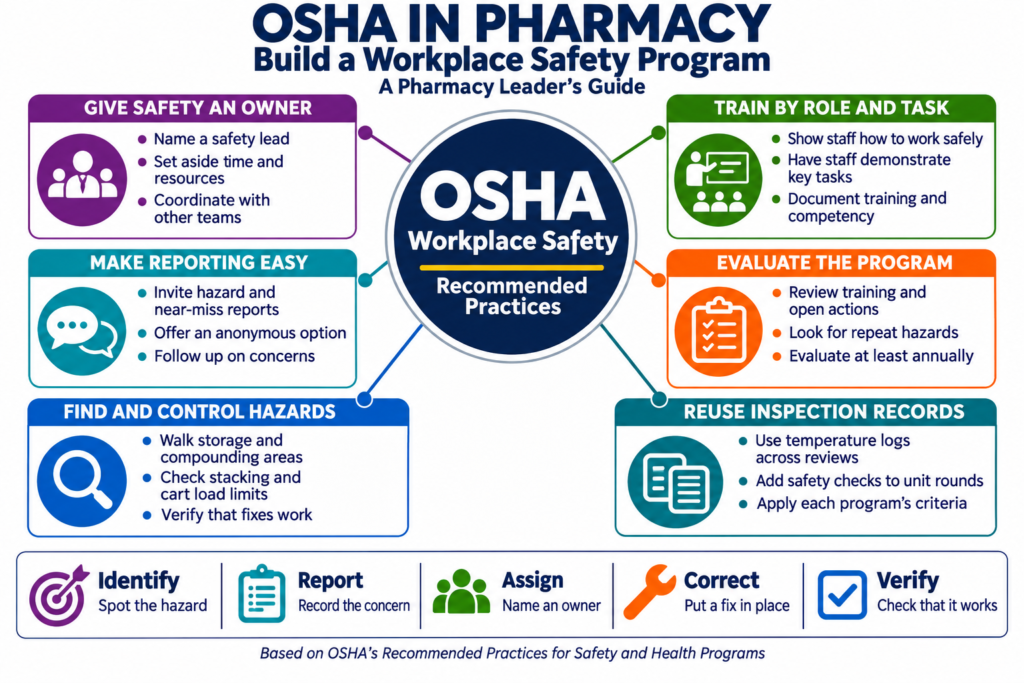
OSHA organizes its guidance around seven program elements. Here’s how each can work in a pharmacy.
1. Give the program an owner and the resources to act
Identify who leads the program for the pharmacy and who can help address hazards that cross department lines. A pharmacy manager may own the storage procedure, while facilities repairs shelving, occupational health evaluates exposures, and hospital safety helps assess the work.
Write down who can act on an urgent hazard, who tracks open issues, and who verifies that a fix worked. Give people time for safety rounds and training, and make sure they know how to request equipment or a workflow change. A documented owner makes it easier to move from “someone should look at this” to an assigned action.
Smaller pharmacies without dedicated occupational health, facilities, or safety teams can designate a staff member as their safety lead and give them time to review concerns, recommend changes, and coordinate follow-up. Basic workplace safety training is a practical starting point, with more specialized training, certification, or outside expertise available as the pharmacy’s needs grow.
2. Make it easy for staff to report concerns and see what happens
Give employees a clear way to report a hazard, near miss, injury, or exposure. Explain which situations need immediate attention and whom to call on every shift. Invite input from technicians, pharmacists, and staff who work in or around the pharmacy. OSHA recommends a reporting process that protects employees from retaliation and offers an option to report concerns anonymously. OSHA worker participation guidance
A useful report captures the location, the task, what happened or nearly happened, and any immediate action. The reviewer can then assign an owner, set a due date, and document how the issue was resolved. Where possible, tell the person who raised the concern what changed. If someone reports that a storage cart rolls while they load it, for example, ask the staff who use it to test the replacement before closing the item.
3. Identify hazards by watching the work
Walk through receiving, storage, the IV room, dispensing, and delivery routes with the people who work there. Include deliveries, peak compounding periods, and off-shift work where practices may differ. Review prior injuries, near misses, employee reports, safety data sheets, and equipment instructions alongside what you observe.
In the IV room, look for repeated syringe manipulation, awkward reaches, and prolonged wrist or shoulder positions. Ask when staff start to feel fatigue and what changes as volume increases. In medication rooms, look for crowded work surfaces, poorly placed sharps containers, and storage that forces staff to reach around equipment. Identify who may be exposed, then prioritize hazards by how serious the harm could be and how likely it is to occur. OSHA hazard identification guidance · OSHA pharmacy ergonomics guidance
4. Control hazards where they occur and check the fix
Start with changes to the equipment, layout, or workflow that reduce the hazard at its source. Training and PPE may also be needed. If an IV room adjustment affects supply placement or workstation setup, have the compounding lead review it for effects on airflow, aseptic technique, and containment before implementation. NIOSH hierarchy of controls
Example — Follow one case of IV fluids from receiving to the patient care unit. At receiving, watch how often staff lift cases from a pallet, how far they reach, and whether they need to twist. Federal OSHA does not set a universal maximum lifting weight. The pharmacy can use a task assessment to decide when it needs a lift aid, a different setup, or an approved assisted-handling method. OSHA interpretation on lifting and carrying · NIOSH Revised Lifting Equation
In bulk storage, keep frequently handled heavy cases within a comfortable reach and make sure stacks are stable, shelving is suitable, and aisles stay clear. An appropriate step stool may work for occasional access to lighter items on a higher shelf. In a larger warehouse, a rolling access stair with handrails and guarding may be a better fit. If retrieving a heavy case requires an employee to climb while carrying it or reach outside a comfortable range, relocate the stock or use an appropriate material-handling aid.
Set a maximum stack height or highest usable shelf for IV fluid cases based on stack stability and how staff can safely retrieve them, and mark the limit with a red line on the warehouse wall or a label on the rack. If a case extends above the mark during a routine round, have it moved to an approved location and use the finding to reinforce the stacking standard with the warehouse team. OSHA material handling standard · OSHA requirements for step stools and mobile access equipment
On the way to the unit, observe the loaded cart at thresholds, turns, doors, and ramps. Its rated capacity describes what it can carry. Assess the effort needed to start, steer, and stop it separately. Use what you observe to inform cart choice, load size, and travel route. Then have staff try the revised procedure under normal working conditions. Post the approved manual push or pull limit on a laminated card attached to the cart, and translate it into counts for common loads, such as how many 3-liter dialysis bags fit within that limit based on their actual packed weight. If a load exceeds the posted limit, split it into smaller loads or use an approved powered cart or other transport aid.
The same assessment can help HR and occupational health describe essential job functions accurately. Record how often staff lift, how far they carry, what pushing and pulling the job involves, and what equipment or assistance is available. If the organization uses employee health evaluations, have HR and occupational health align them with the actual job and applicable rules on medical inquiries, examinations, and accommodations. EEOC guidance on medical questions and examinations
5. Train people for the tasks they actually perform
Start with what everyone needs to know, including how to report a concern, find relevant safety information, and respond to an emergency. Then train by role and task. Receiving staff may need to recognize a damaged hazardous drug shipment and know whom to call. Pharmacy technicians may need to demonstrate safe use of a transport cart. IV room staff may need to show how they dispose of sharps or follow the applicable exposure procedure.
Document the topic, date, employee, trainer or evaluator where relevant, and how understanding was verified. For a hands-on procedure, an observed demonstration can give the pharmacy better evidence than attendance alone. Review training needs when duties, equipment, or hazards change, and follow any training frequencies or recordkeeping requirements that apply to the task. OSHA education and training guidance
6. Evaluate whether the program is working
OSHA recommends evaluating the program when it starts and at least annually. Involve the employees who do the work and review both what the pharmacy is doing to prevent harm and what has already happened. Track practical measures such as completion of role-based training, how quickly reported hazards are addressed, overdue corrective actions, and repeat findings. Review injuries and exposures alongside those measures. An increase in near-miss reports may reflect that staff are more comfortable speaking up. Look at what was reported and how the pharmacy responded before drawing a conclusion. OSHA program evaluation guidance
Record what the review found, which changes the team agreed to make, who owns them, and how the pharmacy will verify improvement. If three rounds flag the same overloaded shelf, review the stock layout or replenishment process before adding another reminder to the inspection form.
7. Coordinate with other departments, contractors, and staffing agencies
Safety responsibilities continue when work crosses the pharmacy door. Agree with nursing, materials management, environmental services, and facilities on who handles a problem at each handoff. When contractors or agency staff work in the pharmacy, coordinate hazard information, training responsibilities, and emergency procedures with their employer before work begins. For example, clarify who briefs a contractor servicing equipment in a hazardous drug area and whom the contractor contacts if there is a potential exposure. OSHA guidance on coordination with contractors and staffing agencies
Where OSHA, CMS, State Board, USP, and Accreditation Programs Overlap
A pharmacy can often record an observation once and use it for several reviews. A temperature log, a medication area inspection, or a training record can serve more than one purpose when it captures enough detail for each reviewer. Keep each program’s acceptance criteria, responsible reviewer, and follow-up clear so the shared record supports the right decision.
| Shared record | How worker safety can use it | How pharmacy compliance can use it |
|---|---|---|
| Room temperature and humidity log | Facilities and safety can review trends alongside staff reports of uncomfortable conditions, ventilation issues, or heat concerns. | Pharmacy can use relevant readings to review medication storage conditions. A compounding program can use readings from the appropriate location when its applicable standards or policies call for them. |
| Unit or medication area inspection | Include questions on blocked aisles, unstable stock, damaged carts, and sharps containers where relevant. Route findings to the people who can address them. | The same form can capture medication security, expired stock, storage conditions, and labeling for applicable CMS, state board, or accreditation reviews. |
| Hazardous drug training or spill drill record | Show who was trained on covered hazards, whom to call, and how staff practiced their response roles. | Use relevant fields to document handling or spill response training under the organization’s applicable USP <800> procedures. |
CMS hospital survey guidance · OSHA indoor air quality guidance · USP <800> implementation overview
Temperature and humidity show why the distinction matters. Controlled room temperature is a medication storage concept. An ambient temperature reading taken for that purpose can also help facilities investigate a workplace concern, particularly when the location and timing match what staff experienced. For example, several employees may report that a medication room feels unusually warm during the afternoon. Pharmacy can use the temperature trend to assess products against their labeled storage conditions and the site’s excursion procedure. Facilities or safety can use the same trend, along with the staff reports and other relevant conditions, to investigate ventilation or heat concerns. Federal OSHA’s general indoor air quality guidance addresses comfort and workplace conditions. It does not establish the medication storage limits or make a temperature log conclusive evidence of safe working conditions. USP <659> Packaging and Storage Requirements · OSHA heat exposure guidance
The same approach works for a medication area inspection. A single round can record that expired stock was found in a cabinet and a cart was blocking access to that cabinet. Assign the expired stock to pharmacy and the cart issue to the appropriate unit or safety owner. Both findings begin on the same form, and each has its own corrective action and verification. If a CMS surveyor, state board inspector, accreditor, or OSHA officer asks about the area, the relevant observation and follow-up are available from the original record. Check that the fields and records meet the applicable requirements for each review. CMS Medication Management Requirements
What Does an OSHA Inspection Look Like?
Employees can raise concerns within the organization and have the right to file a safety and health complaint with OSHA. A complaint can lead to an on-site inspection or other follow-up. On-site Federal OSHA inspections generally include an opening conference, a walkaround and records review, and a closing conference. OSHA worker complaint guidance · OSHA inspection fact sheet
- Opening conference. The compliance officer presents credentials and explains the reason and scope of the inspection, the walkaround process, and how employees may participate.
- Walkaround and records review. The officer may observe work, request relevant records, and interview employees privately. Depending on the scope, pharmacy staff may be asked to explain how they report hazards, access safety data sheets, receive training, or respond to an exposure.
- Closing conference. The officer discusses findings and potential next steps. Formal citations, if issued, may follow the visit. Track the findings and who will follow up.
For pharmacy leaders, readiness means knowing who to contact and being able to show how the program works. On a safety round, ask an employee to show you how they would report a concern and where they would find the procedure. Then pick a closed corrective action and trace it from the original report to the evidence that the fix worked. Know who maintains required injury and illness records and who determines whether an event qualifies for external reporting. OSHA recordkeeping · OSHA severe incident reporting rule
How Pestle Compliance Can Help
Pestle Compliance can help pharmacies document the work behind their safety program. A pharmacy can use a investigation task to capture a routine safety concern or near miss, document the review, and assign a follow-up task. For example, a technician can record that shelving is damaged, the manager can assign the correction, and a follow-up inspection can document when the shelf was repaired and checked. Give staff a clear route for urgent concerns and keep any separate confidential or anonymous reporting channels accessible.
Teams can also use Pestle to assign and document role-based education and competencies, schedule recurring workplace rounds, and organize related SOPs. For an annual program evaluation, the pharmacy can schedule the review and document the findings, decisions, owners, and follow-up. A medication area inspection form can include both medication storage and workplace safety questions, giving the pharmacy a single record of the round and a place to track what it found. Pestle Compliance
Start With What Your Pharmacy Already Does
Review one inspection form, one training record, and one recent safety concern with the people who handle them. Check whether the form captures what each team needs, the training record shows what the employee learned, and the safety concern has a documented outcome. Those three records can show where the program is working and where a small change would give employees better support.
If your pharmacy wants to organize that work across locations, explore how Pestle Compliance can support safety checks, training, and documented follow-up. Explore Pestle Compliance