
Table of Contents
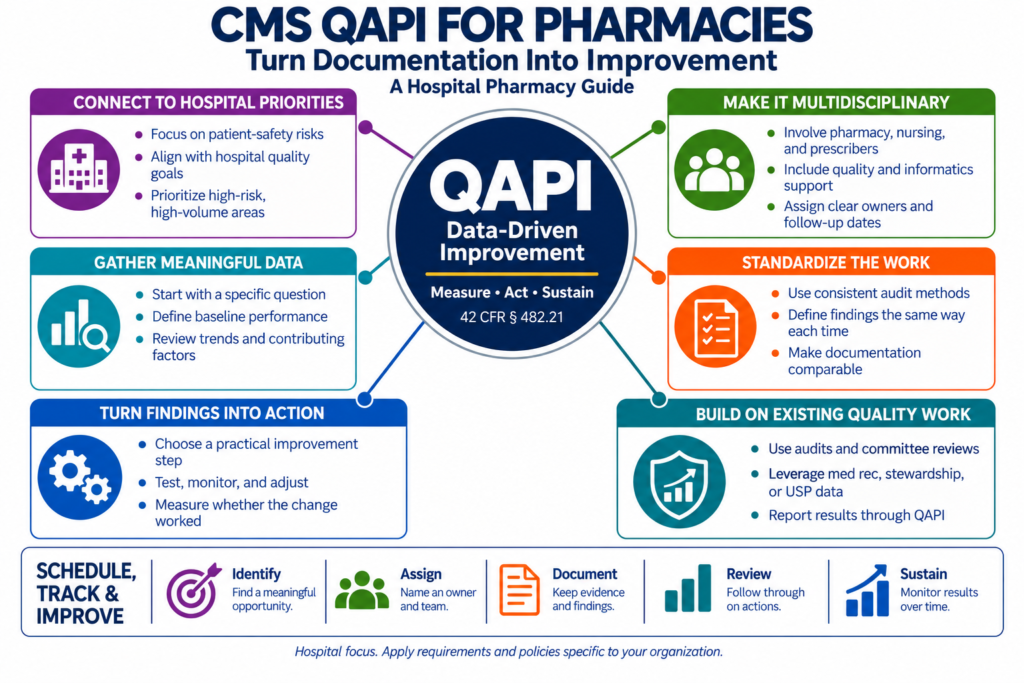
CMS QAPI for Pharmacies: Turn Documentation Into Improvement
Pharmacy teams collect information every day: medication storage findings, automated dispensing cabinet override reviews, compounding exceptions, pharmacy interventions, and corrective actions. The challenge is turning those records into a clear picture of what needs to improve and whether a change actually worked.
CMS QAPI for pharmacies connects pharmacy’s quality and safety work to the hospital’s broader quality assessment and performance improvement program. A useful pharmacy contribution includes consistent data, shared review, practical changes, and follow-up measurement.
This article builds on our overview of CMS pharmacy requirements, focusing on hospital pharmacy participation in QAPI under 42 CFR § 482.21. Other practice settings should evaluate the requirements applicable to their own provider type.
What Does CMS QAPI Require?
Under 42 CFR § 482.21, hospitals must maintain an ongoing, hospital-wide, data-driven QAPI program that includes all departments and services, including contracted services.
The regulation calls for measuring and analyzing quality indicators, prioritizing high-risk, high-volume, or problem-prone areas, addressing errors and adverse events, and evaluating whether improvements last. Hospitals must document improvement projects, their rationale, and measurable progress. Project scope and number must reflect organizational complexity; the governing body specifies data-collection frequency and detail and has oversight responsibilities.
For pharmacy leaders, this creates a practical question: How does the information collected by the pharmacy or can be collected help the hospital identify risk, choose an action, and evaluate the result?
CMS’s hospital QAPI guidance emphasizes continuous monitoring and sustained improvement. It also clarifies that every department does not need to be continuously engaged in a large, resource-intensive project. Pharmacy can contribute through ongoing monitoring, escalation of meaningful findings, and participation in focused improvement work.
Connect Pharmacy QAPI to the Hospital’s Priorities
Start with a conversation with the hospital’s quality team. Ask which organizational priorities intersect with medication use and where pharmacy data could fill a gap.
Potential connections include medication access, transitions of care, high-alert medication processes, medication storage, and preparation workflows. The best starting point is a documented local concern with a clear connection to patient care.
A useful project statement identifies:
- The problem and where it occurs.
- The patients or processes affected.
- The baseline performance.
- The improvement the team wants to achieve.
- The person responsible for coordinating the work.
- How and when results will be reviewed.
For example, “Improve medication storage compliance” is broad. A more actionable aim is: “Reduce repeat medication storage findings on the two pilot units over the next quarter, using a consistent inspection method and follow-up review.”
The hospital should establish the actual target based on its baseline, risks, and priorities. This example is a planning approach, not a CMS-prescribed target.
ISMP resources can also help pharmacy teams identify medication safety priorities for QAPI. Safety self-assessments, Targeted Medication Safety Best Practices, and Quarterly Action Agendas can provide starting points for evaluating local processes and selecting improvement opportunities. Explore our ISMP medication safety article for practical ways to incorporate these resources into your program.
Make Pharmacy QAPI a Multidisciplinary Effort
Medication processes cross departmental boundaries. A delay identified by pharmacy may begin with an order, continue through verification and preparation, and end with delivery or administration.
Bring the people who perform and influence the process into the review.
| Team member | Potential contribution |
|---|---|
| Pharmacists and pharmacy technicians | Explain verification, preparation, distribution, and documentation workflows |
| Nursing | Identify administration barriers, storage practices, and unit-level conditions |
| Prescribers | Clarify ordering decisions and clinical workflow needs |
| Quality and patient safety | Help select measures, analyze findings, and connect the project to hospital priorities |
| Informatics and IT | Validate timestamps, reporting logic, interfaces, and data availability |
| Other departments, as relevant | Address equipment, supply, infection prevention, or operational dependencies |
Include frontline staff from affected shifts. A process that works during weekday staffing may encounter different barriers overnight or on weekends.
Give each meeting a decision to make. Review the findings, identify what remains uncertain, choose the next action, and assign an owner and follow-up date. Record unresolved barriers that require leadership support.
Example: Reviewing Automated Dispensing Cabinet Overrides
Suppose a pharmacy identifies repeated override activity for a medication.
Before setting a reduction target, pharmacy, nursing, prescribers, and informatics should examine why the overrides occur. Are they associated with urgent clinical situations, order availability, verification delays, cabinet configuration, or a workflow that does not match actual care needs?
An override count alone cannot answer those questions.
The team might test a configuration change or revise an ordering workflow, then monitor both the appropriateness of overrides and timely access to needed medication. Reducing a number is useful only when the resulting process supports safe care.
Our CMS medication management article explores related pharmacy oversight activities.
Gather Data That Answers a Specific Question
Choose the question before building the dashboard.
“Are inspections being completed?” and “Are medication storage problems becoming less frequent?” require different measures. Both can be useful, but they describe different aspects of performance.
Consider three complementary types of measures:
| Measure type | Question it answers | Pharmacy example |
|---|---|---|
| Process | Are we performing the intended work? | Percentage of scheduled inspections completed within the organization’s timeframe |
| Outcome | Is the targeted problem improving? | Percentage of inspected locations with repeat storage findings |
| Balancing | Did the change create another problem? | Staff time required after adding a more detailed inspection process |
These are suggested improvement measures, not a required CMS pharmacy scorecard.
Define the Measure Before Comparing Results
Create a short definition for each measure. Include the numerator, denominator, exclusions, data source, responsible reviewer, and reporting period.
For example:
Repeat storage finding rate: Number of inspected locations with a previously identified issue recurring during the defined follow-up period, divided by the total number of locations receiving follow-up inspection.
The team must also define what counts as the “same issue.” Without that definition, one reviewer might count any storage finding as a recurrence while another counts only the identical deficiency.
Keep raw counts beside percentages. One finding in five observations has a different context from 20 findings in 100 observations, even though both equal 20%.
Check Data Quality Before Interpreting a Trend
Review missing fields, duplicate records, changes in sampling, and inconsistent classifications. Distinguish when an event occurred from when someone entered the record.
For time-based measures, confirm time zones and the meaning of each timestamp. A task completion time may not represent the time a medication became available to a patient.
Avoid interpreting a blank field as a successful result. Similarly, an increase in reported events may reflect improved reporting rather than a worsening process. Review the context before drawing conclusions.
Use Standardized Work to Make Documentation Comparable
Standardized work gives staff a shared method for completing an activity, recording the result, and responding to an exception.
For a pharmacy inspection, that might include:
- A consistent checklist and instructions.
- Clear definitions of findings and severity.
- Standard response options, with room for explanation.
- A defined escalation path.
- An assigned corrective-action owner.
- A follow-up step to verify resolution.
The goal is to make findings understandable across reviewers, departments, and time periods.
For example, “refrigerator issue” offers little detail for analysis. Structured categories can distinguish an out-of-range reading, missing documentation, an equipment concern, or an unresolved investigation.
Those distinctions help the team select an appropriate response. Repeated documentation gaps may require a different intervention from recurring equipment failures.
When forms or procedures change, record when the change took effect. Otherwise, a rise in findings after adding a new inspection item may appear to indicate deteriorating performance when the team is simply detecting something it previously did not measure.
Turn Findings Into a Measurable Improvement Project
Consider a hypothetical hospital that repeatedly identifies expired medications during unit inspections.
Removing the expired items addresses the immediate finding. The QAPI opportunity is to understand why the problem returns.
A practical project could follow this sequence:
- Establish a baseline. Review findings by unit, storage location, medication category, and inspection period.
- Understand the work. Observe receiving, stocking, rotation, and removal processes with pharmacy and nursing staff.
- Choose a focused change. Test a revised stock-rotation method and clearer ownership on selected units.
- Measure again. Repeat inspections using the same definitions and a comparable sampling approach.
- Check for unintended effects. Review whether reduced stock or changed handling creates availability problems or excessive workload.
- Sustain the improvement. Incorporate effective changes into procedures and training, assign ongoing monitoring, and establish when recurrence requires renewed review.
A completed corrective-action task documents that someone performed an action. Follow-up results help establish whether that action solved the problem.
Keep both pieces of evidence connected.
Make Results Useful to Leadership and Frontline Teams
A useful QAPI update explains what the team learned and what decision is needed.
Include the baseline, trend, intervention date, interpretation, and next action. Identify limitations such as small samples, missing records, or a change in measurement method.
For example:
“Inspection completion remained stable. Repeat storage findings declined on the pilot units after the stock-rotation change, but one location continues to show recurrence. The team will observe that location’s replenishment process before expanding the intervention.”
That explanation gives leaders and staff more to work with than a green status indicator alone.
For health systems, use consistent definitions where practical while retaining visibility into individual hospitals. Section 482.21 permits eligible systems to establish unified QAPI programs under specified conditions, while requiring attention to each hospital’s circumstances and local issues.
Build on Quality Work Your Pharmacy Already Performs
Starting or strengthening pharmacy’s contribution to QAPI does not always require a new audit or another committee. Existing reports, compliance activities, and improvement projects can provide useful measures and a starting point for action.
This approach fits the hospital-wide framework in 42 CFR § 482.21: use relevant quality data to identify opportunities, implement changes, and evaluate results. Existing work can contribute when it is connected to the hospital’s QAPI priorities, oversight, and follow-up process.
Medication Reconciliation Audits
If your hospital already conducts medication reconciliation audits for Leapfrog, those findings may also inform QAPI. Leapfrog’s medication reconciliation measure addresses the reconciliation process and unintentional medication discrepancies.
Pharmacy could use the existing audit results to identify recurring discrepancy types, examine where the process breaks down, and evaluate a targeted change. For example, the team might improve medication-history collection and then repeat the audit to assess whether discrepancies decline.
Preserve the applicable Leapfrog measure specifications for Leapfrog reporting. If the hospital adds a separate local QAPI measure or expands the sample, clearly document that distinction so results remain interpretable.
Antimicrobial Stewardship Projects
An antimicrobial stewardship team expanding extended-infusion antibiotic use may already be collecting information that can support a QAPI project.
Under the hospital’s approved clinical protocol, potential measures might include appropriate use among eligible patients, adherence to prescribed infusion durations, and administration delays or interruptions. Pharmacy, nursing, prescribers, and informatics can review these findings together and evaluate whether workflow changes improve reliable delivery.
The number of patients transitioned to extended infusion describes implementation; it does not, by itself, demonstrate better patient outcomes. Select measures that address the project’s clinical purpose and potential unintended effects.
This connection is particularly relevant because CMS requires identified infection prevention and antibiotic-use issues to be addressed in collaboration with the hospital-wide QAPI program.
Cleanroom Surface Sampling and Follow-Up
If USP-related surface sampling identifies a cleanroom concern, the investigation and follow-up already being reviewed with infection prevention may also support QAPI.
For example, pharmacy could bring together sampling trends, identified contributing factors, corrective actions, and subsequent results to evaluate whether a cleaning or workflow change reduced recurrence. Keep sampling locations and methods sufficiently consistent for meaningful comparison, and document changes that affect interpretation.
Environmental sampling results are indicators of environmental control; they are not direct proof of patient infection or its absence. The QAPI contribution is the documented connection between an identified risk, the response, and evidence of sustained improvement. QAPI reporting complements the applicable compounding requirements and immediate response procedures.
Connect Existing Reports to Decisions and Follow-Up
A committee report becomes more useful to QAPI when it clearly identifies:
- The patient safety concern and why it matters.
- The measure, baseline, and data limitations.
- The action taken and responsible owner.
- The results after the change.
- The next review date and conditions that would trigger further action.
Coordinate with the quality team so existing reports reach the appropriate hospital oversight process. A shared report can serve more than one purpose without requiring staff to collect the same information twice.
Use existing work to jump-start QAPI, while letting patient safety determine what comes next. Convenient data should not limit the program’s scope. CMS calls for priorities that address high-risk, high-volume, or problem-prone areas. If an important risk is not covered by current audits or committee reports, add the monitoring or improvement work needed to address that gap.
A Planning Note for Hospitals With Obstetrical Services
Beginning January 1, 2027, § 482.21 adds obstetrical QAPI requirements addressing outcomes and disparities, including an annual measurable improvement project.
Pharmacy leaders can coordinate with obstetrical and quality leaders to identify relevant medication-use contributions. Potential topics include emergency medication availability or consistency of medication workflows across care locations. These are possible pharmacy contributions, not individually mandated projects.
How Pestle Can Help
How Pestle Can Help
Pestle Compliance helps pharmacy teams manage compliance activities and collect structured information for quality improvement. Organizations can create quality audit forms and tasks with instructions explaining what to review, how to select the sample, and how to document findings.
Input fields can capture counts, observations, exceptions, and other information needed for a QAPI project. For example, a patient profile audit could collect the number of medications reviewed, the number with findings, the types of issues identified, and actions taken. Using consistent instructions and fields helps teams gather comparable information across reviewers, locations, and review periods.
These forms and tasks can support focused improvement projects, baseline assessments, and follow-up audits, as well as recurring activities such as unit inspections, override audits, automatic stop reviews, recalls, formulary reviews, and medication access audits.
Pestle also provides a free API that organizations can use to retrieve real-time data from their forms and tasks. This allows audit findings and other information documented in Pestle to support the organization’s QAPI reporting, trend analysis, and evaluation of improvement efforts.
Build a QAPI Process That Leads to Better Work
A practical pharmacy QAPI contribution starts with a meaningful question, consistent documentation, and a team positioned to improve the process.
Choose one recurring concern. Define how it will be measured. Bring the affected departments together. Test a change, review the results, and keep monitoring long enough to determine whether improvement lasts.
Explore our CMS pharmacy requirements overview for the broader regulatory context, or connect with Pestle to discuss how standardized forms, scheduled tasks, and access to your operational data can support your hospital’s QAPI program.