
Table of Contents
CMS Pharmacy Infection Prevention: Compounding and Stewardship
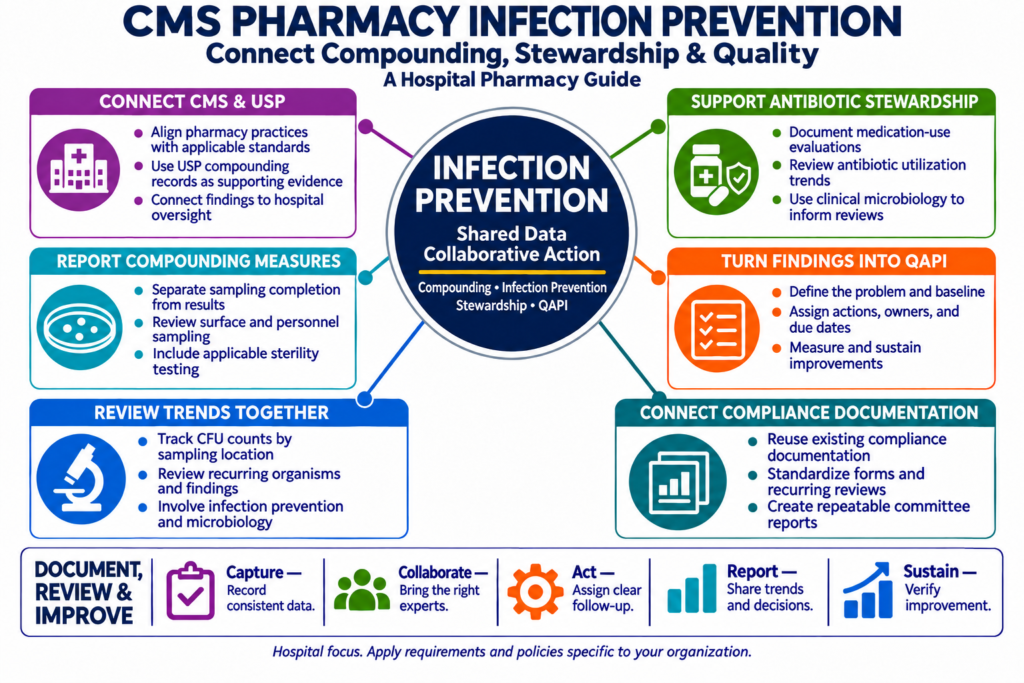
CMS pharmacy infection prevention brings clinical care, pharmacy operations, medication safety, and quality improvement into a shared area of responsibility. A cleanroom sampling result may begin as compounding documentation, but it can also help an infection prevention committee understand contamination risks, evaluate corrective actions, and identify opportunities for improvement.
That connection gives pharmacy teams an opportunity to make their existing compliance work more useful across the organization.
Surface sampling, personnel competency assessments, and applicable sterility testing generate information about the controls surrounding compounded preparations. Antibiotic-use reviews and clinical microbiology data provide a different perspective: whether antimicrobial therapy aligns with the organization’s clinical guidance and improvement priorities.
Together, these activities can support a coordinated patient safety program.
Building on our guide to CMS pharmacy requirements, this article focuses on hospitals subject to the Conditions of Participation in 42 CFR Part 482. Other settings, including nursing facilities, have separate regulatory frameworks.
What CMS Pharmacy Infection Prevention Requirements Look Like
Three hospital requirements help explain the relationship among compounding, infection prevention, and stewardship.
| Requirement | What it addresses | What pharmacy can contribute |
|---|---|---|
| 42 CFR § 482.25: Pharmaceutical services | Pharmacy oversight and medication services, including pharmacist-supervised compounding consistent with applicable law | Compounding policies, preparation records, personnel assessments, and documentation of quality controls |
| 42 CFR § 482.42: Infection prevention and antibiotic stewardship | Hospital-wide infection prevention and antibiotic-use programs, coordination, and collaboration with QAPI | Contamination-control findings, antibiotic-use evaluations, multidisciplinary reviews, and documented follow-up |
| 42 CFR § 482.21: QAPI | An ongoing, hospital-wide program that uses data to identify problems, implement improvements, and evaluate sustained performance | Defined measures, investigations, improvement plans, and evidence that changes were evaluated |
These requirements create connected responsibilities across departments. They do not establish a universal pharmacy committee dashboard or require every hospital to select the same measures.
CMS’s infection prevention and stewardship condition also addresses qualified program leadership, documented policies, and coordination among pharmacy, medical staff, nursing, infection prevention, and QAPI. Stewardship programs must document evidence-based antibiotic use and improvements in that use.
For pharmacy leaders, a practical response is to identify which records can inform these shared responsibilities and establish how findings move from review to action.
How USP Standards Connect Compounding to Infection Prevention
USP <797> addresses sterile compounding practices intended to reduce risks such as microbial contamination. Its relevance extends beyond the preparation itself to the people, environment, and processes involved in producing it.
CMS’s hospital survey guidance identifies USP among the nationally recognized sources informing accepted pharmacy practice. This helps connect the broad pharmaceutical-services requirements to the technical practices evaluated during compounding oversight.
Accreditation organizations also use USP standards within applicable programs. For example, ACHC states that its PCAB sterile compounding accreditation references USP <797>. PCAB is a distinct compounding accreditation program; it should not be confused with hospital accreditation or CMS deemed status. Organizations should confirm the standards and survey expectations applicable to their specific accreditation program.
The practical opportunity is to use compounding records for more than demonstrating completion of required activities. Those records can help the hospital evaluate whether contamination-control practices remain reliable and whether recurring findings deserve broader attention.
Turn Compounding Compliance Records Into Useful Committee Measures
An infection prevention committee needs enough context to interpret what pharmacy reports. A dashboard labeled “surface sampling compliance” can be ambiguous. Does it mean the pharmacy completed the required sampling? Or does it mean the samples met the applicable acceptance criteria? Report those questions separately.
Separate completion, results, and follow-up
Consider these locally selected measures:
| Measure | Example definition | Question it helps answer |
|---|---|---|
| Sampling completion | Required sampling events completed on time ÷ sampling events due | Are we performing the monitoring we planned and are required to perform? |
| Surface sampling results | Number and percentage of valid samples exceeding the applicable action level, separated by location and classification | Where are concerning findings occurring? |
| Personnel assessment results | Initial gloved fingertip and thumb sampling or media-fill assessment outcomes, separated by assessment type | Are personnel demonstrating the required practices? |
| Applicable sterility testing | Required tests completed, results, and associated investigations | Are product-testing obligations and findings being addressed? |
| Corrective-action follow-up | Actions completed by their due dates and effectiveness checks completed | Did identified problems lead to verified improvement? |
These are reporting examples for local consideration, rather than a CMS-mandated measure set.
For instance, a pharmacy might complete all 24 scheduled surface samples while two exceed the applicable action level. Reporting only “100% compliant” would hide the findings. A more useful committee report shows 100% sampling completion, two action-level excursions, the affected locations, and the status of the response.
Keep first-attempt personnel assessment results visible even when subsequent reassessment is successful. Retesting can demonstrate recovery while the original result remains important for understanding training needs.
Sterility testing also needs an applicability statement. Requirements depend on the preparation and applicable USP provisions; it should not be presented as a universal test performed on every compounded preparation. USP’s FAQs, for example, describe sterility testing as part of the additional requirements for Category 3 preparations.
These measures describe contamination-control performance. They do not, by themselves, demonstrate a reduction in patient infections or guarantee the sterility of every preparation.
Bring Infection Prevention and Microbiology Into the Pharmacy Review
Pharmacy does not have to interpret every environmental finding in isolation. Invite infection prevention professionals into the compounding quality program through scheduled reviews, workflow observations, and participation in investigations. Any entry into controlled compounding areas should follow the applicable access, hygiene, and garbing requirements.
A collaborative review can explore:
- Whether findings recur at the same sampling location.
- Whether colony-forming unit counts, or CFUs, change over time.
- Whether the same organisms appear repeatedly.
- Whether findings coincide with changes in staffing, cleaning, material transfer, maintenance, or room conditions.
- Whether previous corrective actions resolved the problem.
A microbiologist can help assess organism identification, sampling and laboratory methods, and the significance of repeated recoveries. An infection preventionist can help connect those findings with observed practices and possible routes of contamination.
For example, repeated recovery of organisms associated with human skin may justify closer review of hand hygiene, garbing, glove disinfection, and touch practices. Other findings may prompt examination of material transfer, moisture, cleaning, or facility conditions. These are investigation hypotheses; organism identity alone does not establish the source or prove a transmission pathway.
Compare results using consistent sampling locations, methods, units, and laboratory conditions. Combining unlike samples into a single CFU average can conceal meaningful differences.
Committee review should complement the pharmacy’s immediate response to a concerning result. Required investigation, escalation, and protective actions should proceed on the appropriate timeline rather than wait for the next meeting.
Use Recurring Findings to Build a Pharmacy QAPI Project
Routine monitoring becomes a stronger quality improvement effort when the team defines a problem, changes a process, and measures whether the change worked.
CMS’s QAPI condition calls for measuring and tracking performance, prioritizing relevant risks, and evaluating whether improvements are sustained. A recurring compounding concern may provide a suitable project when selected through the hospital’s quality process.
Consider a hypothetical example: repeated surface sampling excursions occur near a material-transfer location.
Pharmacy, infection prevention, and microbiology review the sampling history and observe the transfer process. Facilities staff participate if the findings suggest an environmental contributor. The team identifies inconsistent execution of an approved disinfection procedure.
A focused improvement plan could document:
- The baseline: Sampling results and excursion frequency for the defined location and period.
- The intervention: Clarification of the procedure, staff education, and direct observation of the revised workflow.
- The measures: Procedure adherence and subsequent sampling results using consistent methods.
- The accountability: An assigned owner, action dates, and an escalation process.
- The effectiveness review: Whether performance improves and remains improved over the selected follow-up period.
The committee report then tells a complete story: what the team found, what it changed, and what happened afterward.
Apply the Same Documentation Discipline to Antimicrobial Stewardship
Antimicrobial stewardship adds clinical medication-use information to the shared quality program.
CMS uses the term antibiotic stewardship in § 482.42. Hospitals may use the broader term antimicrobial stewardship for programs that also address other antimicrobial agents.
Whether stewardship reports through a combined committee, a subcommittee, or a separate group, establish clear ownership and a route for communicating findings, decisions, and follow-up. The organizational structure should preserve the coordination and accountability required for each program.
CDC’s hospital stewardship framework includes action, tracking, reporting, and education alongside leadership commitment, accountability, and pharmacy expertise. It identifies antibiotic prescribing, intervention effects, resistance patterns, and relevant outcomes as areas for monitoring and feedback.
Useful documentation may include:
- Medication-use evaluations: The clinical question, population reviewed, evaluation criteria, findings, and recommended changes.
- Drug utilization trends: Antibiotic-use measures with clearly defined populations, denominators, and reporting periods.
- Intervention reviews: Recommendations made, whether they were accepted, and the documented follow-up.
- Clinical microbiology reviews: Relevant susceptibility trends, antibiogram updates, and implications for local treatment guidance.
- Education and policy actions: Approved changes, responsible owners, and subsequent evaluation.
For example, a locally approved review might evaluate whether selected antibiotic courses receive reassessment after culture information becomes available. A repeatable form could capture the eligibility criteria, review date, clinical findings, recommendation, and outcome.
Use clinical microbiology data for stewardship decisions and cleanroom environmental microbiology for compounding investigations. Both can inform the same committee, but their populations and purposes differ. Cleanroom isolates should not be combined with patient isolates to create a clinical antibiogram.
How Pestle Can Help Connect the Documentation
Pestle can help pharmacy teams organize the evidence behind these multidisciplinary reviews. When compounding checks, environmental monitoring activities, and infection-control tasks are already documented in Pestle, teams can use that information to build repeatable reports for pharmacy leadership, infection prevention, and quality committees.
The same approach can extend to additional work. Teams can configure forms and recurring tasks to document antimicrobial stewardship reviews, medication-use evaluations, committee follow-up, or other quality activities.
A consistent review form can capture the reporting period, measure definition, findings, reviewer, required action, responsible owner, and follow-up date. Standardizing those fields helps teams compare reporting periods and carry decisions forward.
Pestle Compliance can serve as a shared source of truth for the compliance program’s review records and follow-up work. Clinical and laboratory systems remain the authoritative sources for their underlying data; the corresponding Pestle documentation should identify the source and reporting period.
The value comes from connecting routine documentation with useful reporting and accountable action. Pharmacy and clinical leaders remain responsible for interpreting findings, selecting appropriate measures, and determining applicable requirements.
Build a Shared Review Around the Work You Already Do
Compounding, infection prevention, and antimicrobial stewardship bring different expertise to a common patient safety objective.
Pharmacy can begin with a few well-defined measures, invite infection prevention and microbiology colleagues into the review, and connect recurring concerns with the hospital’s quality improvement process. Stewardship reviews can follow the same discipline: clear evidence, documented interpretation, assigned action, and evaluation over time.
Start with your next committee report. Select one compounding measure and one stewardship measure, clarify what each means, and show what happened after the team identified a concern.
Explore Pestle Compliance to see how your team can organize those recurring reviews and build a more connected compliance program.