
Table of Contents
USP 1079: Building a Pharmacy Quality System Around Medication Storage and Transportation
Medication storage is often treated as a refrigerator log, a room-temperature reading, or a line in a policy. USP 1079 presents a much broader view.
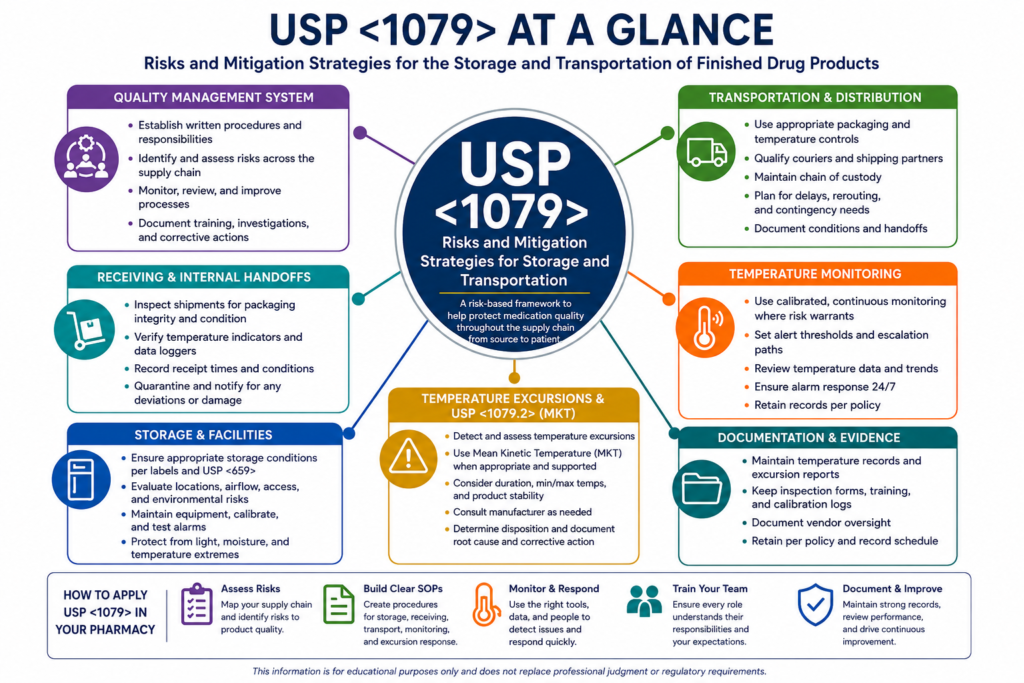
USP General Chapter <1079>, Risks and Mitigation Strategies for the Storage and Transportation of Finished Drug Products, addresses the systems, people, facilities, equipment, documentation, and handoffs involved in protecting finished medications throughout the supply chain. Its scope includes temperature-sensitive small molecules, vaccines, biologics, radiopharmaceuticals, biotechnology products, and combination products.
For pharmacy leaders, the most important lesson is that medication storage does not begin when a product is placed on a pharmacy shelf. It begins with supplier qualification and shipment planning, continues through receiving and internal distribution, and extends to clinics, nursing units, couriers, patients, and other destinations.
USP <1079> can therefore influence far more than temperature monitoring. It can shape:
- Employee onboarding and competency
- Receiving-department relationships
- Vendor and courier oversight
- Storage-area qualification
- Excursion investigations
- Emergency preparedness
- Documentation practices
- Corrective and preventive action
- The pharmacy’s overall quality management system
What Do USP Chapters Above 1000 Mean?
USP general chapters numbered below <1000> may become applicable compendial requirements when referenced by a monograph, another applicable chapter, or USP General Notices. Chapters numbered from <1000> through <1999> are generally categorized as informational chapters rather than independently mandatory requirements.
That distinction is important, but it should not lead pharmacy teams to dismiss chapters such as USP <1079>.
An informational chapter can provide a recognized framework for designing policies, evaluating risk, training personnel, selecting equipment, managing vendors, and documenting quality decisions. It may also influence expectations established by:
- State boards of pharmacy
- Accreditation organizations
- Health-system policies
- Manufacturer agreements
- Payer or specialty-pharmacy contracts
- Internal quality and patient-safety programs
A pharmacy should verify which requirements apply to its jurisdiction, practice setting, contracts, and accreditation programs. Even when USP <1079> is not directly enforceable as a standalone chapter, its risk-based concepts can help a pharmacy build a more consistent and defensible quality system.
What Does USP 1079 Cover?
USP <1079> approaches storage and transportation as parts of an integrated supply chain. The chapter recognizes that finished medications may pass through numerous organizations, environments, vehicles, facilities, and individuals before reaching the patient.
For pharmacies, the chapter’s concepts can be organized into several operational areas.
Quality Management and Written Procedures
A pharmacy’s quality system should define how medication storage and transportation risks are identified, controlled, documented, and reviewed.
Relevant procedures may address:
- Product receipt and inspection
- Temperature monitoring
- Storage-area access
- Alarm response
- Product quarantine
- Temperature excursions
- Emergency relocation
- Transportation and courier controls
- Product returns
- Vendor qualification
- Calibration and maintenance
- Staff training
- Deviation investigation
- Corrective and preventive action
The goal is not simply to create more policies. The goal is to connect responsibilities, monitoring records, investigations, and corrective actions into one functioning system.
Personnel Responsibilities and Training
Storage and transportation controls depend on people making consistent decisions. That includes individuals outside the pharmacy department.
Employees who may affect medication quality include:
- Pharmacy staff
- Receiving personnel
- Materials-management teams
- Nursing staff
- Clinic employees
- Security personnel
- Facilities and engineering staff
- Environmental services
- Drivers and couriers
- Third-party logistics vendors
Training should be appropriate to each role. A receiving employee may not need an advanced explanation of pharmaceutical stability, but that employee should know how to identify a temperature-sensitive package, where to place it, what damage to inspect for, and whom to notify if a shipment arrives late, warm, frozen, wet, crushed, or without expected monitoring data.
Facilities, Storage Areas, and Equipment
Storage locations should be appropriate for the products kept within them. This may involve more than confirming that a refrigerator displays a temperature within range.
A pharmacy may need to evaluate:
- Airflow and temperature distribution
- Proximity to exterior doors
- Direct sunlight
- Heating or cooling vents
- Seasonal conditions
- Loading docks
- Backup power
- Door-opening frequency
- Overstocking
- Equipment maintenance
- Monitoring-probe placement
- Alarm notification pathways
- Access during evenings and weekends
A device reading is only useful when the device is properly placed, maintained, calibrated, reviewed, and connected to an effective response process. For example, responsible personnel for responding to temperature excursions should have proper access to the alarming as well as access to the area to be able to respond.
Transportation and Internal Distribution
Medication transportation can include wholesaler shipments, transfers between pharmacies, movement to hospital units, courier delivery, mail-order distribution, clinic replenishment, home-infusion delivery, and shipment directly to patients.
Each handoff introduces potential risks involving:
- Temperature
- Delay
- Package damage
- Light exposure
- Humidity
- Security
- Chain of custody
- Incorrect destination
- Failure to retrieve a package
- Unattended delivery
- Inadequate packaging
Pharmacies should determine what level of control is appropriate based on the product, shipping duration, environmental conditions, packaging system, destination, and consequences of a failure.
How USP 1079 Relates to USP 659
USP <659>, Packaging and Storage Requirements, provides standardized definitions for packaging and labeled storage conditions. Its purpose includes defining storage terminology relevant to active ingredients, excipients, pharmaceuticals, combination products, and other medical products.
In practical terms, USP <659> helps define what the storage conditions mean, while USP <1079> helps organizations think about how to manage the risks involved in maintaining those conditions.
For example, USP <659> provides the vocabulary used for labeled conditions such as controlled room temperature, cold, refrigerator, freezer, and protection from light. USP <1079> can then help the pharmacy develop systems for:
- Maintaining those conditions
- Selecting monitoring equipment
- Evaluating storage locations
- Responding to alarms
- Investigating excursions
- Managing transportation risks
- Documenting disposition decisions
Pharmacy teams should avoid converting a labeled storage range into a simplistic alarm policy without considering device accuracy, response time, normal operating variation, product risk, and the location’s actual performance.
For a deeper explanation of labeled storage terminology, see Pestle’s article on USP 659 Packaging and Storage Requirements for Pharmacies.
USP 1079.2 and Mean Kinetic Temperature
USP <1079.2>, Mean Kinetic Temperature in the Evaluation of Temperature Excursions During Storage and Transportation of Drug Products, focuses on the use of mean kinetic temperature, commonly abbreviated as MKT, when evaluating certain temperature histories.
The chapter explains that product degradation depends on factors including product stability, packaging, storage, and shipping conditions. Temperature may vary during a product’s life, and those variations can affect degradation pathways and critical quality attributes.
What Is Mean Kinetic Temperature?
Mean kinetic temperature is not a simple arithmetic average.
MKT is a calculated temperature that represents the cumulative thermal stress experienced over time. The calculation gives greater weight to higher temperatures because many degradation reactions accelerate as temperature increases.
Consider two storage histories that both have an arithmetic average of 25°C:
- One location remains close to 25°C throughout the period.
- Another repeatedly moves between much cooler and much warmer temperatures.
Those histories may not create the same degradation risk. MKT is designed to better reflect the potential effect of the warmer periods than a standard average would.
When May MKT Be Useful?
MKT may be useful as one component of a scientifically supported excursion assessment when:
- Complete time-and-temperature data are available
- The product’s labeled storage conditions are understood
- The duration and magnitude of the excursion are known
- The product’s stability characteristics are relevant to the calculation
- Qualified personnel review the result
- Manufacturer or other authoritative stability information is available
- The pharmacy follows an approved excursion-investigation process
MKT may help evaluate cumulative exposure during storage or transportation, particularly when temperatures fluctuate over time rather than remaining at one constant out-of-range temperature.
When Should MKT Not Be Used by Itself?
MKT should not be treated as an automatic release calculation or as permission to disregard an alarm.
A favorable MKT value does not necessarily address every quality risk. MKT may be inappropriate or insufficient when:
- A product may have frozen
- The temperature exceeded a known critical limit
- The excursion involved extreme heat
- The data record is incomplete
- The monitoring device failed
- The product is sensitive to brief temperature spikes
- Light, humidity, vibration, or physical damage may also be involved
- The manufacturer requires direct consultation
- Product-specific stability information does not support the conclusion
The result should be interpreted within a documented, product-specific risk assessment. Final disposition may require consultation with the manufacturer, wholesaler, sponsor, or other qualified authority.
Why Continuous Temperature Monitoring Matters
Manual temperature logs can show that someone looked at a display at a particular time. They do not necessarily show what happened between observations. A good quality management system can best assess when a continuous temperature monitor is more appropriate than daily checks. For example, the risk of a refrigerator going out of range unnoticed that has an alarm in a 24 hour staffed pharmacy will be less than a remote clinic closed on the weekend.
Continuous monitoring can provide a more complete temperature history, including:
- Overnight events
- Weekend failures
- Door-related fluctuations
- Gradual equipment deterioration
- Power interruptions
- Defrost cycles
- Seasonal patterns
- Repeated near-limit conditions
- The duration of an excursion
- The highest and lowest recorded values
This information can improve both immediate response and long-term quality management.
A single alarm may show that something went wrong. A continuous data record can help show when it started, how long it lasted, how severe it was, whether it has happened before, and whether corrective action was effective.
Continuous monitoring also creates opportunities for trending. A refrigerator that remains technically within range but operates progressively closer to the upper boundary may warrant maintenance or adjustments before an actual excursion occurs.
The technology itself, however, is only one part of the control. The pharmacy still needs procedures for alarm routing, escalation, response time, after-hours coverage, data retention, calibration, probe placement, system testing, and downtime.
How USP 1079 Can Influence Employee Onboarding
Storage and transportation responsibilities should be introduced during onboarding rather than taught only after a temperature excursion occurs.
A role-based onboarding program may include:
For Pharmacy Personnel
- Understanding labeled storage conditions
- Reviewing monitoring systems and alarm limits
- Responding to alerts
- Quarantining affected medication
- Documenting investigations
- Escalating disposition decisions
- Managing refrigerator and freezer organization
- Preparing products for internal or external transport
For Receiving Personnel
- Identifying medication shipments
- Prioritizing refrigerated, frozen, or otherwise sensitive products
- Inspecting packaging and seals
- Locating temperature indicators or data loggers
- Recording delivery times
- Recognizing damaged or delayed shipments
- Contacting pharmacy personnel immediately
For Couriers and Drivers
- Maintaining required transportation conditions
- Protecting packages from unattended exposure
- Following chain-of-custody procedures
- Reporting delays or vehicle problems
- Avoiding unauthorized package opening
- Documenting delivery and failed-delivery events
Competency should be demonstrated when practical. A short quiz may confirm knowledge, but a simulated damaged shipment or refrigerator alarm can better reveal whether employees know what to do.
Strengthening the Relationship With the Receiving Department
Receiving is one of the most important medication-quality handoffs in a hospital or health system.
A shipment may arrive at a loading dock rather than directly in the pharmacy. During that interval, medication quality may depend on someone who does not report to the director of pharmacy.
Pharmacy and receiving leaders should jointly define:
- Which packages receive priority handling
- How temperature-sensitive shipments are identified
- Who may sign for medication deliveries
- Where packages are staged
- Maximum acceptable staging time
- What to do when the pharmacy is closed
- How damaged shipments are handled
- How monitoring devices are preserved
- Who contacts the wholesaler or manufacturer
- How delivery deviations are documented
These expectations should appear in written procedures and orientation materials. Periodic tracer exercises can test whether the process works in practice.
A useful tracer may begin with a refrigerated package arriving after normal pharmacy receiving hours. The organization should be able to follow the shipment from delivery through inspection, storage, documentation, and resolution of any abnormalities.
Incorporating USP 1079 Into the Pharmacy QMS
USP <1079> is most valuable when its concepts are integrated into the pharmacy’s quality management system rather than assigned exclusively to the temperature-log.
Document Control
Storage, receiving, transportation, excursion, and emergency procedures should have designated owners, approval dates, review cycles, and version histories.
Deviation Management
Temperature excursions, delayed shipments, damaged packages, equipment failures, and monitoring gaps should enter a consistent deviation process.
Corrective and Preventive Action
An excursion investigation should look beyond the affected product. It should determine whether the event reveals a broader system problem.
Potential corrective actions may include:
- Repairing or replacing equipment
- Moving a probe
- Changing alarm thresholds
- Updating escalation contacts
- Retraining receiving staff
- Revising courier instructions
- Changing package configuration
- Adding backup power
- Increasing monitoring frequency
- Requalifying a storage area
Change Control
Changes to storage equipment, shelving, probe locations, alarm software, packaging, couriers, suppliers, or delivery routes should be evaluated before implementation.
Vendor Qualification
Wholesalers, couriers, monitoring vendors, calibration providers, and third-party logistics organizations can affect medication quality. Vendor oversight may consider:
- Service capabilities
- Quality agreements
- Performance history
- Calibration practices
- Incident notification
- Data availability
- Escalation procedures
- Corrective-action responsiveness
Management Review
Leadership should periodically review more than whether temperatures remained in range.
Useful quality indicators may include:
- Number of excursions
- Alarm-response times
- Repeat equipment failures
- Delayed shipment frequency
- Product loss
- Open investigations
- CAPA completion
- Calibration status
- Training completion
- Vendor-related deviations
- Trends by location or equipment type
A Practical USP 1079 Readiness Checklist
Pharmacy leaders can begin by asking:
- Have we identified every location where medications are received, stored, staged, transported, or delivered?
- Are responsibilities clear across pharmacy, receiving, nursing, facilities, security, and couriers?
- Do our policies use storage terminology consistently with USP <659> and manufacturer labeling?
- Are our storage areas and monitoring-probe locations supported by documented evaluation or, at least, a consistent and repeatable evaluation?
- Do we have continuous monitoring where product and operational risks justify it?
- Can the right person receive and respond to an alarm after hours?
- Do excursion investigations include duration, magnitude, product, packaging, and stability information?
- Is MKT used only within an approved and scientifically supported process? When is the manufacture consulted?
- Are equipment failures and transportation deviations incorporated into CAPA?
- Does leadership review trends rather than isolated temperature logs?
How Pestle Can Help
Pestle Compliance is designed to help pharmacy teams organize recurring compliance activities, assign responsibilities, document completion, and maintain evidence across locations, equipment, and personnel.
For a storage and transportation program, teams can use structured compliance workflows to support activities such as:
- Daily temperature logging
- Periodic monitoring reviews
- Equipment inspection
- Alarm testing guidance and documentation
- Calibration reminders
- Receiving audits
- Staff competencies
- Excursion investigations
- Emergency-plan reviews
- Vendor assessments
- CAPA follow-up
- Policy review schedules
Technology does not replace product labeling, qualified professional judgment, manufacturer consultation, or applicable legal and regulatory requirements. It can, however, help teams create a repeatable system in which responsibilities and evidence are easier to track.
As pharmacy monitoring systems become more connected, continuous-monitoring integrations may also create opportunities to connect environmental data with compliance workflows, escalation steps, investigations, and trend review.
Conclusion
USP <1079> is not simply a chapter about refrigerators.
It provides a framework for understanding how medication quality can be affected by people, facilities, equipment, packaging, transportation, vendors, and organizational handoffs. USP <1079.2> adds an important tool for evaluating certain temperature histories through mean kinetic temperature, but MKT must be used carefully and within a documented product-specific assessment.
A strong program connects USP <659> storage terminology, continuous monitoring, receiving practices, onboarding, excursion management, CAPA, vendor oversight, and leadership review.
Pharmacies that take this broader approach can move beyond collecting temperature readings and begin building a coordinated quality system designed to protect medications throughout their journey.
To explore how Pestle can help standardize pharmacy compliance activities and documentation, visit Pestle Compliance or request a personalized demo.
Links
- USP <659>: Packaging and Storage Requirements
- USP Chapters Explained: Beyond USP 795, 797, and 800
- Pestle Compliance
- Pestle Intelligence
External-Source
- USP General Chapter <1079>, Risks and Mitigation Strategies for the Storage and Transportation of Finished Drug Products
- USP General Chapter <1079.2>, Mean Kinetic Temperature in the Evaluation of Temperature Excursions During Storage and Transportation of Drug Products
- USP General Chapter <659>, Packaging and Storage Requirements
- CDC Vaccine Storage and Handling Toolkit for vaccine-specific programs