
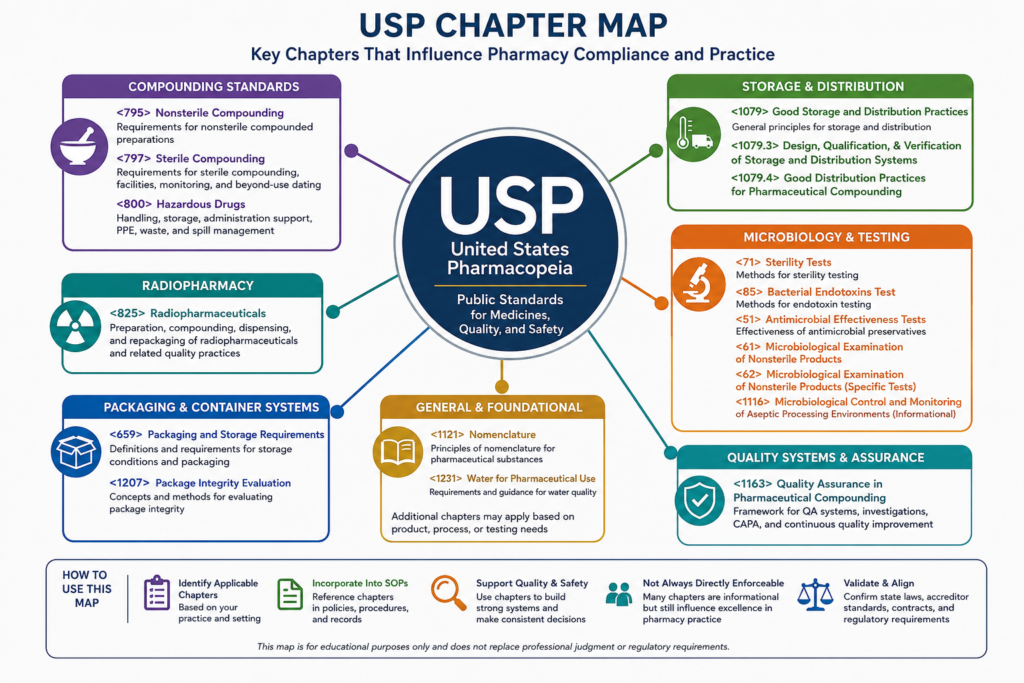
USP Chapters for Pharmacy Compliance: Beyond 795, 797, and 800
Table of Contents
Pharmacy compliance is full of acronyms, agencies, and standards. In that alphabet soup, USP often feels familiar because most compounding teams immediately think of USP <795>, USP <797>, and USP <800>. Those chapters matter, but they are only part of the larger USP chapter ecosystem.
For pharmacy leaders, compliance managers, sterile compounding supervisors, and health-system operations teams, understanding USP chapters for pharmacy compliance means looking beyond the “big three.” Other USP chapters may influence how a pharmacy writes policies, builds SOPs, documents training, evaluates temperature excursions, manages microbiology results, supports radiopharmacy operations, or designs a quality assurance program.
This article is an introduction to USP as part of Pestle’s Pharmacy Compliance Alphabet Soup Series. It is not legal or regulatory advice. Instead, it is a practical framework for thinking about how USP chapters can support stronger pharmacy practice, clearer documentation, and more consistent operations.
What Is USP?
USP stands for the United States Pharmacopeia. USP develops public standards for medicines, ingredients, dosage forms, compounded preparations, packaging, storage, testing, and related quality topics. In pharmacy operations, USP standards often become important because they are referenced by state boards of pharmacy, accreditation organizations, payer or manufacturer expectations, internal policies, and inspection processes.
USP does not generally walk into a pharmacy and enforce chapters directly. Enforcement usually flows through another authority or obligation. For example, a state board of pharmacy may adopt or adapt USP compounding standards into state rules. An accreditor may survey against processes that align with USP expectations. A health system may incorporate USP language into internal policy. A manufacturer or payer contract may require evidence that storage and handling expectations are met.
That distinction matters. USP chapters can shape daily pharmacy practice even when USP itself is not the direct enforcement body.
Why USP Chapters Matter in Pharmacy Compliance
USP chapters help pharmacies create a common operational language. They define terms, describe processes, outline expectations, and provide scientific or practice-based guidance that pharmacy teams can use when building procedures.
For example, USP language may influence:
- Master formulation records and compounding records
- Personnel training and competency documentation
- Environmental monitoring procedures
- Cleaning and disinfecting expectations
- Beyond-use dating rationale
- Hazardous drug handling procedures
- Temperature excursion response
- Storage condition definitions
- Radiopharmaceutical handling
- Quality assurance and corrective action workflows
The practical value is standardization. When different locations, shifts, and teams use the same definitions and documentation structure, it becomes easier to train staff, review evidence, prepare for inspections, and improve consistency across the organization.
The Core USP Compounding Chapters
USP <795>: Nonsterile Compounding
USP <795> addresses nonsterile compounding. It is relevant to pharmacies that prepare nonsterile compounded preparations such as capsules, creams, ointments, oral liquids, suppositories, and other nonsterile dosage forms.
Operationally, USP <795> can influence the pharmacy’s designated person responsibilities, personnel training, facilities, equipment, components, master formulation records, compounding records, cleaning, release checks, labeling, and beyond-use dates.
For many nonsterile compounding pharmacies, USP <795> is the foundation for the compounding SOP set.
USP <797>: Sterile Compounding
USP <797> addresses sterile compounding. USP describes the chapter as covering requirements such as compounding personnel responsibilities, training, facilities, environmental monitoring, storage, and testing of finished preparations.
Sterile compounding teams often use USP <797> to structure policies for garbing, hand hygiene, media fill testing, gloved fingertip and thumb sampling, cleaning and disinfecting, environmental monitoring, primary and secondary engineering controls, beyond-use dates, and response to excursions or microbial findings.
In health systems, USP <797> is often one of the most operationally visible USP chapters because it affects cleanroom design, daily workflows, competency files, environmental monitoring records, and pharmacy leadership oversight.
USP <800>: Hazardous Drugs
USP <800> addresses hazardous drug handling. It can affect both sterile and nonsterile compounding, as well as receipt, storage, transport, administration support, spill response, waste handling, PPE, and staff training.
A key operational concept in USP <800> is that hazardous drug compliance is not only a compounding issue. It also intersects with OSHA, NIOSH, EPA hazardous waste rules, state board requirements, and internal employee safety programs.
USP <825>: Radiopharmaceuticals
USP <825> applies to radiopharmaceutical preparation, compounding, dispensing, and repackaging. It is especially relevant to nuclear pharmacy and health-system settings that handle radiopharmaceuticals.
This chapter can intersect with state board of pharmacy rules, NRC or Agreement State radiation requirements, DOT transportation requirements, radiation safety officer responsibilities, and sterile compounding controls when applicable.
USP Chapters Beyond 795, 797, and 800
A mature pharmacy compliance program should know which USP chapters are directly applicable, which are indirectly useful, and which are informational but still valuable for policy development.
Here are several USP chapters that may matter for compounding pharmacies, health systems, specialty pharmacies, home infusion teams, and other pharmacy settings.
USP <659>: Packaging and Storage Requirements
USP <659> is important because it helps define storage conditions and terminology. Terms such as controlled room temperature, cold, freezer, and other storage descriptions can influence pharmacy labeling, SOPs, temperature monitoring, and excursion response.
For pharmacies, USP <659> may be useful when building policies for medication storage, refrigerator and freezer monitoring, quarantine decisions, and manufacturer consultation after a temperature excursion.
USP <1079>, <1079.3>, and <1079.4>: Storage and Distribution
USP <1079> and related chapters can support policies for storage, transportation, temperature monitoring, mapping, qualification, and distribution practices.
These chapters may be especially useful for health systems, specialty pharmacies, mail order pharmacies, home infusion providers, and pharmacies managing cold-chain products. Even when a chapter is informational, it can help leaders ask better questions:
- Are storage units qualified for their intended use?
- Are data loggers appropriate for the product risk?
- Are shipping lanes reviewed?
- Are excursions documented consistently?
- Who decides whether a product can be released after an excursion?
USP <71>: Sterility Tests
USP <71> is relevant when sterile preparations or products require sterility testing. It describes compendial sterility test methods and can influence how a pharmacy or outsourced testing partner approaches testing, documentation, and interpretation.
Most pharmacies will not treat USP <71> as a standalone operating manual. Instead, it may be referenced when sterile compounding programs evaluate testing requirements, vendor qualifications, release criteria, or investigation workflows.
USP <85>: Bacterial Endotoxins Test
USP <85> addresses bacterial endotoxins testing. This can be relevant for certain sterile preparations where endotoxin limits or testing expectations apply.
For pharmacy operations, USP <85> can influence SOP language around testing triggers, outsourced laboratory coordination, certificates of analysis, release checks, and investigation procedures when results are outside expectations.
USP <51>, <61>, and <62>: Microbiology and Antimicrobial Effectiveness
USP <51> addresses antimicrobial effectiveness testing. USP <61> and USP <62> address microbiological examination of nonsterile products. These chapters may be more relevant to advanced compounding programs, quality teams, 503B outsourcing facilities, or organizations working with laboratories and vendors.
For a pharmacy, the practical question is not, “Do we need to perform every test ourselves?” The better question is, “Does this chapter influence how we evaluate product quality, vendor documentation, testing evidence, or our own policy language?”
USP <1116>: Microbiological Control and Monitoring of Aseptic Processing Environments
USP <1116> is an informational chapter focused on microbiological control and monitoring of aseptic processing environments. For sterile compounding leaders, this chapter can help support deeper thinking about environmental monitoring programs, microbial contamination control, trend evaluation, and response to findings.
Because it is informational, teams should avoid presenting USP <1116> as if it creates the same direct requirement as a mandatory chapter in every setting. However, it can still influence excellence in sterile compounding practice, especially when building a more mature contamination control strategy.
USP <1163>: Quality Assurance in Pharmaceutical Compounding
USP <1163> focuses on quality assurance in pharmaceutical compounding. It is useful because compliance is not only about individual tasks. It is also about the system that connects policies, documentation, training, verification, investigations, corrective action, and ongoing improvement.
USP <1163> can be a helpful framework for pharmacies that want to move from reactive inspection readiness to proactive quality management. It may support future SOPs around deviations, complaint handling, recalls, personnel training, supplier qualification, and CAPA.
USP <1121>: Nomenclature
USP <1121> addresses nomenclature. At first glance, it may seem less operational than chapters about compounding, sterility, or storage. However, naming conventions matter in pharmacy systems, labels, formularies, master formulation records, compounding records, and medication-use policies.
For health systems and multi-site pharmacy organizations, consistent naming can reduce confusion and support standardization across locations.
Additional USP Chapters That May Influence Advanced Programs
Depending on the practice setting, additional USP chapters may also become relevant. These can include chapters related to water quality, package integrity, sterilization, depyrogenation, microbiological methods, biological reactivity, container closure systems, and testing validation.
Examples include:
- USP <1231> for water-related considerations
- USP <1207> for package integrity concepts
- USP <1223> for alternative microbiological methods
- USP <1226> for verification of compendial procedures
- USP <1228> for depyrogenation concepts
- USP <1229> for sterilization concepts
- USP <87> and <88> for biological reactivity testing in certain contexts
Not every pharmacy needs every chapter in its SOP library. The goal is to identify which chapters are applicable, which are useful references, and which belong in vendor or laboratory qualification discussions.
Below 1000 vs. Above 1000: Why the Distinction Matters
A common USP concept is the distinction between chapters numbered below 1000 and chapters numbered 1000 or above.
In general, USP chapters below 1000 are more likely to contain official standards, tests, or requirements when they are applicable through a monograph, another applicable chapter, or General Notices. Chapters numbered 1000 to 1999 are generally informational or interpretive. They provide explanations, context, definitions, scientific background, or recommended practices.
This does not mean informational chapters are unimportant. In pharmacy operations, informational chapters can still influence policies and procedures because they help explain how a quality-focused program should think.
For example, a pharmacy may not treat USP <1163> as a directly enforceable rule in every setting, but it may still use the chapter to strengthen its quality assurance program. A sterile compounding leader may use USP <1116> to improve environmental monitoring review even when the chapter is not the direct enforcement hook.
The key is accuracy. Policies should be clear about whether a chapter is directly applicable, incorporated by regulation, required by accreditation, adopted by internal policy, or used as a best-practice reference.
USP, cGMP, and 503B Outsourcing Facilities
Some USP chapters also matter when pharmacy leaders evaluate outsourcing facilities or manufacturing-style quality systems.
cGMP stands for current good manufacturing practice. In the pharmaceutical context, cGMP regulations are FDA requirements designed to help ensure drug products are manufactured, processed, packed, or held in a way that supports quality, identity, strength, purity, and safety.
This is especially relevant when comparing 503A pharmacy compounding and 503B outsourcing facility operations. A 503A compounding pharmacy generally operates under a different framework than a 503B outsourcing facility. A 503B outsourcing facility is subject to FDA registration and cGMP expectations.
That distinction deserves its own article and this article will be updated with that link in time.
For today’s USP discussion, the important point is this: USP chapters and cGMP are not the same thing, but they can overlap in quality conversations. Health systems that purchase from 503B outsourcing facilities may use USP chapters, FDA expectations, supplier qualification, quality agreements, certificates of analysis, and adverse event or recall history as part of a broader vendor oversight process.
How USP Chapters Influence SOPs and Policies
One of the most practical uses of USP is SOP development. A pharmacy should not simply copy chapter language into a policy and call the job complete. The SOP must translate standards and guidance into the actual workflow used by the team.
A stronger USP-informed SOP should answer:
- Who owns the process?
- Which chapter or external source supports the policy?
- Which roles are trained on the workflow?
- What evidence must be documented?
- What happens when results are outside expectations?
- When does the issue escalate to the designated person, pharmacy director, quality leader, or compliance team?
- How often is the policy reviewed?
- What state, accreditation, contract, or internal requirements also apply?
For example, a temperature excursion SOP may reference USP <659> for storage terminology and USP <1079> concepts for storage and distribution. But the actual policy should still define the pharmacy’s specific alarm response, quarantine process, manufacturer contact steps, release decision documentation, and corrective action workflow.
How Pestle Can Help
Pestle can help pharmacy teams organize USP-related compliance work into repeatable workflows. Instead of relying on scattered spreadsheets, shared folders, or memory, teams can use Pestle Compliance to assign tasks, document completion, track evidence, and standardize recurring activities across pharmacies or departments.
For compounding teams, Pestle can support documentation around cleaning, competency, environmental monitoring follow-up, equipment checks, policy attestations, and inspection readiness. Pestle Formulas can help standardize compounding workflows, master formulation records, preparation records, and compounding documentation. Pestle Intelligence can help teams search approved internal content and knowledge base materials more efficiently, while still requiring qualified professional review.
Pestle does not replace pharmacist judgment, legal guidance, regulatory interpretation, or a pharmacy’s own policies. It is designed to help teams organize the work, document the evidence, and improve operational consistency.
Helpful Links:
Conclusion
USP is more than a short list of familiar compounding chapters. USP <795>, <797>, <800>, and <825> are central to many pharmacy compliance programs, but other chapters can also influence storage, packaging, microbiology, endotoxin testing, quality assurance, nomenclature, distribution, and advanced compounding workflows.
The key is to avoid treating every USP chapter the same way. Some chapters may be directly applicable through law, regulation, accreditation, contract, or internal policy. Others may be informational but still valuable for building better SOPs, stronger documentation, and more consistent pharmacy practice.
For pharmacy leaders, the goal is not to memorize every USP chapter. The goal is to build a practical chapter map that shows which standards apply, which chapters support decision-making, and how each one connects to daily operations.
As the Alphabet Soup Series continues, USP will remain one of the most important threads connecting compounding, storage, hazardous drugs, radiopharmacy, quality systems, and inspection readiness.